Debbie Angle and Craig Hohlman arc analysts for a large commercial bank, Arbutus National Bank. Arbutus has extensive dealings in both the spot and forward foreign exchange markets. Angle and Hohlman are providing a refresher course on foreign exchange relations for its traders. Unless indicated otherwise, Angle tells the traders to assume that real interest rates are equivalent throughout the world.
Angle uses a three country example from North America to illustrate foreign exchange parity relations. In it, the Canadian dollar is expected to depreciate relative to the U.S. dollar and the Mexican peso. Nominal, one year interest rates in the United States are 7% and are 13% in Mexico. From this data and using the uncovered interest rate parity relationship, Angle forecasts future spot rates.
During their presentation, Hohlman discusses the effect of monetary and fiscal policies on exchange rates. He cites a historical example from the United States, where the Federal Reserve shifted to an expansionary-monetary policy to stimulate economic growth. This shift was largely unanticipated by the financial markets because the markets thought the Federal Reserve was more concerned with inflationary pressures. Hohlman states that the effect of this policy was an increase in economic growth and an increase in inflation. The cumulative effect on the dollar was unchanged, however, because, according to Hohlman, an increase in U.S. economic growth would strengthen the dollar whereas an increase in inflation would weaken the dollar.
Regarding U.S. fiscal policies, Hohlman states that if these were unexpectedly expansionary, real interest rates would increase, which would produce an appreciation of the dollar. But, Hohlman adds, an increase in the federal budget would encourage imports such that the overall short-run effect would be for a decrease in the value of the dollar.
Using this same historical example, Angle discusses capital flows and the effect on the balance-of- payments components. Angle makes the following statements:
Statement 1: Differences in real interest rates will cause a flow of capital into those countries with the highest available real rates of interest. Therefore, there will be an increased demand for those currencies, and they will appreciate relative to the currencies of countries whose available real rates of return are low.
Statement 2: The flow of foreign capital into U.S. investments, net of outflows of U.S. capital, is measured by the financial account. In the case of an expansionary fiscal policy, the financial account will increase and move towards a surplus.
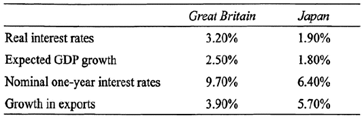
Angle next discusses the foreign exchange expectation relation. She states that, examining Great Britain and Japan, it appears that the four year forward rate, which is currently ¥200/£, is an accurate predictor of the expected future spot rate. Furthermore, she states that uncovered interest rate parity and relative purchasing power parity hold. In the example for her presentation, she uses the following figures for the two countries.
As a follow-up to Angle's example, Hohlman discusses the use and evidence for purchasing power parity. He makes the following statements.
Statement 3: Absolute purchasing power parity is based on the law of one price, which states that a good should have the same price throughout the world. Absolute purchasing power parity is not widely used in practice to forecast interest rates.
Statement 4: Although relative purchasing power parity is useful as an input for long-run exchange rate forecasts, it is not useful for predicting short-run currency values.
Which of the following is closest to the current ¥/£ spot rate, using relative purchasing power parity? Use the exact methodology in your calculations.
Answer(s): B
Explanation:
Angle assumes the forward rate is an accurate predictor of the expected future spot rate, so we will use ¥200/£ as the future spot rate.
She also assumes that relative purchasing power parity holds, which states that the future spot rate is a function of the current spot rate and relative inflation rates. We will use relative purchasing power parity to obtain the current spot rate.
To obtain the expected inflation rates in each country, we back them out using the domestic Fisher relation:
1 + nominal interest rate = (1 + real interest rate)(l + expected inflation rate)
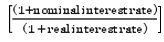 expected inflation rare = -1
In Great Britain, the expected inflation rate is:
 expected inflation rate = =6.30% In Japan, the expected inflation rate is:
 expected inflation rate = - =4.42%
Note that unlike the international Fisher relation, we did not assume that real interest rates were equivalent throughout the world when we used the domestic Fisher relation.
We now we back out the current spot rate, using relative purchasing power parity:
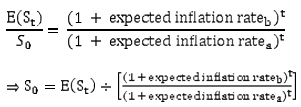
Note: Because the Japanese currency is in the numerator in the exchange rate, we will put the Japanese infMtion rate on top in the relative purchasing power parity calculation.
So if Japan is country b and Great Britain is country a, then we have:

Notice that the exchange rate will move from ¥215/£ to ¥200/£. So it takes less yen to buy one pound (i.e. the yen has strengthened), which relative purchasing power parity predicts because Japanese inflation is lower. (Study Session 4, LOS 19.g, h,j,m,n)