Free L6M1 Exam Braindumps
Strategic Ethical Leadership Questions 6–10 (page: 3)

Updated On: 10-Feb-2026

SIMULATION

Discuss transformational and transactional approaches to leadership.
Which is the most appropriate approach in the following case study:

Mo is a procurement manager at a large manufacturing organisation. He oversees a team of 5 procurement assistants. The assistants are currently not working to a high level; they lack skills and confidence in completing tenders and Mo is concerned about their abilities to conduct accurate work. (25 points)

  1. See Explanation for the Answer.

Answer(s): A

Explanation:

Introduction

Leadership is a critical factor in shaping employee performance, motivation, and overall organizational success. In procurement, managers must adopt a leadership style that aligns with their team's capabilities, business objectives, and operational challenges. Two widely recognized leadership styles are Transformational Leadership and Transactional Leadership, each with distinct characteristics and effects on team performance.

This essay will discuss both leadership styles, outlining their advantages and disadvantages. It will then evaluate which approach is best suited for Mo, a procurement manager facing skill and confidence issues among his team members.

Understanding Transformational Leadership

Definition

Transformational leadership is a leadership style that focuses on inspiring, motivating, and developing employees to reach their full potential. Transformational leaders act as mentors and role models, encouraging innovation, professional growth, and long-term performance improvements.

Key Characteristics of Transformational Leadership

Inspiration and Motivation ­ The leader encourages employees to perform beyond expectations through a compelling vision.

Individualized Support ­ Focuses on mentoring and coaching employees to enhance their skills.

Encourages Innovation ­ Employees are empowered to think creatively and solve problems.

Develops Future Leaders ­ Focuses on long-term talent development rather than short-term task completion.

High Engagement and Emotional Intelligence ­ Builds strong relationships with employees and fosters a positive workplace culture.

Advantages of Transformational Leadership

Encourages professional growth ­ Employees develop new skills and gain confidence. Increases motivation and job satisfaction ­ Employees feel valued and supported. Promotes innovation and continuous improvement ­ Encourages employees to think creatively. Builds long-term organizational success ­ Creates future leaders through mentoring and skill development.

Disadvantages of Transformational Leadership

Time-consuming ­ Requires significant time and effort for mentoring and development. Not suitable for urgent performance issues ­ If immediate performance improvement is needed, transformational leadership may be too slow.
Employees may resist change ­ Some employees may be unwilling to embrace coaching and new expectations.

Understanding Transactional Leadership

Definition

Transactional leadership is a leadership style based on a structured, performance-driven approach. It focuses on clear expectations, rewards for success, and consequences for underperformance. This style is best suited for improving task efficiency, enforcing compliance, and ensuring consistency.

Key Characteristics of Transactional Leadership

Clear Expectations and Rules ­ Employees have defined roles and responsibilities.

Performance-Based Rewards and Punishments ­ Good performance is rewarded, while poor performance is corrected through disciplinary actions.

Focus on Efficiency and Results ­ Emphasizes productivity and operational efficiency over employee growth.

Short-Term Performance Goals ­ Ensures immediate improvements in employee performance.

Hierarchy and Structure ­ Follows a strict chain of command.

Advantages of Transactional Leadership

Ensures short-term efficiency and compliance ­ Clearly defines expectations, which leads to immediate improvements in performance.
Effective for structured tasks ­ Employees know exactly what is expected, reducing uncertainty. Increases accountability ­ Employees are held responsible for meeting targets. Useful for crisis management ­ Provides a clear directive in high-pressure situations.

Disadvantages of Transactional Leadership

Limited employee development ­ Focuses more on task completion rather than skill enhancement.
Can reduce creativity and innovation ­ Employees may feel restricted by rigid expectations. May reduce motivation ­ Over-reliance on rules and punishments can create a negative work environment.
Not ideal for building long-term talent ­ Employees may not develop leadership skills or confidence.

Which Leadership Style is Most Suitable for Mo?

Case Study Analysis: Mo's Leadership Challenge

Mo is a procurement manager leading a team of 5 procurement assistants.

The assistants are underperforming due to lack of skills and confidence.

Mo is concerned about their ability to complete procurement tenders accurately.

Evaluating the Best Leadership Approach for Mo


Based on the specific challenges Mo is facing, neither leadership style alone is perfect. Instead, a combined approach is most suitable:

Recommended Approach: A Blend of Transformational and Transactional Leadership

Short-Term Approach: Transactional Leadership for Immediate Performance Improvement

Mo should set clear expectations and enforce accountability to ensure the assistants improve their performance in procurement tenders.

Implement a structured training program with performance benchmarks.

Use performance-based incentives (e.g., bonuses, recognition for accurate work).

Provide constructive feedback on mistakes to encourage learning.

Long-Term Approach: Transformational Leadership for Skill Development and Confidence

Mo should act as a mentor and coach, providing continuous learning opportunities.

Encourage assistants to develop confidence in procurement by assigning them progressively challenging tasks.

Inspire the team by highlighting the importance of procurement excellence in achieving organizational goals.

Implement peer learning and mentorship programs to create a supportive learning environment.

Conclusion

Both Transformational Leadership and Transactional Leadership offer valuable benefits, but in the case of Mo's underperforming team, a blended approach is the most effective strategy.

Transactional Leadership should be used in the short term to improve immediate performance, enforce accountability, and ensure accuracy in procurement tenders.

Transformational Leadership should be introduced gradually to develop skills, boost confidence, and foster long-term career growth among the procurement assistants.

By combining both approaches, Mo can quickly improve his team's performance while ensuring they gain the necessary skills and confidence to succeed in procurement. This balanced leadership approach ensures short-term efficiency and long-term growth, making it the most effective strategy for Mo's situation.


SIMULATION

Evaluate the 'Traits' approach to leadership (25 points)

  1. See Explanation for the Answer.

Answer(s): A

Explanation:

Introduction

Leadership plays a pivotal role in organizational success, influencing decision-making, team performance, and strategic direction. One of the earliest and most enduring leadership theories is the "Traits Approach to Leadership." This theory suggests that certain inherent traits make an individual an effective leader. Unlike other leadership theories that focus on behaviors or situational factors, the traits approach assumes that leaders are born, not made.

This essay will critically evaluate the traits approach to leadership, discussing its key characteristics,

advantages, limitations, and relevance in modern organizational contexts, particularly in procurement and supply chain management.

Understanding the Traits Approach to Leadership

Definition

The Traits Approach to Leadership is based on the idea that effective leaders possess inherent personality traits that differentiate them from non-leaders. These traits are considered stable over time and consistent across different situations.

Early leadership research focused on identifying the common traits found in successful leaders across industries, military settings, and politics.

Key Characteristics of the Traits Approach

Innate Leadership Qualities ­ Leadership is seen as something a person is born with, rather than developed.

Focus on Personality Traits ­ Effective leaders exhibit specific personality traits such as intelligence, confidence, and emotional stability.

Universal Application ­ The theory assumes that leadership traits apply across all industries and organizational settings.

Predictability of Leadership Success ­ If someone possesses the right traits, they are more likely to become a successful leader.

Common Leadership Traits Identified in Research


These traits suggest that leaders are naturally equipped with qualities that allow them to excel in their roles.

Advantages of the Traits Approach to Leadership (10 Points)

1. Identifies Key Leadership Qualities

The traits approach helps organizations identify individuals with leadership potential by assessing personality traits.

Example: In procurement, a leader with high intelligence and problem-solving skills can effectively negotiate supplier contracts and manage risks.

2. Provides a Foundation for Leadership Selection

Organizations can use personality assessments to select and promote leaders based on their inherent characteristics.

Example: A company hiring a Chief Procurement Officer (CPO) may look for candidates who exhibit confidence, strong decision-making skills, and integrity.

3. Universally Recognized and Researched

This approach has been extensively studied for decades, making it one of the most well-documented leadership theories.

Example: Many successful world leaders, such as Steve Jobs and Nelson Mandela, exhibited self- confidence, resilience, and intelligence--key traits identified in the model.

4. Helps Develop Leadership Training Programs

Although traits are largely inborn, some leadership traits can be developed through training and experience.

Example: An employee with high intelligence but low sociability can undergo communication and emotional intelligence training to become a more effective leader.

5. Supports Leadership Continuity and Succession Planning

Organizations can identify and groom future leaders by assessing leadership traits early in their careers.

Example: A procurement manager with initiative, strong ethics, and analytical skills can be promoted to a strategic leadership role.

Limitations of the Traits Approach to Leadership (10 Points)

1. Ignores the Influence of Situations and Context

Leadership effectiveness depends on the situation rather than just traits.

Example: A leader with strong confidence and intelligence may struggle in a highly bureaucratic organization where decision-making is slow.

2. Fails to Explain Leadership Development

This theory assumes that leaders are born, not made, which contradicts modern research showing that leadership can be learned and developed.

Example: Many successful CEOs started as entry-level employees and developed their leadership skills over time.

3. Overlooks the Importance of Leadership Behaviors

Having the right traits does not automatically make someone an effective leader--their actions, decision-making style, and adaptability matter more.

Example: A procurement leader with high intelligence but poor communication skills may fail to build strong supplier relationships.

4. No Clear Agreement on Essential Traits

Different studies identify different sets of leadership traits, making it difficult to define a universal leadership profile.

Example: Some researchers emphasize charisma and extroversion, while others focus on humility and adaptability.

5. Does Not Account for Cultural Differences

Leadership traits may not be universal across cultures--a trait that is valuable in one culture may not be as important in another.

Example: In Western cultures, assertiveness is valued, while in Asian cultures, humility and collective decision-making are preferred leadership traits.

Relevance of the Traits Approach in Modern Organizations

Despite its limitations, the traits approach remains relevant in leadership selection and development. Modern organizations integrate it with other leadership theories to create a holistic leadership model.

1. Integration with Behavioral Leadership Models

Instead of assuming that traits alone determine leadership success, organizations combine it with behavioral approaches that emphasize leadership actions.

Example: Transformational leadership combines traits (e.g., charisma, confidence) with inspiring behaviors to create an effective leadership model.

2. Use in Leadership Assessments and Hiring

Organizations use psychometric assessments to evaluate potential leaders based on personality traits.

Example: The Big Five Personality Model (openness, conscientiousness, extraversion, agreeableness, neuroticism) is commonly used in executive hiring.

3. Helps in Leadership Development Programs

While some leadership traits are inborn, others can be developed through mentorship, training, and experience.

Example: Procurement professionals can enhance their decision-making skills, emotional intelligence, and adaptability through leadership development programs.

Conclusion

The traits approach to leadership has been a foundational theory in leadership studies, helping organizations understand the qualities that define effective leaders. It provides valuable insights into leadership selection, succession planning, and training.

However, the approach has several limitations, particularly its lack of situational awareness and failure to explain leadership development. Modern organizations recognize that while leadership traits are important, behaviors, experience, and adaptability play an equally critical role.

The most effective approach to leadership combines trait theory with behavioral and situational leadership models to create a well-rounded leadership development framework. This ensures that leadership is not just about natural talent but also about continuous learning, adaptability, and strategic execution.


SIMULATION

Discuss the 5 approaches to management of the Blake Mouton Managerial Grid. How can this be applied to the role of a procurement manager? (25 points)

  1. See Explanation for the Answer.

Answer(s): A

Explanation:

Introduction

Management effectiveness is critical for organizational success, particularly in functions like procurement, where balancing cost efficiency, supplier relationships, and operational effectiveness is key. The Blake Mouton Managerial Grid provides a framework for evaluating leadership styles based on a manager's concern for people (team members, stakeholders, suppliers) versus concern for production (task completion, efficiency, and profitability).

This essay will discuss the five approaches to management outlined in the Blake Mouton Managerial Grid and explore how procurement managers can apply them to enhance procurement performance.

Understanding the Blake Mouton Managerial Grid

The Blake Mouton Managerial Grid (1964) classifies management styles based on two axes:

Concern for People ­ The degree to which a leader considers employee motivation, satisfaction, and well-being.

Concern for Production (or Task) ­ The extent to which a leader focuses on achieving organizational goals, efficiency, and productivity.

This results in five distinct leadership styles, each with its strengths and weaknesses.

The Five Approaches to Management in the Blake Mouton Grid


1. Impoverished Management (Low Concern for People, Low Concern for Production)

Description:

Leaders with an impoverished management style exert minimal effort to manage people or production.

They often avoid decision-making, fail to motivate employees, and show little interest in organizational goals.

This approach leads to low productivity, disengaged employees, and poor procurement outcomes.

Impact on Procurement Management:

Weak supplier management ­ Poor relationships with suppliers may lead to delivery delays and contract failures.
No cost control ­ Procurement teams may fail to negotiate favorable pricing due to lack of leadership.
Lack of strategic alignment ­ Procurement fails to support organizational goals, resulting in inefficiencies.

Example:

A procurement manager who ignores supplier performance reviews, does not enforce contract terms, and fails to manage procurement risks would be practicing an impoverished management style.

2. Task Management (High Concern for Production, Low Concern for People)

Description:

Task-oriented managers focus solely on efficiency, cost-cutting, and productivity, while neglecting employee well-being and engagement.

This style is highly authoritative and focuses on strict rules, efficiency, and results-driven processes.

Impact on Procurement Management:

Strict cost control ­ The procurement team will focus on cutting costs and maximizing efficiency. Strong compliance enforcement ­ Ensures strict adherence to procurement policies and regulations.
Supplier dissatisfaction ­ Overly aggressive cost-cutting and negotiation tactics may harm supplier relationships.
Low employee morale ­ Procurement assistants may feel undervalued, leading to high staff turnover.

Example:

A procurement manager who focuses only on cost reduction and efficiency, without considering supplier relationships or team well-being, would fit this style.

3. Country Club Management (High Concern for People, Low Concern for Production)

Description:

A country club manager prioritizes employee satisfaction and relationships but neglects productivity and performance.

This results in a friendly, low-pressure environment, but with low accountability and inefficiency.

Impact on Procurement Management:

Strong supplier and stakeholder relationships ­ Procurement teams collaborate well with suppliers but may overpay due to a lack of tough negotiations. High team morale ­ Employees feel valued and motivated. Lack of cost efficiency ­ Over-prioritizing relationships may result in weak cost controls.

Ineffective risk management ­ Procurement managers may fail to enforce strict supplier performance criteria.

Example:

A procurement manager who develops strong relationships with suppliers but fails to hold them accountable for poor performance is practicing country club management.

4. Middle-of-the-Road Management (Moderate Concern for People, Moderate Concern for Production)

Description:

Balances both people and task concerns, but does not excel in either.

Ensures some level of efficiency and employee satisfaction, but lacks a strong strategic direction.

Impact on Procurement Management:

Balanced supplier relationships ­ Ensures cost efficiency while maintaining supplier goodwill. Moderate employee engagement ­ The team feels reasonably motivated, but lacks innovation and strong leadership.
Missed cost-saving opportunities ­ Procurement might fail to maximize value due to a lack of strategic focus.
Lack of strong risk mitigation ­ The procurement manager may not aggressively manage risks, leading to supply chain disruptions.

Example:

A procurement manager who performs adequately but does not drive significant improvements or cost savings fits this style.

5. Team Management (High Concern for People, High Concern for Production)

Description:

The most effective leadership style, where the manager prioritizes both team well-being and achieving high performance.

Encourages collaboration, innovation, and accountability.

Focuses on both supplier relationships and cost efficiency.

Impact on Procurement Management:

Optimized supplier performance ­ Ensures strong contract management, strategic sourcing, and supplier collaboration.
High employee morale and performance ­ Employees are engaged, trained, and motivated to drive procurement success.
Balanced cost and quality approach ­ Focuses on achieving cost efficiency while maintaining quality standards.
Encourages innovation in procurement ­ Uses data analytics, AI, and technology to improve procurement processes.

Example:

A procurement manager who mentors their team, fosters supplier partnerships, and ensures cost savings while maintaining ethical procurement practices follows a team management approach.

Application of the Blake Mouton Grid to Procurement Management

The Blake Mouton Grid helps procurement managers identify their leadership style and improve team performance and supplier management. Here's how:

Developing High-Performance Procurement Teams ­ Procurement managers should strive for a team management approach, ensuring both efficiency and employee engagement.

Enhancing Supplier Relationship Management ­ A balanced approach ensures fair negotiations, long- term partnerships, and cost efficiency.

Strategic Cost Management ­ Managers should avoid being overly task-focused (cost-cutting) or too lenient on supplier pricing.

Improving Risk Management ­ Ensuring strong governance and compliance while maintaining good supplier relationships.

Continuous Improvement ­ Encouraging innovation, sustainability, and procurement technology adoption.

Conclusion

The Blake Mouton Managerial Grid provides valuable insights into leadership effectiveness in procurement management. Among the five approaches:

Team Management is the most effective style for procurement managers, balancing supplier relationships, cost efficiency, and employee engagement.

Task Management may be useful in cost-control situations, but must be balanced with ethical supplier management.

Country Club, Middle-of-the-Road, and Impoverished Management styles are less effective, as they fail to balance procurement efficiency and supplier relationships.

By adopting a "Team Management" approach, procurement managers can drive strategic value, optimize supplier performance, and enhance procurement team capabilities, ultimately contributing to long-term business success


SIMULATION

What is situational leadership? (5 points) Discuss and evaluate how this approach may be used in supply chain management (20 points)

  1. See Explanation for the Answer.

Answer(s): A

Explanation:

Introduction

Leadership effectiveness depends on how well a leader adapts to changing situations, team capabilities, and organizational needs. Situational Leadership, developed by Paul Hersey and Ken

Blanchard, is a flexible leadership model that suggests no single leadership style is best in all situations. Instead, leaders must adapt their approach based on the maturity, competence, and motivation of their team members.

In the context of supply chain management, where conditions are constantly evolving due to market dynamics, supplier relationships, technological changes, and risk factors, situational leadership is a highly relevant approach.

1.
What is Situational Leadership? (5 Points)

Definition

Situational Leadership is a contingency-based leadership model that suggests leaders should adjust their leadership style based on the specific situation and the readiness level of their team members.

Key Concept: Leadership Styles Based on Team Readiness

The Situational Leadership Model identifies four leadership styles, which are determined by a combination of directive (task-oriented) and supportive (relationship-oriented) behaviors:


Why Situational Leadership is Important?

Encourages flexibility in leadership.

Helps develop employees' skills and confidence.

Ensures effective leadership in changing environments like supply chain management.

2. How Situational Leadership Applies to Supply Chain Management (20 Points)

Supply Chain Management Overview

Supply chain management (SCM) involves planning, procurement, logistics, inventory management, risk assessment, and supplier relationships. Given the fast-changing nature of supply chains, managers must adapt their leadership style based on team capabilities, supplier maturity, and operational challenges.

Situational Leadership Applied to Supply Chain Functions

1. Telling (S1) ­ Directive Leadership for New or Inexperienced Teams

Application in Supply Chain:

Best for new supply chain employees who need strict guidance on procurement, contract management, and compliance.

Works well in structured environments, such as warehouse management and logistics operations, where standard operating procedures (SOPs) must be followed.

Example:
A newly hired procurement officer struggling with contract negotiation may need step-by-step instructions from a senior manager to ensure compliance with procurement regulations.

2. Selling (S2) ­ Coaching Approach for Semi-Skilled Supply Chain Teams

Application in Supply Chain:

Used when employees have some knowledge but need motivation and guidance.

Effective in supplier relationship management, where procurement staff need training on negotiation techniques and ethical sourcing.

Helps employees understand the bigger picture and improve decision-making skills.

Example:
A procurement team transitioning to a digital procurement system may need training, encouragement, and strategic direction to adopt new technologies.

3. Participating (S3) ­ Collaboration in Strategic Supply Chain Decisions

Application in Supply Chain:

Works best for experienced supply chain professionals who need empowerment and involvement in decision-making.

Encourages team input on strategic decisions, such as risk management, cost optimization, and sustainability initiatives.

Best for cross-functional collaboration, where procurement, logistics, and finance teams work together.

Example:
A supply chain manager engaging with senior procurement professionals to co-develop a supplier diversification strategy to reduce dependency on a single supplier.

4. Delegating (S4) ­ Empowering High-Performing Supply Chain Teams

Application in Supply Chain:

Best for highly experienced and autonomous supply chain professionals who require minimal supervision.

Used in global supply chain operations, where regional managers handle logistics, procurement, and supplier engagement independently.

Encourages innovation, allowing supply chain teams to optimize processes using AI, automation, and data analytics.

Example:
A senior procurement manager overseeing global supplier contracts operates with full autonomy and implements a digital supplier performance dashboard without needing daily oversight.

3. Advantages and Challenges of Situational Leadership in SCM


Conclusion

Situational leadership is a highly effective approach for supply chain management, where dynamic conditions require flexible leadership styles. By adjusting leadership approaches based on team competency, motivation, and operational needs, supply chain leaders can optimize procurement, logistics, and supplier relationship management.

The most effective supply chain leaders use all four styles, applying:

Telling (S1) for new procurement staff,

Selling (S2) for skill-building in supplier management,

Participating (S3) for strategic decision-making, and

Delegating (S4) for experienced global supply chain teams.

By mastering situational leadership, procurement and supply chain managers can increase efficiency, reduce risks, and improve supplier partnerships, ultimately enhancing organizational success.


SIMULATION

Sarah is the manager of a small cake shop. She employs 8 staff members and has several local suppliers. Her approach to leadership is the Contingency approach. Explain what is meant by this approach (5 points) and discuss how Sarah could use this approach to ensure her business is successful. (25 points)

  1. See Explanation for the Answer.

Answer(s): A

Explanation:

Introduction

Effective leadership plays a crucial role in the success of a business, especially in small enterprises where employee motivation, supplier management, and operational efficiency directly impact profitability. Leadership styles should be adaptable to different situations, team dynamics, and external challenges.

Sarah, the manager of a small cake shop, adopts the Contingency Approach to Leadership, which means she adjusts her leadership style based on the specific circumstances her business faces. This essay will first explain what the Contingency Approach is and then discuss how Sarah can apply it to ensure her cake shop thrives.

1.
What is the Contingency Approach to Leadership? (5 Points)

Definition

The Contingency Approach to Leadership suggests that there is no single best way to lead--instead, the best leadership style depends on the situation. A leader must evaluate environmental factors, team capabilities, business challenges, and supplier relationships to determine the most effective leadership style.

Key Principles of the Contingency Approach

Situational Adaptability ­ Leaders must adjust their behavior based on the context, team skills, and challenges.

Flexibility in Decision-Making ­ Some situations require authoritative leadership, while others benefit from a collaborative approach.

Focus on Environmental Factors ­ External factors such as market trends, customer demand, and supplier reliability influence leadership decisions.

Influence of Team Maturity ­ The leadership approach changes depending on whether employees are highly skilled and independent or require supervision and guidance.

Example of the Contingency Approach

If Sarah's cake shop faces a sudden staff shortage, she may need to adopt a directive leadership style, giving clear instructions to manage the crisis.

If she is introducing a new product line, she might collaborate with her team, encouraging creativity and innovation.

2. How Sarah Can Use the Contingency Approach to Ensure Business Success (20 Points)

Sarah's cake shop operates in a highly customer-focused industry where quality, efficiency, and customer service are essential. Applying the Contingency Approach effectively can help her improve operations, manage staff effectively, and strengthen supplier relationships.

(A) Adjusting Leadership Style for Employee Management

Sarah employs 8 staff members with varying skill levels, meaning she must tailor her leadership style to each employee's capabilities.
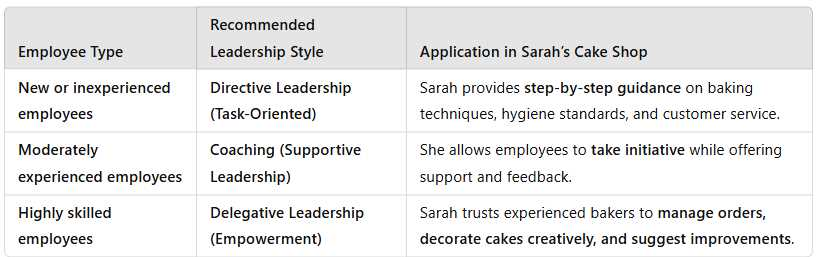


By adapting her approach to different staff members, Sarah ensures high productivity, job satisfaction, and skill development within her team.

(B) Supplier Relationship Management

Sarah's cake shop depends on local suppliers for ingredients such as flour, sugar, and dairy. A contingency approach helps her manage these relationships effectively:

Handling Reliable Suppliers (Low-Risk Situations)

Uses a collaborative leadership style, fostering strong long-term relationships.

Works closely with suppliers to negotiate bulk discounts and ensure high-quality ingredients.

Dealing with Supplier Disruptions (High-Risk Situations)

Uses directive leadership to make quick alternative sourcing decisions.

If a supplier fails to deliver ingredients on time, Sarah must quickly find replacements to keep operations running smoothly.

By adapting her approach based on supplier reliability, Sarah ensures consistent ingredient supply, cost efficiency, and business continuity.

(C) Responding to Business Challenges and Market Changes

The food industry is highly competitive, and Sarah must adjust her leadership approach to respond effectively to external challenges such as:

Seasonal Demand Fluctuations (Christmas, Weddings, Special Events)

Uses a participative approach, involving her team in planning for high-demand periods.

Encourages staff to suggest new cake designs, flavors, and promotional offers.

Handling Customer Complaints and Service Issues

Uses a customer-focused leadership approach, ensuring that employees prioritize customer satisfaction and feedback resolution.

Trains employees in effective communication and problem-solving.

Implementing New Technologies (e.g., Online Ordering System)

Uses a coaching approach, training staff step-by-step on the new system while gathering their feedback.

By staying flexible and responsive, Sarah ensures that her cake shop remains competitive, innovative, and customer-focused.

(D) Managing Workload and Crisis Situations

In any small business, unexpected crises can arise, such as staff shortages, equipment breakdowns, or raw material shortages. Sarah can use different leadership styles based on urgency:

Crisis Situations (e.g., Oven Malfunction, Sudden Staff Absences)

Uses a directive approach, giving clear instructions to ensure quick problem resolution.

Example: If a baker calls in sick on a busy day, Sarah reallocates tasks immediately to keep up with orders.

Daily Operations (Stable Work Conditions)

Uses a participative approach, allowing employees to contribute ideas for improving workflows and efficiency.

By using contingency-based leadership, Sarah ensures her cake shop runs smoothly under different circumstances.

(E) Encouraging Teamwork and Employee Motivation

A successful cake shop requires a motivated, engaged team. Sarah can use different leadership techniques to build a strong team culture:

Team Meetings and Brainstorming

Uses a democratic approach, encouraging employees to share creative cake designs and customer engagement strategies.

Recognizing Employee Achievements

Uses a supportive approach, rewarding employees for exceptional performance and customer service.

By adapting to different employee needs, Sarah builds a motivated, skilled, and loyal team, reducing turnover and improving overall performance.

Conclusion

The Contingency Approach to Leadership is an effective strategy for Sarah as it allows her to adapt to various challenges in her cake shop, ensuring smooth operations, strong supplier management, and motivated employees.

By modifying her leadership style based on the situation, employee skill levels, supplier performance, and business challenges, Sarah can:
Develop a high-performing team by offering the right mix of guidance and independence. Manage supplier relationships effectively by adjusting her leadership approach based on reliability and market conditions.
Handle operational challenges efficiently, ensuring business continuity and customer satisfaction.

Ultimately, flexibility and adaptability are key to her success, making the Contingency Approach an ideal leadership style for small business management.


Viewing page 3 of 9
Viewing questions 11 - 15 out of 40 questions


Post your Comments and Discuss CIPS L6M1 exam prep with other Community members:

AI Tutor AI Tutor 👋 I’m here to help!