Free CFA-Level-II Exam Braindumps
CFA Level II Chartered Financial Analyst Questions 63–66 (page: 74)

Updated On: 10-Feb-2026

Michael Thomas, CFA, is a fixed-income portfolio manager for TFC Investments. As part of his portfolio strategy for the Prosperity Fund, Thomas searches for companies that he expects to be upgraded or downgraded. Those potential upgrades he finds are added to the portfolio or if already in the portfolio are increased in proportion to other holdings before the upgrade takes place.

Potential downgrades are sold from the portfolio before the downgrade takes place. Thomas is evaluating his portfolio's current holdings which include several bonds issued by companies in the oil and gas exploration and refining industries. Year-end rating updates are expected to occur in a few days and Thomas is preparing to adjust his portfolio based on expected changes in credit ratings. He has assembled the following annual data on four of the oil and gas stocks in the portfolio:

Exhibit: 1


Thomas has been discussing his fixed-income strategies with a fellow portfolio manager, Shawna Reese. Reese has indicated that while his initial approach is good, the overall credit analysis strategy could be improved and has made the following suggestions to Thomas for both the Prosperity Fund and other fixed-income funds he manages:

The current methodology does not consider special issues related to high-yield debt which makes up approximately 5% of the Prosperity Fund. Because most high-yield issuers have such a heavy dependence on short-term debt financing, analysis of the firm's debt structure will be extremely important to determine the priority of claims on the firm's assets as well as what source(s) of funds will be used to repay the principal. In addition, the corporate structure of high-yield issuers must be examined to determine the issuer's access to cash flows generated by its subsidiaries. A simple analysis of the parent's financial ratios will not reveal complicated corporate structures and indebtedness of subsidiaries that may restrict the issuer's ability to obtain the cash flows necessary to service its debt.

The current methodology as applied to the Municipal Opportunities Fund does not include the necessary specialized analysis for municipal securities. Among other items, tax-backed munis must be scrutinized as to the issuer's ability to maintain balanced budgets as well as to ensure that the issue has first priority of claims to revenue from public works projects. Revenue-backed munis require an assessment of the sufficiency of rate covenants to cover expenses and debt servicing of the underlying project as well as the ability for other government entities to access the revenues generated by the enterprise before they are passed on to revenue bondholders.

As part of his portfolio analysis, Thomas also examines yield volatility. Thomas makes the following statements:
Statement 1: Implied yield volatility estimates are based on the assumptions that the option pricing model is correct and that volatility is constant.

Statement 2: Yield volatility has been observed to follow patterns over time that can be modeled and used to forecast future volatility.
He concludes his analysis by comparing the swap rate curve to a government bond yield curve as a benchmark.

Evaluate Reese's statements about high-yield debt securities with respect to the issuer's debt structure and corporate structure.

  1. Reese is correct only with regard to the issuer's debt structure.
  2. Reese is correct only with regard to the corporate structure of the issuer.
  3. Both of Reese's statements are correct.

Answer(s): C

Explanation:

Reese's first statement is correct. High-yield issuers generally depend heavily on short-term bank debt as it is difficult for them to obtain long-term financing. Because of the short- term nature of bank debt and its priority of claim to zsscts over existing bondholders, a careful examination of the issuer's debt structure is necessary. Reese's second statement is also correct. High-yield issuers usually have a holding company structure requiring cash flows from its subsidiaries to pay the interest and principal on its debt issues. If the subsidiaries have their own debt obligations to service and if the corporate structure is so complex that cash flow between subsidiaries and the parent company are restricted, it will be difficult for the parent issuer to obtain funds to pay interest and principal when due. (Study Session 14, LOS 51-0


Michael Thomas, CFA, is a fixed-income portfolio manager for TFC Investments. As part of his portfolio strategy for the Prosperity Fund, Thomas searches for companies that he expects to be upgraded or downgraded. Those potential upgrades he finds are added to the portfolio or if already in the portfolio are increased in proportion to other holdings before the upgrade takes place.

Potential downgrades are sold from the portfolio before the downgrade takes place. Thomas is evaluating his portfolio's current holdings which include several bonds issued by companies in the oil and gas exploration and refining industries. Year-end rating updates are expected to occur in a few days and Thomas is preparing to adjust his portfolio based on expected changes in credit ratings. He has assembled the following annual data on four of the oil and gas stocks in the portfolio:

Exhibit: 1


Thomas has been discussing his fixed-income strategies with a fellow portfolio manager, Shawna Reese. Reese has indicated that while his initial approach is good, the overall credit analysis strategy could be improved and has made the following suggestions to Thomas for both the Prosperity Fund and other fixed-income funds he manages:

The current methodology does not consider special issues related to high-yield debt which makes up approximately 5% of the Prosperity Fund. Because most high-yield issuers have such a heavy dependence on short-term debt financing, analysis of the firm's debt structure will be extremely important to determine the priority of claims on the firm's assets as well as what source(s) of funds will be used to repay the principal. In addition, the corporate structure of high-yield issuers must be examined to determine the issuer's access to cash flows generated by its subsidiaries. A simple analysis of the parent's financial ratios will not reveal complicated corporate structures and indebtedness of subsidiaries that may restrict the issuer's ability to obtain the cash flows necessary to service its debt.

The current methodology as applied to the Municipal Opportunities Fund does not include the necessary specialized analysis for municipal securities. Among other items, tax-backed munis must be scrutinized as to the issuer's ability to maintain balanced budgets as well as to ensure that the issue has first priority of claims to revenue from public works projects. Revenue-backed munis require an assessment of the sufficiency of rate covenants to cover expenses and debt servicing of the underlying project as well as the ability for other government entities to access the revenues generated by the enterprise before they are passed on to revenue bondholders.

As part of his portfolio analysis, Thomas also examines yield volatility. Thomas makes the following statements:
Statement 1: Implied yield volatility estimates are based on the assumptions that the option pricing model is correct and that volatility is constant.

Statement 2: Yield volatility has been observed to follow patterns over time that can be modeled and used to forecast future volatility.
He concludes his analysis by comparing the swap rate curve to a government bond yield curve as a benchmark.

Evaluate Reese's statements about municipal securities with respect to tax-backed securities and revenue-backed securities.

  1. Reese is correct only with regard to tax-backed securities.
  2. Reese is correct only with regard to revenue-backed securities.
  3. Reese is incorrect with regard to both types of securities.

Answer(s): B

Explanation:

The first statement regarding tax-backed securities is incorrect. Tax-backed municipal bonds are serviced using the general taxing authority of the municipality. They do not have a claim to the revenue generated from public works projects. Therefore, analyzing a tax- backed municipal's claim to revenue from public works projects is not necessary. The second statement, regarding revenue-backed securities, is correct. Of particular concern for the analysis of municipal revenue bonds is the ability of the municipality to change the rate or user-charge. This will be governed by the rate covenant in the bond which will determine the level of revenue generated by the project. In addition, it is essential to determine the priority of revenue claims and whether or not other government entities can access revenues from the underlying project before bondholders. (Study Session 14, LOS 51.h)


Michael Thomas, CFA, is a fixed-income portfolio manager for TFC Investments. As part of his portfolio strategy for the Prosperity Fund, Thomas searches for companies that he expects to be upgraded or downgraded. Those potential upgrades he finds are added to the portfolio or if already in the portfolio are increased in proportion to other holdings before the upgrade takes place.

Potential downgrades are sold from the portfolio before the downgrade takes place. Thomas is evaluating his portfolio's current holdings which include several bonds issued by companies in the oil and gas exploration and refining industries. Year-end rating updates are expected to occur in a few days and Thomas is preparing to adjust his portfolio based on expected changes in credit ratings. He has assembled the following annual data on four of the oil and gas stocks in the portfolio:

Exhibit: 1


Thomas has been discussing his fixed-income strategies with a fellow portfolio manager, Shawna Reese. Reese has indicated that while his initial approach is good, the overall credit analysis strategy could be improved and has made the following suggestions to Thomas for both the Prosperity Fund and other fixed-income funds he manages:

The current methodology does not consider special issues related to high-yield debt which makes up approximately 5% of the Prosperity Fund. Because most high-yield issuers have such a heavy dependence on short-term debt financing, analysis of the firm's debt structure will be extremely important to determine the priority of claims on the firm's assets as well as what source(s) of funds will be used to repay the principal. In addition, the corporate structure of high-yield issuers must be examined to determine the issuer's access to cash flows generated by its subsidiaries. A simple analysis of the parent's financial ratios will not reveal complicated corporate structures and indebtedness of subsidiaries that may restrict the issuer's ability to obtain the cash flows necessary to service its debt.

The current methodology as applied to the Municipal Opportunities Fund does not include the necessary specialized analysis for municipal securities. Among other items, tax-backed munis must be scrutinized as to the issuer's ability to maintain balanced budgets as well as to ensure that the issue has first priority of claims to revenue from public works projects. Revenue-backed munis require an assessment of the sufficiency of rate covenants to cover expenses and debt servicing of the underlying project as well as the ability for other government entities to access the revenues generated by the enterprise before they are passed on to revenue bondholders.

As part of his portfolio analysis, Thomas also examines yield volatility. Thomas makes the following statements:
Statement 1: Implied yield volatility estimates are based on the assumptions that the option pricing model is correct and that volatility is constant.

Statement 2: Yield volatility has been observed to follow patterns over time that can be modeled and used to forecast future volatility.
He concludes his analysis by comparing the swap rate curve to a government bond yield curve as a benchmark.

Which of Thomas's statements concerning yield volatility are correct?

  1. Statement 1 only.
  2. Statement 2 only.
  3. Both statements are correct.

Answer(s): C

Explanation:

Both statements are correct. Implied volatility can be estimated using observed prices for interest rate derivatives and option pricing models. Implied volatility is criticized because k is based on the assumptions that the option pricing model is correct and that volatility is constant. Yield volatility has been observed to follow patterns over time that can be modeled and used to forecast volatility using autoregressive statistical models. (Study Session 14, LOS 53.g)


Michael Thomas, CFA, is a fixed-income portfolio manager for TFC Investments. As part of his portfolio strategy for the Prosperity Fund, Thomas searches for companies that he expects to be upgraded or downgraded. Those potential upgrades he finds are added to the portfolio or if already in the portfolio are increased in proportion to other holdings before the upgrade takes place.

Potential downgrades are sold from the portfolio before the downgrade takes place. Thomas is evaluating his portfolio's current holdings which include several bonds issued by companies in the oil and gas exploration and refining industries. Year-end rating updates are expected to occur in a few days and Thomas is preparing to adjust his portfolio based on expected changes in credit ratings. He has assembled the following annual data on four of the oil and gas stocks in the portfolio:

Exhibit: 1


Thomas has been discussing his fixed-income strategies with a fellow portfolio manager, Shawna Reese. Reese has indicated that while his initial approach is good, the overall credit analysis strategy could be improved and has made the following suggestions to Thomas for both the Prosperity Fund and other fixed-income funds he manages:

The current methodology does not consider special issues related to high-yield debt which makes up approximately 5% of the Prosperity Fund. Because most high-yield issuers have such a heavy dependence on short-term debt financing, analysis of the firm's debt structure will be extremely important to determine the priority of claims on the firm's assets as well as what source(s) of funds will be used to repay the principal. In addition, the corporate structure of high-yield issuers must be examined to determine the issuer's access to cash flows generated by its subsidiaries. A simple analysis of the parent's financial ratios will not reveal complicated corporate structures and indebtedness of subsidiaries that may restrict the issuer's ability to obtain the cash flows necessary to service its debt.

The current methodology as applied to the Municipal Opportunities Fund does not include the necessary specialized analysis for municipal securities. Among other items, tax-backed munis must be scrutinized as to the issuer's ability to maintain balanced budgets as well as to ensure that the issue has first priority of claims to revenue from public works projects. Revenue-backed munis require an assessment of the sufficiency of rate covenants to cover expenses and debt servicing of the underlying project as well as the ability for other government entities to access the revenues generated by the enterprise before they are passed on to revenue bondholders.

As part of his portfolio analysis, Thomas also examines yield volatility. Thomas makes the following statements:
Statement 1: Implied yield volatility estimates are based on the assumptions that the option pricing model is correct and that volatility is constant.

Statement 2: Yield volatility has been observed to follow patterns over time that can be modeled and used to forecast future volatility.
He concludes his analysis by comparing the swap rate curve to a government bond yield curve as a benchmark.

Which of the following statements regarding the choice between government bond yield curves and swap rate curves as benchmark yields is most likely correct?

  1. The swap yield curve is preferred because swaps reflect similar levels of credit risk.
  2. Government bond yield curves are preferred because they are based on a more complete set of market yields.
  3. Government bond yield curves are preferred because the lack of a liquid secondary market can distort swap yields compared to government bond yields.

Answer(s): A

Explanation:

Market participants typically prefer to use the swap rate curve as a benchmark for the following reasons;
• The availability of swaps and the equilibrium pricing arc only driven by the interaction of supply and demand. It is not affected by technical market factors that can affect government bond yields.
• Swap curves across countries are also more comparable than sovereign bond yield curves because they reflect similar levels of credit risk, while sovereign bond yield curves also reflect credit risk unique to each country's government bonds.
• The swap curve typically has yield quotes at 11 maturities between 2 and 30 years. The U.S. government bond yield curve typically only has on-the-run issues trading at four maturities between 2 and 30 years.
• . The swap market is not regulated by any government, which makes swap rates across different countries more comparable.
(Study Session 14, LOS 53.d)


MediSoft Inc. develops and distributes high-tech medical software used in hospitals and clinics across the United States and Canada. The firm's software provides an integrated solution to monitoring, analyzing, and managing output from a variety of diagnostic medical equipment including MRls, CT scans, and EKG machines. MediSoft has grown rapidly since its inception ten years ago, averaging 25% growth in sales over the last decade. The company went public three years ago. Twelve months after their IPO, MediSoft made two semiannual coupon bond offerings, the first of which was a convertible bond. At the time of issuance, the convertible bond had a coupon rate of 7.25%, par value of $1,000, a conversion price of $55.56, and ten years until maturity. Two years after issuance, the bond became callable at 102% of par value. Soon after the issuance of the convertible bond, the company issued another series of bonds which were putable, but contained no conversion or call features. The putable bonds were issued with a coupon of 8.0%, par value of $1,000, and 15 years until maturity. One year after their issuance, the put feature of the putable bonds became active, allowing the bonds to be put at a price of 95% of par value, and increasing linearly over five years to 100% of par value. MediSoft's convertible bonds are now trading in the market for a price of $947 with an estimated straight value of $917. The company's putable bonds are trading at a price of $1,052. Volatility in the price of MediSoft's common stock has been relatively high over the last few months. Currently the stock is priced at $50 on the New York Stock Exchange and is expected to continue its annual dividend in the amount of $1.80 per share.

High-tech industry analysts for Brown & Associates, a money management firm specializing in fixed-income investments, have been closely following MediSoft ever since it went public three years ago. In general, portfolio managers at Brown & Associates do not participate in initial offerings of debt investments, preferring instead to see how the issue trades before considering taking a position in the issue. Since MediSoft's bonds have had ample time to trade in the marketplace, analysts and portfolio managers have taken an interest in the company's bonds. At a meeting to discuss the merits of MediSofVs bonds, the following comments were made by various portfolio managers and analysts at Brown & Associates:
"Choosing to invest in MediSoft's convertible bond would benefit our portfolios in many ways, but the primary benefit is the limited downside risk associated with the bond. Since the straight value will provide a floor for the value of the convertible bond, downside risk is limited to the difference between the market price of the bond and the straight value."
"Decreasing volatility in the price of MediSoft's common stock as well as increasing volatility in the level of interest rates are expected in the near future. The combined effects of these changes in volatility will be a decrease in the price of MediSoft's putable bonds and an increase in the price of the convertible bonds. Therefore, only the convertible bonds would be a suitable purchase."

Calculate the market conversion premium per share for MediSoft's convertible bonds.

  1. $2.61.
  2. $2.95.
  3. $5.56.

Answer(s): A

Explanation:

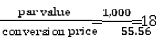
First, calculate the conversion ratio: conversion ratio =


Now, calculate market conversion price:
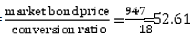
market conversion price =

Finally, calculate the market conversion premium per share as the difference between the market conversion price and the market price of the stock:
market conversion premium = 52.61 - 50.00 = 2.61. (Study Session 14, LOS 54.j)


Viewing page 74 of 145
Viewing questions 366 - 370 out of 715 questions


Post your Comments and Discuss CFA CFA-Level-II exam prep with other Community members:

AI Tutor AI Tutor 👋 I’m here to help!