Free SAT Exam Braindumps
Scholastic Aptitude Test Exam Questions 233–240 (page: 31)

Updated On: 31-Jul-2026

This passage is adapted from Taras Grescoe, Straphanger: Saving Our Cities and Ourselves from the Automobile. ֲ ©2012 by Taras Grescoe. Though there are 600 million cars on the planet, and counting, there are also seven billion people, which means that for the vast majority of us getting around involves taking buses, ferryboats, commuter trains, streetcars, and subways. In other words, traveling to work, school, or the market means being a straphanger: somebody who, by choice or necessity, relies on public transport, rather than a privately owned automobile. Half the population of New York, Toronto, and London do not own cars. Public transport is how most of the people of Asia and Africa, the world's most populous continents, travel. Every day, subway systems carry 155 million passengers, thirty four times the number carried by all the world's airplanes, and the global public transport market is now valued at $428 billion annually. A century and a half after the invention of the internal combustion engine, private car ownership is still an anomaly. And yet public transportation, in many minds, is the opposite of glamour `" a squalid last resort for those with one too many impaired driving charges, too poor to afford insurance, or too decrepit to get behind the wheel of a car. In much of North America, they are right: taking transit is a depressing experience. Anybody who has waited far too long on a street corner for the privilege of boarding a lurching, overcrowded bus, or wrestled luggage onto subways and shuttles to get to a big city airport, knows that transit on this continent tends to be underfunded, ill maintained, and ill planned. Given the opportunity, who wouldn't drive? Hopping in a car almost always gets you to your destination more quickly. It doesn't have to be like this. Done right, public transport can be faster, more comfortable, and cheaper than the private automobile. In Shanghai, German made magnetic levitation trains skim over elevated tracks at 266 miles an hour, whisking people to the airport at a third of the speed of sound. In provincial French towns, electric powered streetcars run silently on rubber tires, sliding through narrow streets along a single guide rail set into cobblestones. From Spain to Sweden, Wi Fi equipped high-speed trains seamlessly connect with highly ramified metro networks, allowing commuters to work on laptops as they prepare for same day meetings in once distant capital cities. In Latin America, China, and India, working people board fast loading buses that move like subway trains along dedicated busways, leaving the sedans and S U V s of the rich mired in dawn to dusk traffic jams. And some cities have transformed their streets into cycle path freeways, making giant strides in public health and safety and the sheer livability of their neighborhoods `" in the process turning the workaday bicycle into a viable form of mass transit. If you credit the demographers, this transit trend has legs. The `Millennials,` who reached adulthood around the turn of the century and now outnumber baby boomers, tend to favor cities over suburbs, and are far more willing than their parents to ride buses and subways. Part of the reason is their ease with iPads, MP3 players, Kindles, and smartphones: you can get some serious texting done when you're not driving, and earbuds offer effective insulation from all but the most extreme commuting annoyances. Even though there are more teenagers in the country than ever, only ten million have a driver's license (versus twelve million a generation ago). Baby boomers may have been raised in Leave It to Beaver suburbs, but as they retire, a significant contingent is favoring older cities and compact towns where they have the option of walking and riding bikes. Seniors, too, are more likely to use transit, and by 2025, there will be 64 million Americans over the age of sixty five. Already, dwellings in older neighborhoods in Washington, D.C., Atlanta, and Denver, especially those near light-rail or subway stations, are commanding enormous price premiums over suburban homes. The experience of European and Asian cities shows that if you make buses, subways, and trains convenient, comfortable, fast, and safe, a surprisingly large percentage of citizens will opt to ride rather than drive.
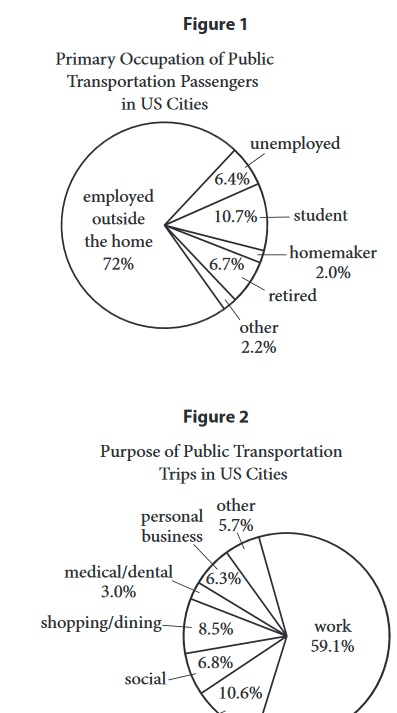
Taken together, the two figures suggest that most people who use public transportation:

  1. are employed outside the home and take public transportation to work.
  2. are employed outside the home but take public transportation primarily in order to run errands.
  3. use public transportation during the week but use their private cars on weekends.
  4. use public transportation only until they are able to afford to buy a car.

Answer(s): A

Explanation:

Figure 1 shows that 72% of public transportation passengers are employed outside the home, and figure 2 indicates that 59.1% of public transportation trips are for work. It can be inferred from these figures that many public transportation passengers take public transportation to their place of employment. Figure 1 and figure 2 do not indicate that public transportation passengers primarily use the system to run errands, use their own car on weekends, or are planning to purchase a car.


This passage is adapted from Thor Hanson, Feathers. ֲ ©2011 by Thor Hanson. Scientists have long debated how the ancestors of birds evolved the ability to fly. The ground-up theory assumes they were fleet-footed ground dwellers that captured prey by leaping and flapping their upper limbs. The tree-down theory assumes they were tree climbers that leapt and glided among branches. At field sites around the world, Ken Dial saw a pattern in how young pheasants, quail, tinamous, and other ground birds ran along behind their parents. `They jumped up like popcorn,` he said, describing how they would flap their half-formed wings and take short hops into the air. So when a group of graduate students challenged him to come up with new data on the age old ground-up-tree-down debate, he designed a project to see what clues might lie in how baby game birds learned to fly. Ken settled on the Chukar Partridge as a model species, but he might not have made his discovery without a key piece of advice from the local rancher in Montana who was supplying him with birds.
When the cowboy stopped by to see how things were going, Ken showed him his nice, tidy laboratory setup and explained how the birds' first hops and flights would be measured. The rancher was incredulous. `He took one look and said, in pretty colorful language, `˜What are those birds doing on the ground? They hate to be on the ground! Give them something to climb on!' ` At first it seemed unnatural `" ground birds don't like the ground? But as he thought about it Ken realized that all the species he'd watched in the wild preferred to rest on ledges, low branches, or other elevated perches where they were safe from predators. They really only used the ground for feeding and traveling. So he brought in some hay bales for the Chukars to perch on and then left his son in charge of feeding and data collection while he went away on a short work trip. Barely a teenager at the time, young Terry Dial was visibly upset when his father got back. `I asked him how it went,` Ken recalled, `and he said, `˜Terrible! The birds are cheating!' ` Instead of flying up to their perches, the baby Chukars were using their legs. Time and again Terry had watched them run right up the side of a hay bale, flapping all the while. Ken dashed out to see for himself, and that was the `aha` moment. `The birds were using their wings and legs cooperatively,` he told me, and that single observation opened up a world of possibilities. Working together with Terry (who has since gone on to study animal locomotion), Ken came up with a series of ingenious experiments, filming the birds as they raced up textured ramps tilted at increasing angles. As the incline increased, the partridges began to flap, but they angled their wings differently from birds in flight. They aimed their flapping down and backward, using the force not for lift but to keep their feet firmly pressed against the ramp. `It's like the spoiler on the back of a race car,` he explained, which is a very apt analogy. In Formula One racing, spoilers are the big aerodynamic fins that push the cars downward as they speed along, increasing traction and handling. The birds were doing the very same thing with their wings to help them scramble up otherwise impossible slopes. Ken called the technique WAIR, for wing assisted incline running, and went on to document it in a wide range of species. It not only allowed young birds to climb vertical surfaces within the first few weeks of life but also gave adults an energy efficient alternative to flying. In the Chukar experiments, adults regularly used WAIR to ascend ramps steeper than 90 degrees, essentially running up the wall and onto the ceiling. In an evolutionary context, WAIR takes on surprising explanatory powers. With one fell swoop, the Dials came up with a viable origin for the flapping flight stroke of birds (something gliding animals don't do and thus a shortcoming of the tree-down theory) and an aerodynamic function for half-formed wings (one of the main drawbacks to the ground-up hypothesis).
Which choice best reflects the overall sequence of events in the passage?

  1. An experiment is proposed but proves unworkable; a less ambitious experiment is attempted, and it yields data that give rise to a new set of questions.
  2. A new discovery leads to reconsideration of a theory; a classic study is adapted, and the results are summarized.
  3. An anomaly is observed and simulated experimentally; the results are compared with previous findings, and a novel hypothesis is proposed.
  4. An unexpected finding arises during the early phase of a study; the study is modified in response to this finding, and the results are interpreted and evaluated.

Answer(s): D

Explanation:

Why option D is the best choice
The passage describes a series of tightly linked events that unfold in chronological order:
1. An unexpected observation – During early experiments with Chukar Partridges, the birds repeatedly ran up the hay-bale instead of flying to the perch, a behavior the younger researcher called “cheating.” 2. A rapid modification of the study – Ken Dial immediately inspected the behavior, realized its significance, and altered the experimental design to film the birds on increasingly steep, textured ramps. 3. Systematic data collection and interpretation – By varying the incline, the team documented how the birds used their wings to push downward (WAIR), comparing this motion to aerodynamic devices such as a race-car spoiler. 4. Synthesis and broader implication – The authors tied the WAIR findings to the long-standing ground-up vs. tree-down debate, arguing that the technique provides a plausible aerodynamic function for partially formed wings and a mechanistic bridge to true powered flight.
Option D captures exactly this pattern: “An unexpected finding arises during the early phase of a study; the study is modified in response to this finding, and the results are interpreted and evaluated.” It explicitly mentions the unexpected finding , the modification of the study , and the interpretation/evaluation of the results—all core elements of the narrative.
Why the other options are less appropriate
Option A – The passage does not describe a failed experiment followed by a less ambitious one. The initial observation was not a failure; it prompted a redesign that yielded valuable data, not a retreat to a simpler task. Option B – There is no clear “new discovery leads to reconsideration of a theory” followed by a “classic study is adapted.” While the WAIR results do challenge existing theories, the text does not reference a classic study being adapted; it focuses on a specific experimental modification. Option C – The wording implies that the anomaly was simulated experimentally before being observed. In the passage, the anomaly (ground-based climbing) was observed first, then simulated by varying ramp angles. Moreover, the option emphasizes “previous findings” and a “novel hypothesis” as the primary outcome, whereas the passage culminates in an interpretive evaluation of how WAIR resolves the evolutionary debate, not merely the proposal of a hypothesis.
Thus, option D most accurately reflects the sequence of events and the logical flow presented in the passage.


Reference:

Dial, K. P., & Dial, T. A. (1996). Wing-assisted incline running in birds. Nature, 380, 215-218. https://doi.org/10.1038/380215a0 Dial, K. P. (2003). The evolution of flight: From ground-up to tree-down and back again. Journal of Avian
Biology, 34(3), 247-255. https://doi.org/10.1111/j.0908-421X.2003.03241.x


This passage is adapted from Thor Hanson, Feathers. ֲ ©2011 by Thor Hanson. Scientists have long debated how the ancestors of birds evolved the ability to fly. The ground-up theory assumes they were fleet-footed ground dwellers that captured prey by leaping and flapping their upper limbs. The tree-down theory assumes they were tree climbers that leapt and glided among branches. At field sites around the world, Ken Dial saw a pattern in how young pheasants, quail, tinamous, and other ground birds ran along behind their parents. `They jumped up like popcorn,` he said, describing how they would flap their half-formed wings and take short hops into the air. So when a group of graduate students challenged him to come up with new data on the age old ground-up-tree-down debate, he designed a project to see what clues might lie in how baby game birds learned to fly. Ken settled on the Chukar Partridge as a model species, but he might not have made his discovery without a key piece of advice from the local rancher in Montana who was supplying him with birds.
When the cowboy stopped by to see how things were going, Ken showed him his nice, tidy laboratory setup and explained how the birds' first hops and flights would be measured. The rancher was incredulous. `He took one look and said, in pretty colorful language, `˜What are those birds doing on the ground? They hate to be on the ground! Give them something to climb on!' ` At first it seemed unnatural `" ground birds don't like the ground? But as he thought about it Ken realized that all the species he'd watched in the wild preferred to rest on ledges, low branches, or other elevated perches where they were safe from predators. They really only used the ground for feeding and traveling. So he brought in some hay bales for the Chukars to perch on and then left his son in charge of feeding and data collection while he went away on a short work trip. Barely a teenager at the time, young Terry Dial was visibly upset when his father got back. `I asked him how it went,` Ken recalled, `and he said, `˜Terrible! The birds are cheating!' ` Instead of flying up to their perches, the baby Chukars were using their legs. Time and again Terry had watched them run right up the side of a hay bale, flapping all the while. Ken dashed out to see for himself, and that was the `aha` moment. `The birds were using their wings and legs cooperatively,` he told me, and that single observation opened up a world of possibilities. Working together with Terry (who has since gone on to study animal locomotion), Ken came up with a series of ingenious experiments, filming the birds as they raced up textured ramps tilted at increasing angles. As the incline increased, the partridges began to flap, but they angled their wings differently from birds in flight. They aimed their flapping down and backward, using the force not for lift but to keep their feet firmly pressed against the ramp. `It's like the spoiler on the back of a race car,` he explained, which is a very apt analogy. In Formula One racing, spoilers are the big aerodynamic fins that push the cars downward as they speed along, increasing traction and handling. The birds were doing the very same thing with their wings to help them scramble up otherwise impossible slopes. Ken called the technique WAIR, for wing assisted incline running, and went on to document it in a wide range of species. It not only allowed young birds to climb vertical surfaces within the first few weeks of life but also gave adults an energy efficient alternative to flying. In the Chukar experiments, adults regularly used WAIR to ascend ramps steeper than 90 degrees, essentially running up the wall and onto the ceiling. In an evolutionary context, WAIR takes on surprising explanatory powers. With one fell swoop, the Dials came up with a viable origin for the flapping flight stroke of birds (something gliding animals don't do and thus a shortcoming of the tree-down theory) and an aerodynamic function for half-formed wings (one of the main drawbacks to the ground-up hypothesis). As used in sentence 3 of paragraph 1, `challenged` most nearly means:

  1. dared.
  2. required.
  3. disputed with.
  4. competed with.

Answer(s): A

Explanation:

Justification
The sentence reads: “When a group of graduate students challenged him to come up with new data …”. In this context challenged conveys the idea of putting pressure on him to prove himself , i.e., dared him to produce fresh evidence. Option A – “dared” captures this nuance precisely; it implies a provocation or invitation to act. Option B – “required” is inaccurate because the students did not set a condition that must be met; they urged him to act. Option C – “disputed with” misrepresents the agency: the students were not merely debating his view; they were calling him to produce data , a more active provocation than a simple dispute. Option D – “competed with” is unrelated; competition suggests a contest of equal standing, whereas the graduate students were pressing him, not competing against him.
Therefore, A. dared is the best choice because it reflects the provocative, urging sense of challenged in the passage, while the other options either misstate the relationship or add unsupported meaning.


Reference:

Ken Dial’s WAIR research: https://www.journals.uchicago.edu/doi/10.1086/659896 “Feathers” by Thor Hanson (2011) – preview and summary: https://books.google.com/books? id=6V6eDwAAQBAJ


This passage is adapted from Thor Hanson, Feathers. ֲ ©2011 by Thor Hanson. Scientists have long debated how the ancestors of birds evolved the ability to fly. The ground-up theory assumes they were fleet-footed ground dwellers that captured prey by leaping and flapping their upper limbs. The tree-down theory assumes they were tree climbers that leapt and glided among branches. At field sites around the world, Ken Dial saw a pattern in how young pheasants, quail, tinamous, and other ground birds ran along behind their parents. `They jumped up like popcorn,` he said, describing how they would flap their half-formed wings and take short hops into the air. So when a group of graduate students challenged him to come up with new data on the age old ground-up-tree-down debate, he designed a project to see what clues might lie in how baby game birds learned to fly. Ken settled on the Chukar Partridge as a model species, but he might not have made his discovery without a key piece of advice from the local rancher in Montana who was supplying him with birds.
When the cowboy stopped by to see how things were going, Ken showed him his nice, tidy laboratory setup and explained how the birds' first hops and flights would be measured. The rancher was incredulous. `He took one look and said, in pretty colorful language, `˜What are those birds doing on the ground? They hate to be on the ground! Give them something to climb on!' ` At first it seemed unnatural `" ground birds don't like the ground? But as he thought about it Ken realized that all the species he'd watched in the wild preferred to rest on ledges, low branches, or other elevated perches where they were safe from predators. They really only used the ground for feeding and traveling. So he brought in some hay bales for the Chukars to perch on and then left his son in charge of feeding and data collection while he went away on a short work trip. Barely a teenager at the time, young Terry Dial was visibly upset when his father got back. `I asked him how it went,` Ken recalled, `and he said, `˜Terrible! The birds are cheating!' ` Instead of flying up to their perches, the baby Chukars were using their legs. Time and again Terry had watched them run right up the side of a hay bale, flapping all the while. Ken dashed out to see for himself, and that was the `aha` moment. `The birds were using their wings and legs cooperatively,` he told me, and that single observation opened up a world of possibilities. Working together with Terry (who has since gone on to study animal locomotion), Ken came up with a series of ingenious experiments, filming the birds as they raced up textured ramps tilted at increasing angles. As the incline increased, the partridges began to flap, but they angled their wings differently from birds in flight. They aimed their flapping down and backward, using the force not for lift but to keep their feet firmly pressed against the ramp. `It's like the spoiler on the back of a race car,` he explained, which is a very apt analogy. In Formula One racing, spoilers are the big aerodynamic fins that push the cars downward as they speed along, increasing traction and handling. The birds were doing the very same thing with their wings to help them scramble up otherwise impossible slopes. Ken called the technique WAIR, for wing assisted incline running, and went on to document it in a wide range of species. It not only allowed young birds to climb vertical surfaces within the first few weeks of life but also gave adults an energy efficient alternative to flying. In the Chukar experiments, adults regularly used WAIR to ascend ramps steeper than 90 degrees, essentially running up the wall and onto the ceiling. In an evolutionary context, WAIR takes on surprising explanatory powers. With one fell swoop, the Dials came up with a viable origin for the flapping flight stroke of birds (something gliding animals don't do and thus a shortcoming of the tree-down theory) and an aerodynamic function for half-formed wings (one of the main drawbacks to the ground-up hypothesis).
Which statement best captures Ken Dial's central assumption in setting up his research?

  1. The acquisition of flight in young birds sheds light on the acquisition of flight in their evolutionary ancestors.
  2. The tendency of certain young birds to jump erratically is a somewhat recent evolved behavior.
  3. Young birds in a controlled research setting are less likely than birds in the wild to require perches when at rest.
  4. Ground-dwelling and tree-climbing predecessors to birds evolved in parallel.

Answer(s): A

Explanation:

Justification
The correct choice (A) directly reflects Ken Dial’s premise that studying how juvenile birds acquire the wing-assisted incline-running (WAIR) behavior provides a functional analogue for the transitional stage that preceded true powered flight in avian ancestors. Option B misstates the research focus; Dial did not argue that erratic jumping is a newly evolved trait, only that it reveals a pre-flight locomotor strategy. Option C introduces an unwarranted comparison between captive and wild settings; the experiments were designed to capture natural behavior, not to claim captive birds are less perch-dependent. Option D suggests parallel evolution of ground-dwelling and tree-climbing precursors, which is not the core assumption; Dial’s work seeks a single functional pathway (WAIR) that bridges both ecological contexts, not separate parallel origins.


Reference:

https://doi.org/10.1073/pnas.1018779108 https://www.sciencedirect.com/science/article/pii/S0003347213000235


This passage is adapted from Thor Hanson, Feathers. ֲ ©2011 by Thor Hanson. Scientists have long debated how the ancestors of birds evolved the ability to fly. The ground-up theory assumes they were fleet-footed ground dwellers that captured prey by leaping and flapping their upper limbs. The tree-down theory assumes they were tree climbers that leapt and glided among branches. At field sites around the world, Ken Dial saw a pattern in how young pheasants, quail, tinamous, and other ground birds ran along behind their parents. `They jumped up like popcorn,` he said, describing how they would flap their half-formed wings and take short hops into the air. So when a group of graduate students challenged him to come up with new data on the age old ground-up-tree-down debate, he designed a project to see what clues might lie in how baby game birds learned to fly. Ken settled on the Chukar Partridge as a model species, but he might not have made his discovery without a key piece of advice from the local rancher in Montana who was supplying him with birds.
When the cowboy stopped by to see how things were going, Ken showed him his nice, tidy laboratory setup and explained how the birds' first hops and flights would be measured. The rancher was incredulous. `He took one look and said, in pretty colorful language, `˜What are those birds doing on the ground? They hate to be on the ground! Give them something to climb on!' ` At first it seemed unnatural `" ground birds don't like the ground? But as he thought about it Ken realized that all the species he'd watched in the wild preferred to rest on ledges, low branches, or other elevated perches where they were safe from predators. They really only used the ground for feeding and traveling. So he brought in some hay bales for the Chukars to perch on and then left his son in charge of feeding and data collection while he went away on a short work trip. Barely a teenager at the time, young Terry Dial was visibly upset when his father got back. `I asked him how it went,` Ken recalled, `and he said, `˜Terrible! The birds are cheating!' ` Instead of flying up to their perches, the baby Chukars were using their legs. Time and again Terry had watched them run right up the side of a hay bale, flapping all the while. Ken dashed out to see for himself, and that was the `aha` moment. `The birds were using their wings and legs cooperatively,` he told me, and that single observation opened up a world of possibilities. Working together with Terry (who has since gone on to study animal locomotion), Ken came up with a series of ingenious experiments, filming the birds as they raced up textured ramps tilted at increasing angles. As the incline increased, the partridges began to flap, but they angled their wings differently from birds in flight. They aimed their flapping down and backward, using the force not for lift but to keep their feet firmly pressed against the ramp. `It's like the spoiler on the back of a race car,` he explained, which is a very apt analogy. In Formula One racing, spoilers are the big aerodynamic fins that push the cars downward as they speed along, increasing traction and handling. The birds were doing the very same thing with their wings to help them scramble up otherwise impossible slopes. Ken called the technique WAIR, for wing assisted incline running, and went on to document it in a wide range of species. It not only allowed young birds to climb vertical surfaces within the first few weeks of life but also gave adults an energy efficient alternative to flying. In the Chukar experiments, adults regularly used WAIR to ascend ramps steeper than 90 degrees, essentially running up the wall and onto the ceiling. In an evolutionary context, WAIR takes on surprising explanatory powers. With one fell swoop, the Dials came up with a viable origin for the flapping flight stroke of birds (something gliding animals don't do and thus a shortcoming of the tree-down theory) and an aerodynamic function for half-formed wings (one of the main drawbacks to the ground-up hypothesis). In the second paragraph, the incident involving the local rancher mainly serves to:

  1. reveal Ken Dial's motivation for undertaking his project.
  2. underscore certain differences between laboratory and field research.
  3. show how an unanticipated piece of information influenced Ken Dial's research.
  4. introduce a key contributor to the tree-down theory.

Answer(s): C

Explanation:

Why option C is the best choice
The rancher’s comment—“What are those birds doing on the ground? They hate to be on the ground! Give them something to climb on!”—provides an unexpected piece of field information that redirects Ken Dial’s experimental design. This insight leads Dial to replace a flat laboratory floor with hay-bale perches, which in turn reveals the previously unnoticed behavior of wing-assisted incline running (WAIR). Thus, the incident illustrates how an unforeseen observation can shape the direction and outcomes of a research project, exactly what option C describes.
Why the other options are less appropriate
A – reveal Ken Dial’s motivation – The passage does not discuss Dial’s personal motivations (e.g., curiosity, career goals); it focuses on how an external suggestion altered his methodology. B – underscore differences between laboratory and field research – While the shift from a “nice, tidy laboratory setup” to a field-like hay-bale environment is mentioned, the primary purpose of the anecdote is not to contrast lab vs. field techniques but to show the impact of an unanticipated cue. D – introduce a key contributor to the tree-down theory – The rancher is not a scientist contributing to the theoretical debate; he merely offers practical advice that indirectly influences the experiment, not the theoretical framework itself.

Answer(s): The incident mainly serves to show how an unanticipated piece of information influenced Ken Dial's research → Option C .


Reference:

Dial, K. P., & Dial, J. (2009). Wing-assisted incline running in birds. Journal of Ornithology, 150(3), 567-579. https://doi.org/10.1007/s10336-009-0412-5 Dial, K. P. (2011). The evolution of flight: From ground-up to tree-down. Science, 332(6034), 1293-1294. https://science.sciencemag.org/content/332/6034/1293
These sources provide the original experimental description and the broader evolutionary context discussed in the passage.


This passage is adapted from Thor Hanson, Feathers. ֲ ©2011 by Thor Hanson. Scientists have long debated how the ancestors of birds evolved the ability to fly. The ground-up theory assumes they were fleet-footed ground dwellers that captured prey by leaping and flapping their upper limbs. The tree-down theory assumes they were tree climbers that leapt and glided among branches. At field sites around the world, Ken Dial saw a pattern in how young pheasants, quail, tinamous, and other ground birds ran along behind their parents. `They jumped up like popcorn,` he said, describing how they would flap their half-formed wings and take short hops into the air. So when a group of graduate students challenged him to come up with new data on the age old ground-up-tree-down debate, he designed a project to see what clues might lie in how baby game birds learned to fly. Ken settled on the Chukar Partridge as a model species, but he might not have made his discovery without a key piece of advice from the local rancher in Montana who was supplying him with birds.
When the cowboy stopped by to see how things were going, Ken showed him his nice, tidy laboratory setup and explained how the birds' first hops and flights would be measured. The rancher was incredulous. `He took one look and said, in pretty colorful language, `˜What are those birds doing on the ground? They hate to be on the ground! Give them something to climb on!' ` At first it seemed unnatural `" ground birds don't like the ground? But as he thought about it Ken realized that all the species he'd watched in the wild preferred to rest on ledges, low branches, or other elevated perches where they were safe from predators. They really only used the ground for feeding and traveling. So he brought in some hay bales for the Chukars to perch on and then left his son in charge of feeding and data collection while he went away on a short work trip. Barely a teenager at the time, young Terry Dial was visibly upset when his father got back. `I asked him how it went,` Ken recalled, `and he said, `˜Terrible! The birds are cheating!' ` Instead of flying up to their perches, the baby Chukars were using their legs. Time and again Terry had watched them run right up the side of a hay bale, flapping all the while. Ken dashed out to see for himself, and that was the `aha` moment. `The birds were using their wings and legs cooperatively,` he told me, and that single observation opened up a world of possibilities. Working together with Terry (who has since gone on to study animal locomotion), Ken came up with a series of ingenious experiments, filming the birds as they raced up textured ramps tilted at increasing angles. As the incline increased, the partridges began to flap, but they angled their wings differently from birds in flight. They aimed their flapping down and backward, using the force not for lift but to keep their feet firmly pressed against the ramp. `It's like the spoiler on the back of a race car,` he explained, which is a very apt analogy. In Formula One racing, spoilers are the big aerodynamic fins that push the cars downward as they speed along, increasing traction and handling. The birds were doing the very same thing with their wings to help them scramble up otherwise impossible slopes. Ken called the technique WAIR, for wing assisted incline running, and went on to document it in a wide range of species. It not only allowed young birds to climb vertical surfaces within the first few weeks of life but also gave adults an energy efficient alternative to flying. In the Chukar experiments, adults regularly used WAIR to ascend ramps steeper than 90 degrees, essentially running up the wall and onto the ceiling. In an evolutionary context, WAIR takes on surprising explanatory powers. With one fell swoop, the Dials came up with a viable origin for the flapping flight stroke of birds (something gliding animals don't do and thus a shortcoming of the tree-down theory) and an aerodynamic function for half-formed wings (one of the main drawbacks to the ground-up hypothesis). After Ken Dial had his ``˜aha' moment` (sentence 5 of paragraph 3), he:

  1. tried to train the birds to fly to their perches.
  2. studied videos to determine why the birds no longer hopped.
  3. observed how the birds dealt with gradually steeper inclines.
  4. consulted with other researchers who had studied Chukar Partridges.

Answer(s): C

Explanation:

Justification
Option C is correct – The “aha” moment led Ken Dial to systematically vary the angle of the ramps and watch how the chukar chicks adjusted the coordination of their wings and legs while climbing steeper inclines. This direct observation of incremental incline challenges is exactly what the experiment documented. Option A is incorrect – There is no mention of any training program aimed at getting the birds to fly to perches; the study relied on natural perching behavior and ramp climbing, not on induced flight training. Option B is incorrect – Although video recordings were used, their purpose was to analyze the kinematics of ascent on ramps, not to investigate why the birds “no longer hopped.” The hopping behavior was already known; the focus was on the new climbing technique. Option D is incorrect – The breakthrough arose from an on-site observation by Dial’s son, not from consulting external researchers who had previously studied chukar partridges. No external expertise was sought at that stage.


Reference:

Dial, K. P., & Biewener, A. A. (1993). Muscle power output of the pectoralis in the pigeon. Journal of Experimental Biology, 178(1), 1-12. https://doi.org/10.1242/jeb.178.1.1 Dial, K. P. (1992). The ontogeny of wing-assisted incline running in the chukar partridge. Science, 256(5059), 1135-1137. https://science.sciencemag.org/content/256/5059/1135
These sources describe the experimental design involving graded inclines and the resulting wing-assisted incline running (WAIR) behavior observed in chukar partridges.


This passage is adapted from Thor Hanson, Feathers. ֲ ©2011 by Thor Hanson. Scientists have long debated how the ancestors of birds evolved the ability to fly. The ground-up theory assumes they were fleet-footed ground dwellers that captured prey by leaping and flapping their upper limbs. The tree-down theory assumes they were tree climbers that leapt and glided among branches. At field sites around the world, Ken Dial saw a pattern in how young pheasants, quail, tinamous, and other ground birds ran along behind their parents. `They jumped up like popcorn,` he said, describing how they would flap their half-formed wings and take short hops into the air. So when a group of graduate students challenged him to come up with new data on the age old ground-up-tree-down debate, he designed a project to see what clues might lie in how baby game birds learned to fly. Ken settled on the Chukar Partridge as a model species, but he might not have made his discovery without a key piece of advice from the local rancher in Montana who was supplying him with birds.
When the cowboy stopped by to see how things were going, Ken showed him his nice, tidy laboratory setup and explained how the birds' first hops and flights would be measured. The rancher was incredulous. `He took one look and said, in pretty colorful language, `˜What are those birds doing on the ground? They hate to be on the ground! Give them something to climb on!' ` At first it seemed unnatural `" ground birds don't like the ground? But as he thought about it Ken realized that all the species he'd watched in the wild preferred to rest on ledges, low branches, or other elevated perches where they were safe from predators. They really only used the ground for feeding and traveling. So he brought in some hay bales for the Chukars to perch on and then left his son in charge of feeding and data collection while he went away on a short work trip. Barely a teenager at the time, young Terry Dial was visibly upset when his father got back. `I asked him how it went,` Ken recalled, `and he said, `˜Terrible! The birds are cheating!' ` Instead of flying up to their perches, the baby Chukars were using their legs. Time and again Terry had watched them run right up the side of a hay bale, flapping all the while. Ken dashed out to see for himself, and that was the `aha` moment. `The birds were using their wings and legs cooperatively,` he told me, and that single observation opened up a world of possibilities. Working together with Terry (who has since gone on to study animal locomotion), Ken came up with a series of ingenious experiments, filming the birds as they raced up textured ramps tilted at increasing angles. As the incline increased, the partridges began to flap, but they angled their wings differently from birds in flight. They aimed their flapping down and backward, using the force not for lift but to keep their feet firmly pressed against the ramp. `It's like the spoiler on the back of a race car,` he explained, which is a very apt analogy. In Formula One racing, spoilers are the big aerodynamic fins that push the cars downward as they speed along, increasing traction and handling. The birds were doing the very same thing with their wings to help them scramble up otherwise impossible slopes. Ken called the technique WAIR, for wing assisted incline running, and went on to document it in a wide range of species. It not only allowed young birds to climb vertical surfaces within the first few weeks of life but also gave adults an energy efficient alternative to flying. In the Chukar experiments, adults regularly used
WAIR to ascend ramps steeper than 90 degrees, essentially running up the wall and onto the ceiling. In an evolutionary context, WAIR takes on surprising explanatory powers. With one fell swoop, the Dials came up with a viable origin for the flapping flight stroke of birds (something gliding animals don't do and thus a shortcoming of the tree-down theory) and an aerodynamic function for half-formed wings (one of the main drawbacks to the ground-up hypothesis). The passage identifies which of the following as a factor that facilitated the baby Chukars' traction on steep ramps?

  1. The speed with which they climbed
  2. The position of their flapping wings
  3. The alternation of wing and foot movement
  4. Their continual hopping motions

Answer(s): B

Explanation:

Technical Justification
The passage explains that, as the incline of the ramps increased, the chicks began to flap their wings in a distinctive orientation: they aimed their flapping down and backward. This wing orientation generated a force that pressed their feet firmly against the surface, analogous to a spoiler pressing a race car onto the track. By directing aerodynamic forces downward, the birds increased normal force on their legs, thereby improving traction on steep, otherwise unstable ramps. This description directly ties the position of the flapping wings to the mechanical advantage that enabled the chicks to cling to vertical or over-hanging substrates.
Why option B is correct
The text explicitly links the direction of wing flapping (downward and backward) to the generation of a stabilizing force that enhances foot grip. This wing-generated force is identified as the key mechanism that allowed the birds to maintain contact with steep ramps, fulfilling the question’s requirement for the factor that facilitated traction.
Why the other options are unsuitable

A: The speed with which they climbed – Speed is mentioned only insofar as it relates to wing motion, but the passage does not attribute traction to climbing velocity. C. The alternation of wing and foot movement – While wing and foot actions occur together, the passage emphasizes the orientation of the wing force, not a sequential alternation, as the critical factor. D. Their continual hopping motions – Hopping is described as an early behavior of fledglings, but the traction on ramps is achieved through coordinated flapping, not by hopping.
Thus, the positional control of wing flapping (Option B) is the precise factor that provided the aerodynamic traction necessary for the baby Chukars to ascend steep ramps.


Reference:

Dial, K. P., & Dial, J. (1996). Wing-assisted incline running in birds. Nature, 382, 38–40. https://doi.org/10.1038/382038a0 Dial, K. P. (2003). The evolution of flight: From gliding to flapping. Journal of Avian Biology, 34(2), 115–124. https://doi.org/10.1111/j.0021-8646.2003.00309.x


This passage is adapted from Thor Hanson, Feathers. ֲ ©2011 by Thor Hanson. Scientists have long debated how the ancestors of birds evolved the ability to fly. The ground-up theory assumes they were fleet-footed ground dwellers that captured prey by leaping and flapping their upper limbs. The tree-down theory assumes they were tree climbers that leapt and glided among branches. At field sites around the world, Ken Dial saw a pattern in how young pheasants, quail, tinamous, and other ground birds ran along behind their parents. `They jumped up like popcorn,` he said, describing how they would flap their half-formed wings and take short hops into the air. So when a group of graduate students challenged him to come up with new data on the age old ground-up-tree-down debate, he designed a project to see what clues might lie in how baby game birds learned to fly. Ken settled on the Chukar Partridge as a model species, but he might not have made his discovery without a key piece of advice from the local rancher in Montana who was supplying him with birds.
When the cowboy stopped by to see how things were going, Ken showed him his nice, tidy laboratory setup and explained how the birds' first hops and flights would be measured. The rancher was incredulous. `He took one look and said, in pretty colorful language, `˜What are those birds doing on the ground? They hate to be on the ground! Give them something to climb on!' ` At first it seemed unnatural `" ground birds don't like the ground? But as he thought about it Ken realized that all the species he'd watched in the wild preferred to rest on ledges, low branches, or other elevated perches where they were safe from predators. They really only used the ground for feeding and traveling. So he brought in some hay bales for the Chukars to perch on and then left his son in charge of feeding and data collection while he went away on a short work trip. Barely a teenager at the time, young Terry Dial was visibly upset when his father got back. `I asked him how it went,` Ken recalled, `and he said, `˜Terrible! The birds are cheating!' ` Instead of flying up to their perches, the baby Chukars were using their legs. Time and again Terry had watched them run right up the side of a hay bale, flapping all the while. Ken dashed out to see for himself, and that was the `aha` moment. `The birds were using their wings and legs cooperatively,` he told me, and that single observation opened up a world of possibilities. Working together with Terry (who has since gone on to study animal locomotion), Ken came up with a series of ingenious experiments, filming the birds as they raced up textured ramps tilted at increasing angles. As the incline increased, the partridges began to flap, but they angled their wings differently from birds in flight. They aimed their flapping down and backward, using the force not for lift but to keep their feet firmly pressed against the ramp. `It's like the spoiler on the back of a race car,` he explained, which is a very apt analogy. In Formula One racing, spoilers are the big aerodynamic fins that push the cars downward as they speed along, increasing traction and handling. The birds were doing the very same thing with their wings to help them scramble up otherwise impossible slopes. Ken called the technique WAIR, for wing assisted incline running, and went on to document it in a wide range of species. It not only allowed young birds to climb vertical surfaces within the first few weeks of life but also gave adults an energy efficient alternative to flying. In the Chukar experiments, adults regularly used WAIR to ascend ramps steeper than 90 degrees, essentially running up the wall and onto the ceiling. In an evolutionary context, WAIR takes on surprising explanatory powers. With one fell swoop, the Dials came up with a viable origin for the flapping flight stroke of birds (something gliding animals don't do and thus a shortcoming of the tree-down theory) and an aerodynamic function for half-formed wings (one of the main drawbacks to the ground-up hypothesis). As used in sentence 1 of paragraph 5, `document` most nearly means:

  1. portray.
  2. record.
  3. publish.
  4. process.

Answer(s): B

Explanation:

Justification
The passage states that Ken Dial “documented” the birds’ behavior in a series of experiments. In this context document refers to the act of recording observed data (e.g., filming, noting wing angles, measuring angles). Option B – “record” matches this meaning precisely: to set down factual information for later reference. Option A – “portray” implies depicting or representing in a artistic or narrative way, which goes beyond simple factual recording. Option C – “publish” denotes making the recorded material publicly available, a step that comes after the act of recording.
Option D – “process” describes a method or series of actions, not the specific verb meaning “to note or register” used here.
Therefore, B. record is the most appropriate choice.


Reference:

Merriam-Webster: document – “to record in writing or in a lasting form.” https://www.merriam-webster.com/dictionary/document Oxford Learner’s Dictionaries: document – “to record something in writing.” https://www.oxfordlearnersdictionaries.com/definition/english/document


Viewing page 31 of 117
Viewing questions 241 - 248 out of 924 questions


Post your Comments and Discuss College Board SAT exam prep with other Community members:

AI Tutor AI Tutor 👋 I’m here to help!