Free SAT Exam Braindumps
Scholastic Aptitude Test Exam Questions 225–232 (page: 30)

Updated On: 31-Jul-2026

Passage 1 is adapted from Michael Slezak, `Space Mining: the Next Gold Rush?` Copyright 2013 by New Scientist. Passage 2 is from the editors of New Scientist, `Taming the Final Frontier.` Copyright 2013 by New Scientist. Passage 1 -Follow the money and you will end up in space. That's the message from a first of its kind forum on mining beyond Earth. Convened in Sydney by the Australian Centre for Space Engineering Research, the event brought together mining companies, robotics experts, lunar scientists, and government agencies that are all working to make space mining a reality. The forum comes hot on the heels of the 2012 unveiling of two private asteroid mining firms. Planetary Resources of Washington says it will launch its first prospecting telescopes in two years, while Deep Space Industries of Virginia hopes to be harvesting metals from asteroids by 2020. Another commercial venture that sprung up in 2012, Golden Spike of Colorado, will be offering trips to the moon, including to potential lunar miners. Within a few decades, these firms may be meeting earthly demands for precious metals, such as platinum and gold, and the rare earth elements vital for personal electronics, such as yttrium and lanthanum. But like the gold rush pioneers who transformed the western United States, the first space miners won't just enrich themselves. They also hope to build an off planet economy free of any bonds with Earth, in which the materials extracted and processed from the moon and asteroids are delivered for space based projects. In this scenario, water mined from other worlds could become the most desired commodity. `In the desert, what's worth more: a kilogram of gold or a kilogram of water?` asks Kris Zacny of HoneyBee Robotics in New York. `Gold is useless. Water will let you live.` Water ice from the moon's poles could be sent to astronauts on the International Space Station for drinking or as a radiation shield. Splitting water into oxygen and hydrogen makes spacecraft fuel, so ice rich asteroids could become interplanetary refuelling stations. Companies are eyeing the iron, silicon, and aluminium in lunar soil and asteroids, which could be used in 3 D printers to make spare parts or machinery. Others want to turn space dirt into concrete for landing pads, shelters, and roads. Passage 2 -The motivation for deep space travel is shifting from discovery to economics. The past year has seen a flurry of proposals aimed at bringing celestial riches down to Earth. No doubt this will make a few billionaires even wealthier, but we all stand to gain: the mineral bounty and spin off technologies could enrich us all. But before the miners start firing up their rockets, we should pause for thought. At first glance, space mining seems to sidestep most environmental concerns: there is (probably!) no life on asteroids, and thus no habitats to trash. But its consequences `" both here on Earth and in space `" merit careful consideration. Part of this is about principles. Some will argue that space's `magnificent desolation` is not ours to despoil, just as they argue that our own planet's poles should remain pristine. Others will suggest that glutting ourselves on space's riches is not an acceptable alternative to developing more sustainable ways of earthly life. History suggests that those will be hard lines to hold, and it may be difficult to persuade the public that such barren environments are worth preserving. After all, they exist in vast abundance, and even fewer people will experience them than have walked through Antarctica's icy landscapes. There's also the emerging off world economy to consider. The resources that are valuable in orbit and beyond may be very different to those we prize on Earth. Questions of their stewardship have barely been broached `" and the relevant legal and regulatory framework is fragmentary, to put it mildly. Space miners, like their earthly counterparts, are often reluctant to engage with such questions. One speaker at last week's space mining forum in Sydney, Australia, concluded with a plea that regulation should be avoided. But miners have much to gain from a broad agreement on the for profit exploitation of space. Without consensus, claims will be disputed, investments risky, and the gains made insecure. It is in all of our long term interests to seek one out.
Which point about the resources that will be highly valued in space is implicit in Passage 1 and explicit in Passage 2?

  1. They may be different resources from those that are valuable on Earth.
  2. They will be valuable only if they can be harvested cheaply.
  3. They are likely to be primarily precious metals and rare earth elements.
  4. They may increase in value as those same resources become rare on Earth.

Answer(s): A

Explanation:

Why option A is the best choice
Passage 1 describes the types of materials that will be sought in space – water-ice for life-support and fuel, regolith metals for 3-D printing, and lunar soil for construction. These are resources that differ from the “precious metals and rare-earth elements” emphasized on Earth, highlighting a distinct set of priorities for off-world exploitation. Passage 2 explicitly states that “the resources that are valuable in orbit and beyond may be very different to those we prize on Earth.” This sentence makes the distinction clear and directly supports the idea that space-valued resources are not identical to Earth-valued ones. Therefore, option A – “They may be different resources from those that are valuable on Earth.” – captures the implicit viewpoint of Passage 1 and the explicit statement of Passage 2, making it the only answer fully aligned with both texts.
Why the other options are less suitable
B – “They will be valuable only if they can be harvested cheaply.” Neither passage discusses cost as a prerequisite for value; they focus on the nature of the resources, not on economic feasibility. C – “They are likely to be primarily precious metals and rare earth elements.” While Passage 1 mentions precious metals and rare-earth elements, it also emphasizes water, ice, and construction materials. Passage 2 does not limit space resources to these items; instead, it stresses that the valuable resources may differ altogether. Hence the statement is too narrow and not explicitly supported by both passages. D – “They may increase in value as those same resources become rare on Earth.” The texts do not address future scarcity on Earth as a driver of value. The discussion is about the different types of resources needed in space, not about market dynamics tied to Earth-based rarity.
Conclusion Option A is the only answer that is directly reflected in both passages: Passage 1 implicitly lists alternative resources, and Passage 2 explicitly declares that space-valuable resources may differ from Earth-valued ones.


Reference:

New Scientist – Space Mining: the Next Gold Rush? (2013) – https://www.newscientist.com/article/mg21839910.720-space-mining-the-next-gold-rush
New Scientist – Taming the Final Frontier (2013) – https://www.newscientist.com/article/mg21839910.720-taming-the-final-frontier
These links provide the full texts of Passage 1 and Passage 2 for verification.


This passage is adapted from Taras Grescoe, Straphanger: Saving Our Cities and Ourselves from the Automobile. ֲ ©2012 by Taras Grescoe. Though there are 600 million cars on the planet, and counting, there are also seven billion people, which means that for the vast majority of us getting around involves taking buses, ferryboats, commuter trains, streetcars, and subways. In other words, traveling to work, school, or the market means being a straphanger: somebody who, by choice or necessity, relies on public transport, rather than a privately owned automobile. Half the population of New York, Toronto, and London do not own cars. Public transport is how most of the people of Asia and Africa, the world's most populous continents, travel. Every day, subway systems carry 155 million passengers, thirty four times the number carried by all the world's airplanes, and the global public transport market is now valued at $428 billion annually. A century and a half after the invention of the internal combustion engine, private car ownership is still an anomaly. And yet public transportation, in many minds, is the opposite of glamour `" a squalid last resort for those with one too many impaired driving charges, too poor to afford insurance, or too decrepit to get behind the wheel of a car. In much of North America, they are right: taking transit is a depressing experience. Anybody who has waited far too long on a street corner for the privilege of boarding a lurching, overcrowded bus, or wrestled luggage onto subways and shuttles to get to a big city airport, knows that transit on this continent tends to be underfunded, ill maintained, and ill planned. Given the opportunity, who wouldn't drive? Hopping in a car almost always gets you to your destination more quickly. It doesn't have to be like this. Done right, public transport can be faster, more comfortable, and cheaper than the private automobile. In Shanghai, German made magnetic levitation trains skim over elevated tracks at 266 miles an hour, whisking people to the airport at a third of the speed of sound. In provincial French towns, electric powered streetcars run silently on rubber tires, sliding through narrow streets along a single guide rail set into cobblestones. From Spain to Sweden, Wi Fi equipped high-speed trains seamlessly connect with highly ramified metro networks, allowing commuters to work on laptops as they prepare for same day meetings in once distant capital cities. In Latin America, China, and India, working people board fast loading buses that move like subway trains along dedicated busways, leaving the sedans and S U V s of the rich mired in dawn to dusk traffic jams. And some cities have transformed their streets into cycle path freeways, making giant strides in public health and safety and the sheer livability of their neighborhoods `" in the process turning the workaday bicycle into a viable form of mass transit. If you credit the demographers, this transit trend has legs. The `Millennials,` who reached adulthood around the turn of the century and now outnumber baby boomers, tend to favor cities over suburbs, and are far more willing than their parents to ride buses and subways. Part of the reason is their ease with iPads, MP3 players, Kindles, and smartphones: you can get some serious texting done when you're not driving, and earbuds offer effective insulation from all but the most extreme commuting annoyances. Even though there are more teenagers in the country than ever, only ten million have a driver's license (versus twelve million a generation ago). Baby boomers may have been raised in Leave It to Beaver suburbs, but as they retire, a significant contingent is favoring older cities and compact towns where they have the option of walking and riding bikes. Seniors, too, are more likely to use transit, and by 2025, there will be 64 million Americans over the age of sixty five. Already, dwellings in older neighborhoods in Washington, D.C., Atlanta, and Denver, especially those near light-rail or subway stations, are commanding enormous price premiums over suburban homes. The experience of European and Asian cities shows that if you make buses, subways, and trains convenient, comfortable, fast, and safe, a surprisingly large percentage of citizens will opt to ride rather than drive.
What function does the third paragraph serve in the passage as a whole?

  1. It acknowledges that a practice favored by the author of the passage has some limitations.
  2. It illustrates with detail the arguments made in the first two paragraphs of the passage.
  3. It gives an overview of a problem that has not been sufficiently addressed by the experts mentioned in the passage.
  4. It advocates for abandoning a practice for which the passage as a whole provides mostly favorable data.

Answer(s): A

Explanation:

While the author predominantly supports the use of public transportation, in the third paragraph he recognizes some limitations to the public transportation system: it is a depressing experience (sentence 2) and underfunded, ill-maintained, and ill-planned (sentence 3).


This passage is adapted from Taras Grescoe, Straphanger: Saving Our Cities and Ourselves from the Automobile. ֲ ©2012 by Taras Grescoe. Though there are 600 million cars on the planet, and counting, there are also seven billion people, which means that for the vast majority of us getting around involves taking buses, ferryboats, commuter trains, streetcars, and subways. In other words, traveling to work, school, or the market means being a straphanger: somebody who, by choice or necessity, relies on public transport, rather than a privately owned automobile. Half the population of New York, Toronto, and London do not own cars. Public transport is how most of the people of Asia and Africa, the world's most populous continents, travel. Every day, subway systems carry 155 million passengers, thirty four times the number carried by all the world's airplanes, and the global public transport market is now valued at $428 billion annually. A century and a half after the invention of the internal combustion engine, private car ownership is still an anomaly. And yet public transportation, in many minds, is the opposite of glamour `" a squalid last resort for those with one too many impaired driving charges, too poor to afford insurance, or too decrepit to get behind the wheel of a car. In much of North America, they are right: taking transit is a depressing experience. Anybody who has waited far too long on a street corner for the privilege of boarding a lurching, overcrowded bus, or wrestled luggage onto subways and shuttles to get to a big city airport, knows that transit on this continent tends to be underfunded, ill maintained, and ill planned. Given the opportunity, who wouldn't drive? Hopping in a car almost always gets you to your destination more quickly. It doesn't have to be like this. Done right, public transport can be faster, more comfortable, and cheaper than the private automobile. In Shanghai, German made magnetic levitation trains skim over elevated tracks at 266 miles an hour, whisking people to the airport at a third of the speed of sound. In provincial French towns, electric powered streetcars run silently on rubber tires, sliding through narrow streets along a single guide rail set into cobblestones. From Spain to Sweden, Wi Fi equipped high-speed trains seamlessly connect with highly ramified metro networks, allowing commuters to work on laptops as they prepare for same day meetings in once distant capital cities. In Latin America, China, and India, working people board fast loading buses that move like subway trains along dedicated busways, leaving the sedans and S U V s of the rich mired in dawn to dusk traffic jams. And some cities have transformed their streets into cycle path freeways, making giant strides in public health and safety and the sheer livability of their neighborhoods `" in the process turning the workaday bicycle into a viable form of mass transit. If you credit the demographers, this transit trend has legs. The `Millennials,` who reached adulthood around the turn of the century and now outnumber baby boomers, tend to favor cities over suburbs, and are far more willing than their parents to ride buses and subways. Part of the reason is their ease with iPads, MP3 players, Kindles, and smartphones: you can get some serious texting done when you're not driving, and earbuds offer effective insulation from all but the most extreme commuting annoyances. Even though there are more teenagers in the country than ever, only ten million have a driver's license (versus twelve million a generation ago). Baby boomers may have been raised in Leave It to Beaver suburbs, but as they retire, a significant contingent is favoring older cities and compact towns where they have the option of walking and riding bikes. Seniors, too, are more likely to use transit, and by 2025, there will be 64 million Americans over the age of sixty five. Already, dwellings in older neighborhoods in Washington, D.C., Atlanta, and Denver, especially those near light-rail or subway stations, are commanding enormous price premiums over suburban homes. The experience of European and Asian cities shows that if you make buses, subways, and trains convenient, comfortable, fast, and safe, a surprisingly large percentage of citizens will opt to ride rather than drive.

Which choice does the author explicitly cite as an advantage of automobile travel in North America?

  1. Environmental impact
  2. Convenience
  3. Speed
  4. Cost

Answer(s): C

Explanation:

Choice [Speed] is the best answer. The author notes that in North America hopping in a car almost always gets you to your destination more quickly (sentence 5 of paragraph 3). This statement suggests that speed is one advantage to driving in North America. Other choices are incorrect because the author does not cite environmental impact, convenience, or cost as advantages of driving in North America.


This passage is adapted from Taras Grescoe, Straphanger: Saving Our Cities and Ourselves from the Automobile. ֲ ©2012 by Taras Grescoe. Though there are 600 million cars on the planet, and counting, there are also seven billion people, which means that for the vast majority of us getting around involves taking buses, ferryboats, commuter trains, streetcars, and subways. In other words, traveling to work, school, or the market means being a straphanger: somebody who, by choice or necessity, relies on public transport, rather than a privately owned automobile. Half the population of New York, Toronto, and London do not own cars. Public transport is how most of the people of Asia and Africa, the world's most populous continents, travel. Every day, subway systems carry 155 million passengers, thirty four times the number carried by all the world's airplanes, and the global public transport market is now valued at $428 billion annually. A century and a half after the invention of the internal combustion engine, private car ownership is still an anomaly. And yet public transportation, in many minds, is the opposite of glamour `" a squalid last resort for those with one too many impaired driving charges, too poor to afford insurance, or too decrepit to get behind the wheel of a car. In much of North America, they are right: taking transit is a depressing experience. Anybody who has waited far too long on a street corner for the privilege of boarding a lurching, overcrowded bus, or wrestled luggage onto subways and shuttles to get to a big city airport, knows that transit on this continent tends to be underfunded, ill maintained, and ill planned. Given the opportunity, who wouldn't drive? Hopping in a car almost always gets you to your destination more quickly. It doesn't have to be like this. Done right, public transport can be faster, more comfortable, and cheaper than the private automobile. In Shanghai, German made magnetic levitation trains skim over elevated tracks at 266 miles an hour, whisking people to the airport at a third of the speed of sound. In provincial French towns, electric powered streetcars run silently on rubber tires, sliding through narrow streets along a single guide rail set into cobblestones. From Spain to Sweden, Wi Fi equipped high-speed trains seamlessly connect with highly ramified metro networks, allowing commuters to work on laptops as they prepare for same day meetings in once distant capital cities. In Latin America, China, and India, working people board fast loading buses that move like subway trains along dedicated busways, leaving the sedans and S U V s of the rich mired in dawn to dusk traffic jams. And some cities have transformed their streets into cycle path freeways, making giant strides in public health and safety and the sheer livability of their neighborhoods `" in the process turning the workaday bicycle into a viable form of mass transit. If you credit the demographers, this transit trend has legs. The `Millennials,` who reached adulthood around the turn of the century and now outnumber baby boomers, tend to favor cities over suburbs, and are far more willing than their parents to ride buses and subways. Part of the reason is their ease with iPads, MP3 players, Kindles, and smartphones: you can get some serious texting done when you're not driving, and earbuds offer effective insulation from all but the most extreme commuting annoyances. Even though there are more teenagers in the country than ever, only ten million have a driver's license (versus twelve million a generation ago). Baby boomers may have been raised in Leave It to Beaver suburbs, but as they retire, a significant contingent is favoring older cities and compact towns where they have the option of walking and riding bikes. Seniors, too, are more likely to use transit, and by 2025, there will be 64 million Americans over the age of sixty five. Already, dwellings in older neighborhoods in Washington, D.C., Atlanta, and Denver, especially those near light-rail or subway stations, are commanding enormous price premiums over suburban homes. The experience of European and Asian cities shows that if you make buses, subways, and trains convenient, comfortable, fast, and safe, a surprisingly large percentage of citizens will opt to ride rather than drive.

The central idea of the fourth paragraph is that:

  1. European countries excel at public transportation.
  2. some public transportation systems are superior to travel by private automobile.
  3. Americans should mimic foreign public transportation systems when possible.
  4. much international public transportation is engineered for passengers to work while on board.

Answer(s): B

Explanation:

The author argues in the fourth paragraph that public transportation can be faster, more comfortable, and cheaper than the private automobile (sentence 2 of paragraph 4) and provides examples of fast and convenient public transportation systems.


This passage is adapted from Taras Grescoe, Straphanger: Saving Our Cities and Ourselves from the Automobile. ֲ ©2012 by Taras Grescoe. Though there are 600 million cars on the planet, and counting, there are also seven billion people, which means that for the vast majority of us getting around involves taking buses, ferryboats, commuter trains, streetcars, and subways. In other words, traveling to work, school, or the market means being a straphanger: somebody who, by choice or necessity, relies on public transport, rather than a privately owned automobile. Half the population of New York, Toronto, and London do not own cars. Public transport is how most of the people of Asia and Africa, the world's most populous continents, travel. Every day, subway systems carry 155 million passengers, thirty four times the number carried by all the world's airplanes, and the global public transport market is now valued at $428 billion annually. A century and a half after the invention of the internal combustion engine, private car ownership is still an anomaly. And yet public transportation, in many minds, is the opposite of glamour `" a squalid last resort for those with one too many impaired driving charges, too poor to afford insurance, or too decrepit to get behind the wheel of a car. In much of North America, they are right: taking transit is a depressing experience. Anybody who has waited far too long on a street corner for the privilege of boarding a lurching, overcrowded bus, or wrestled luggage onto subways and shuttles to get to a big city airport, knows that transit on this continent tends to be underfunded, ill maintained, and ill planned. Given the opportunity, who wouldn't drive? Hopping in a car almost always gets you to your destination more quickly. It doesn't have to be like this. Done right, public transport can be faster, more comfortable, and cheaper than the private automobile. In Shanghai, German made magnetic levitation trains skim over elevated tracks at 266 miles an hour, whisking people to the airport at a third of the speed of sound. In provincial French towns, electric powered streetcars run silently on rubber tires, sliding through narrow streets along a single guide rail set into cobblestones. From Spain to Sweden, Wi Fi equipped high-speed trains seamlessly connect with highly ramified metro networks, allowing commuters to work on laptops as they prepare for same day meetings in once distant capital cities. In Latin America, China, and India, working people board fast loading buses that move like subway trains along dedicated busways, leaving the sedans and S U V s of the rich mired in dawn to dusk traffic jams. And some cities have transformed their streets into cycle path freeways, making giant strides in public health and safety and the sheer livability of their neighborhoods `" in the process turning the workaday bicycle into a viable form of mass transit. If you credit the demographers, this transit trend has legs. The `Millennials,` who reached adulthood around the turn of the century and now outnumber baby boomers, tend to favor cities over suburbs, and are far more willing than their parents to ride buses and subways. Part of the reason is their ease with iPads, MP3 players, Kindles, and smartphones: you can get some serious texting done when you're not driving, and earbuds offer effective insulation from all but the most extreme commuting annoyances. Even though there are more teenagers in the country than ever, only ten million have a driver's license (versus twelve million a generation ago). Baby boomers may have been raised in Leave It to Beaver suburbs, but as they retire, a significant contingent is favoring older cities and compact towns where they have the option of walking and riding bikes. Seniors, too, are more likely to use transit, and by 2025, there will be 64 million Americans over the age of sixty five. Already, dwellings in older neighborhoods in Washington, D.C., Atlanta, and Denver, especially those near light-rail or subway stations, are commanding enormous price premiums over suburban homes. The experience of European and Asian cities shows that if you make buses, subways, and trains convenient, comfortable, fast, and safe, a surprisingly large percentage of citizens will opt to ride rather than drive.

As used in sentence 1 of paragraph 5, `credit` most nearly means:

  1. endow.
  2. attribute.
  3. believe.
  4. honor.

Answer(s): C

Explanation:

Choice believe is the best answer. In the last paragraph, the author explains the trend that people who became adults around the end of the twentieth century are more willing to use public transportation than people from older generations. The author notes, If you credit the demographers, this transit trend has legs (sentence 1 of paragraph 5). In this context, credit means to believe the demographers' claims about the trend. Other choices are incorrect because in this context, credit does not mean endow, attribute, or honor.


This passage is adapted from Taras Grescoe, Straphanger: Saving Our Cities and Ourselves from the Automobile. ֲ ©2012 by Taras Grescoe. Though there are 600 million cars on the planet, and counting, there are also seven billion people, which means that for the vast majority of us getting around involves taking buses, ferryboats, commuter trains, streetcars, and subways. In other words, traveling to work, school, or the market means being a straphanger: somebody who, by choice or necessity, relies on public transport, rather than a privately owned automobile. Half the population of New York, Toronto, and London do not own cars. Public transport is how most of the people of Asia and Africa, the world's most populous continents, travel. Every day, subway systems carry 155 million passengers, thirty four times the number carried by all the world's airplanes, and the global public transport market is now valued at $428 billion annually. A century and a half after the invention of the internal combustion engine, private car ownership is still an anomaly. And yet public transportation, in many minds, is the opposite of glamour `" a squalid last resort for those with one too many impaired driving charges, too poor to afford insurance, or too decrepit to get behind the wheel of a car. In much of North America, they are right: taking transit is a depressing experience. Anybody who has waited far too long on a street corner for the privilege of boarding a lurching, overcrowded bus, or wrestled luggage onto subways and shuttles to get to a big city airport, knows that transit on this continent tends to be underfunded, ill maintained, and ill planned. Given the opportunity, who wouldn't drive? Hopping in a car almost always gets you to your destination more quickly. It doesn't have to be like this. Done right, public transport can be faster, more comfortable, and cheaper than the private automobile. In Shanghai, German made magnetic levitation trains skim over elevated tracks at 266 miles an hour, whisking people to the airport at a third of the speed of sound. In provincial French towns, electric powered streetcars run silently on rubber tires, sliding through narrow streets along a single guide rail set into cobblestones. From Spain to Sweden, Wi Fi equipped high-speed trains seamlessly connect with highly ramified metro networks, allowing commuters to work on laptops as they prepare for same day meetings in once distant capital cities. In Latin America, China, and India, working people board fast loading buses that move like subway trains along dedicated busways, leaving the sedans and S U V s of the rich mired in dawn to dusk traffic jams. And some cities have transformed their streets into cycle path freeways, making giant strides in public health and safety and the sheer livability of their neighborhoods `" in the process turning the workaday bicycle into a viable form of mass transit. If you credit the demographers, this transit trend has legs. The `Millennials,` who reached adulthood around the turn of the century and now outnumber baby boomers, tend to favor cities over suburbs, and are far more willing than their parents to ride buses and subways. Part of the reason is their ease with iPads, MP3 players, Kindles, and smartphones: you can get some serious texting done when you're not driving, and earbuds offer effective insulation from all but the most extreme commuting annoyances. Even though there are more teenagers in the country than ever, only ten million have a driver's license (versus twelve million a generation ago). Baby boomers may have been raised in Leave It to Beaver suburbs, but as they retire, a significant contingent is favoring older cities and compact towns where they have the option of walking and riding bikes. Seniors, too, are more likely to use transit, and by 2025, there will be 64 million Americans over the age of sixty five. Already, dwellings in older neighborhoods in Washington, D.C., Atlanta, and Denver, especially those near light-rail or subway stations, are commanding enormous price premiums over suburban homes. The experience of European and Asian cities shows that if you make buses, subways, and trains convenient, comfortable, fast, and safe, a surprisingly large percentage of citizens will opt to ride rather than drive.

As used in sentence 2 of paragraph 5, `favor` most nearly means:

  1. indulge.
  2. prefer.
  3. resemble.
  4. serve.

Answer(s): B

Explanation:

Choice prefer is the best answer. In sentence 2 of paragraph 5, the author explains the trend of people who became adults around the end of the twentieth century tend[ing] to favor cities over suburbs. In this context, these adults favor, or prefer, cities over suburbs. Other choices are incorrect because in this context favor does not mean indulge, resemble, or serve.


This passage is adapted from Taras Grescoe, Straphanger: Saving Our Cities and Ourselves from the Automobile. ֲ ©2012 by Taras Grescoe. Though there are 600 million cars on the planet, and counting, there are also seven billion people, which means that for the vast majority of us getting around involves taking buses, ferryboats, commuter trains, streetcars, and subways. In other words, traveling to work, school, or the market means being a straphanger: somebody who, by choice or necessity, relies on public transport, rather than a privately owned automobile. Half the population of New York, Toronto, and London do not own cars. Public transport is how most of the people of Asia and Africa, the world's most populous continents, travel. Every day, subway systems carry 155 million passengers, thirty four times the number carried by all the world's airplanes, and the global public transport market is now valued at $428 billion annually. A century and a half after the invention of the internal combustion engine, private car ownership is still an anomaly. And yet public transportation, in many minds, is the opposite of glamour `" a squalid last resort for those with one too many impaired driving charges, too poor to afford insurance, or too decrepit to get behind the wheel of a car. In much of North America, they are right: taking transit is a depressing experience. Anybody who has waited far too long on a street corner for the privilege of boarding a lurching, overcrowded bus, or wrestled luggage onto subways and shuttles to get to a big city airport, knows that transit on this continent tends to be underfunded, ill maintained, and ill planned. Given the opportunity, who wouldn't drive? Hopping in a car almost always gets you to your destination more quickly. It doesn't have to be like this. Done right, public transport can be faster, more comfortable, and cheaper than the private automobile. In Shanghai, German made magnetic levitation trains skim over elevated tracks at 266 miles an hour, whisking people to the airport at a third of the speed of sound. In provincial French towns, electric powered streetcars run silently on rubber tires, sliding through narrow streets along a single guide rail set into cobblestones. From Spain to Sweden, Wi Fi equipped high-speed trains seamlessly connect with highly ramified metro networks, allowing commuters to work on laptops as they prepare for same day meetings in once distant capital cities. In Latin America, China, and India, working people board fast loading buses that move like subway trains along dedicated busways, leaving the sedans and S U V s of the rich mired in dawn to dusk traffic jams. And some cities have transformed their streets into cycle path freeways, making giant strides in public health and safety and the sheer livability of their neighborhoods `" in the process turning the workaday bicycle into a viable form of mass transit. If you credit the demographers, this transit trend has legs. The `Millennials,` who reached adulthood around the turn of the century and now outnumber baby boomers, tend to favor cities over suburbs, and are far more willing than their parents to ride buses and subways. Part of the reason is their ease with iPads, MP3 players, Kindles, and smartphones: you can get some serious texting done when you're not driving, and earbuds offer effective insulation from all but the most extreme commuting annoyances. Even though there are more teenagers in the country than ever, only ten million have a driver's license (versus twelve million a generation ago). Baby boomers may have been raised in Leave It to Beaver suburbs, but as they retire, a significant contingent is favoring older cities and compact towns where they have the option of walking and riding bikes. Seniors, too, are more likely to use transit, and by 2025, there will be 64 million Americans over the age of sixty five. Already, dwellings in older neighborhoods in Washington, D.C., Atlanta, and Denver, especially those near light-rail or subway stations, are commanding enormous price premiums over suburban homes. The experience of European and Asian cities shows that if you make buses, subways, and trains convenient, comfortable, fast, and safe, a surprisingly large percentage of citizens will opt to ride rather than drive.

Which choice best supports the conclusion that public transportation is compatible with the use of personal electronic devices?

  1. The 'Millenials,' who reached adulthood around the turn of the century and now outnumber baby boomers, tend to favor cities over suburbs, and are far more willing than their parents to ride buses and subways.
  2. Part of the reason is their ease with iPads, MP3 players, Kindles, and smartphones: you can get some serious texting done when you're not driving, and earbuds offer effective insulation from all but the most extreme commuting annoyances.
  3. Even though there are more teenagers in the country than ever, only ten million have a driver's license (versus twelve million a generation ago).
  4. Already, dwellings in older neighborhoods in Washington, C., Atlanta, and Denver, especially those near light-rail or subway stations, are commanding enormous price premiums over suburban homes.

Answer(s): B

Explanation:

In sentence 3 of paragraph 5, the author explains that while riding on public transportation, people can use personal electronic devices, such as iPads, MP3 players, Kindles, and smartphones.


This passage is adapted from Taras Grescoe, Straphanger: Saving Our Cities and Ourselves from the Automobile. ֲ ©2012 by Taras Grescoe. Though there are 600 million cars on the planet, and counting, there are also seven billion people, which means that for the vast majority of us getting around involves taking buses, ferryboats, commuter trains, streetcars, and subways. In other words, traveling to work, school, or the market means being a straphanger: somebody who, by choice or necessity, relies on public transport, rather than a privately owned automobile. Half the population of New York, Toronto, and London do not own cars. Public transport is how most of the people of Asia and Africa, the world's most populous continents, travel. Every day, subway systems carry 155 million passengers, thirty four times the number carried by all the world's airplanes, and the global public transport market is now valued at $428 billion annually. A century and a half after the invention of the internal combustion engine, private car ownership is still an anomaly. And yet public transportation, in many minds, is the opposite of glamour `" a squalid last resort for those with one too many impaired driving charges, too poor to afford insurance, or too decrepit to get behind the wheel of a car. In much of North America, they are right: taking transit is a depressing experience. Anybody who has waited far too long on a street corner for the privilege of boarding a lurching, overcrowded bus, or wrestled luggage onto subways and shuttles to get to a big city airport, knows that transit on this continent tends to be underfunded, ill maintained, and ill planned. Given the opportunity, who wouldn't drive? Hopping in a car almost always gets you to your destination more quickly. It doesn't have to be like this. Done right, public transport can be faster, more comfortable, and cheaper than the private automobile. In Shanghai, German made magnetic levitation trains skim over elevated tracks at 266 miles an hour, whisking people to the airport at a third of the speed of sound. In provincial French towns, electric powered streetcars run silently on rubber tires, sliding through narrow streets along a single guide rail set into cobblestones. From Spain to Sweden, Wi Fi equipped high-speed trains seamlessly connect with highly ramified metro networks, allowing commuters to work on laptops as they prepare for same day meetings in once distant capital cities. In Latin America, China, and India, working people board fast loading buses that move like subway trains along dedicated busways, leaving the sedans and S U V s of the rich mired in dawn to dusk traffic jams. And some cities have transformed their streets into cycle path freeways, making giant strides in public health and safety and the sheer livability of their neighborhoods `" in the process turning the workaday bicycle into a viable form of mass transit. If you credit the demographers, this transit trend has legs. The `Millennials,` who reached adulthood around the turn of the century and now outnumber baby boomers, tend to favor cities over suburbs, and are far more willing than their parents to ride buses and subways. Part of the reason is their ease with iPads, MP3 players, Kindles, and smartphones: you can get some serious texting done when you're not driving, and earbuds offer effective insulation from all but the most extreme commuting annoyances. Even though there are more teenagers in the country than ever, only ten million have a driver's license (versus twelve million a generation ago). Baby boomers may have been raised in Leave It to Beaver suburbs, but as they retire, a significant contingent is favoring older cities and compact towns where they have the option of walking and riding bikes. Seniors, too, are more likely to use transit, and by 2025, there will be 64 million Americans over the age of sixty five. Already, dwellings in older neighborhoods in Washington, D.C., Atlanta, and Denver, especially those near light-rail or subway stations, are commanding enormous price premiums over suburban homes. The experience of European and Asian cities shows that if you make buses, subways, and trains convenient, comfortable, fast, and safe, a surprisingly large percentage of citizens will opt to ride rather than drive.

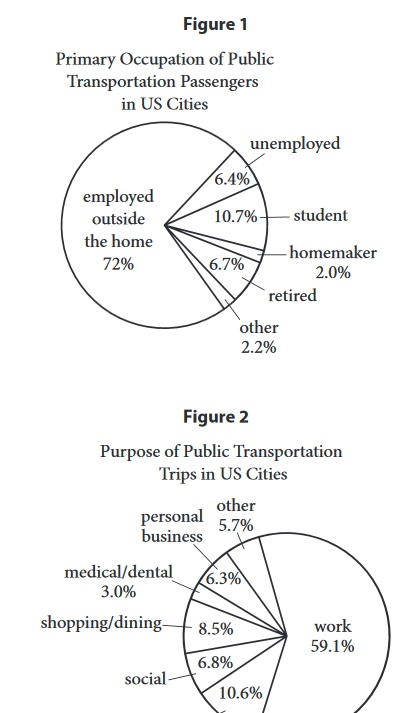
Which choice is supported by the data in the first figure?

  1. The number of students using public transportation is greater than the number of retirees using public transportation.
  2. The number of employed people using public transportation and the number of unemployed people using public transportation is roughly the same.
  3. People employed outside the home are less likely to use public transportation than are homemakers.
  4. Unemployed people use public transportation less often than do people employed outside the home.

Answer(s): A

Explanation:

Choice [The number of students using public transportation is...] is the best answer. Figure 1 shows that 10.7% of public transportation passengers are students and 6.7% of public transportation passengers are retirees. Thus, more students than retirees use public transportation. Choices [The number of employed people using public transportation and...] and [People employed outside the home are less...] are incorrect because figure 1 shows that more employed than unemployed people use public transportation and that more employed people than homemakers use public transportation. Choice [Unemployed people use public transportation less...] is incorrect because figure 1 does not explain how frequently passengers use public transportation; it only identifies public transportation passengers by their primary occupation.


Viewing page 30 of 117
Viewing questions 233 - 240 out of 924 questions


Post your Comments and Discuss College Board SAT exam prep with other Community members:

AI Tutor AI Tutor 👋 I’m here to help!