 Topic 1
QUESTION: 1
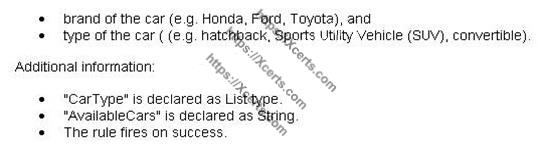
A car manufacturer wants to display a list of available cars based on what the customer
chooses for the:
What should be the rule fragment/condition written for this?
A. value(AvailableCars) not in list(CarType) [Fragment is false]
B. value(AvailableCars) not in propval(CarType) [Fragment is false]
C. propval(AvailableCars) not in list(CarType) [Fragment is false]
D. propval(AvailableCars) not in parent(CarType) [Fragment is false]
Answer(s): C
QUESTION: 2
A modeler is working on a rule to determine if the customer's location is one of the 10 possible
locations where a discounted offer can be given. What type of property SHOULD be used for
storing all 10 of the locations in one property?
A. List property
B. String property
C. Location property
D. String Array property
Answer(s): A
QUESTION: 3
A company wants to give its customers a 10% volume discount for its Professional Services if
the order totals 100 or more hours. The $250 hourly (undiscounted) base rate for Professional
Services is retained in an Option Item under an Option Class called base rates in the model and
is never displayed in the UI. Rules will be used to set the UI: PRICE for the Professional
Services Option Item displayed in the UI based on the quantity of hours ordered and the UI:
PRICE of the hidden base rate Option Item.
Review the following images which show what is presented to the user in the UI with and
without a discount.
Overview of the IBM Sterling Configurator V9.1, Deployment Exam Exam
The C2050-240 certification validates technical proficiency for Sterling Configurator implementers and solution architects tasked with deploying complex product configuration environments. Candidates must demonstrate expertise in configuring the Sterling Configurator Modeling Workbench to define rules, constraints, and bill of materials structures. The exam assesses competency in integrating Sterling Configurator with Sterling Order Management via XML messaging and API interactions. Key technical objectives include managing global rules, troubleshooting the runtime engine, and configuring UI layouts within the Configurator runtime framework. Furthermore, successful examinees must exhibit deep knowledge of performance tuning, database interaction patterns, and multi-tenant deployment strategies within the IBM Sterling enterprise ecosystem.