Free AZ-700 Exam Braindumps
Designing and Implementing Microsoft Azure Networking Solutions Questions 91–95 (page: 20)

Updated On: 10-Feb-2026
View Related Case Study

Note: This question is part of a series of questions that present the same scenario. Each question in the series contains a unique solution that might meet the stated goals. Some question sets might have more than one correct solution, while others might not have a correct solution.

After you answer a question in this section, you will NOT be able to return to it. As a result, these questions will not appear in the review screen.

You have two Azure virtual networks named Vnet1 and Vnet2.

You have a Windows 10 device named Client1 that connects to Vnet1 by using a Point-to-Site (P2S) IKEv2 VPN.

You implement virtual network peering between Vnet1 and Vnet2. Vnet1 allows gateway transit. Vnet2 can use the remote gateway.

You discover that Client1 cannot communicate with Vnet2.

You need to ensure that Client1 can communicate with Vnet2.

Solution: You resize the gateway of Vnet1 to a larger SKU.

Does this meet the goal?

  1. Yes
  2. No

Answer(s): B

Explanation:

The VPN client must be downloaded again if any changes are made to VNet peering or the network topology.


Reference:

https://docs.microsoft.com/en-us/azure/vpn-gateway/vpn-gateway-about-point-to-site-routing


View Related Case Study

You have an Azure subscription that contains the virtual networks shown in the following table.
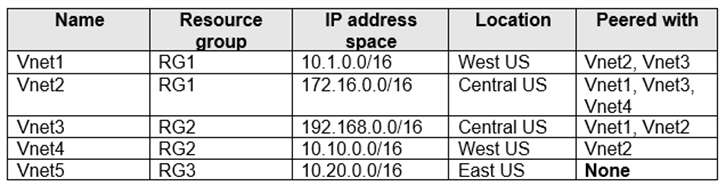


You plan to deploy an Azure firewall named AF1 to RG1 in the West US Azure region.

To which virtual networks can you deploy AF1?

  1. Vnet1 and Vnet4 only
  2. Vnet1, Vnet2, Vnet3, and Vnet4
  3. Vnet1 only
  4. Vnet1 and Vnet2 only
  5. Vnet1, Vnet2, and Vnet4 only

Answer(s): C

Explanation:

Azure Firewall operates in a single VNET.
Azure Firewall is a regional service.
Yes. Vnet1: Same VNET and same region.
No. Vnet2: Same Resource Group but different VNET and different region. Must be in the same region.
No. Vnet3: Different VNET, different region. Must be in the same region.
No. Vnet4: Different VNET, same region.


Reference:

https://docs.microsoft.com/en-us/azure/architecture/networking/guide/well-architected-framework-azure-firewall


View Related Case Study

HOTSPOT (Drag and Drop is not supported)

You have two Azure App Service instances that host the web apps shown the following table.


You deploy an Azure 2 that has one public frontend IP address and two backend pools.

You need to publish all the web apps to the application gateway. Requests must be routed based on the HTTP host headers.

What is the minimum number of listeners and routing rules you should configure? To answer, select the appropriate options in the answer area.

Note: Each correct selection is worth one point.

Hot Area:

  1. See Explanation section for answer.

Answer(s): A

Explanation:


Box 1: 2
Listeners

One listener for As1.contoso.com, and one listener for As2.contoso.com.

Note: Multiple site hosting enables you to configure more than one web application on the same port of application gateways using public-facing listeners. It allows you to configure a more efficient topology for your deployments by adding up to 100+ websites to one application gateway. Each website can be directed to its own backend pool. For example, three domains, contoso.com, fabrikam.com, and adatum.com, point to the IP address of the application gateway. You'd create three multi-site listeners and configure each listener for the respective port and protocol setting.

You can also define wildcard host names in a multi-site listener and up to 5 host names per listener.

Box 2: 2
Routing rules

Application Gateway request routing rules
Rule type
When you create a rule, you choose between basic and path-based.

* Choose basic if you want to forward all requests on the associated listener (for example, blog.contoso.com/*) to a single backend pool.
* Choose path-based if you want to route requests from specific URL paths to specific backend pools. The path pattern is applied only to the path of the URL, not to its query parameters.

Associated backend pool
Associate to the rule the backend pool that contains the backend targets that serve requests that the listener receives.
* For a basic rule, only one backend pool is allowed. All requests on the associated listener are forwarded to that backend pool.

* For a path-based rule, add multiple backend pools that correspond to each URL path. The requests that match the URL path that's entered are forwarded to the corresponding backend pool. Also, add a default backend pool. Requests that don't match any URL path in the rule are forwarded to that pool.


Reference:

https://learn.microsoft.com/en-us/azure/application-gateway/multiple-site-overview


View Related Case Study

Your company has four branch offices and an Azure subscription. The subscription contains an Azure VPN gateway named GW1.

The branch offices are configured as shown in the following table.


The branch office routers provide internet connectivity and Site-to-Site VPN connections to GW1.

The users in Branch1 report that they can connect to internet resources, but cannot access Azure resources.

You need to ensure that the Branch1 users can connect to the Azure resources. The solution must meet the following requirements:

Minimize downtime for all users.

Minimize administrative effort.

What should you do first?

  1. Recreate LNG1.
  2. Reset RTR1.
  3. Reset Connection1.
  4. Reset GW1.

Answer(s): C

Explanation:

Azure VPN gateway Site-to-Site VPN connections local network gateway Resetting an Azure VPN gateway or gateway connection is helpful if you lose cross-premises VPN connectivity on one or more site-to-site VPN tunnels. In this situation, your on-premises VPN devices are all working correctly, but aren't able to establish IPsec tunnels with the Azure VPN gateways.
Connection reset

When you select to reset a connection, the gateway doesn't reboot. Only the selected connection is reset and restored.
Incorrect:
Not D: Resetting GW1 would affect all VPN connections.
Gateway reset
A VPN gateway is composed of two VM instances running in an active-standby configuration.
When you reset the gateway, it reboots the gateway, and then reapplies the cross-premises configurations to it.


Reference:

https://learn.microsoft.com/en-us/azure/vpn-gateway/reset-gateway


View Related Case Study

DRAG DROP (Drag and Drop is not supported)

You have an Azure subscription that contains a virtual network named Vnet1 and an Azure SQL database named SQL1. SQL1 has a private endpoint on Vnet1.

You have a partner company named Fabrikam, Inc. Fabrikam has an Azure subscription that contains a virtual network named Vnet2 and a virtual machine named VM1. VM1 is connected to Vnet2.

You need to provide VM1 with access to SQL1 by using an Azure Private Link service.

What should you implement on each virtual network? To answer, drag the appropriate resources to the correct virtual networks. Each resource may be used once, more than once, or not at all. You may need to drag the split bar between panes or scroll to view content.

Note: Each correct selection is worth one point.

Select and Place:

  1. See Explanation section for answer.

Answer(s): A

Explanation:


Box 1: A private endpoint
You can connect to an Azure SQL server using an Azure Private Endpoint Create an Azure SQL server and private endpoint.
Test connectivity to the SQL server private endpoint.

Note: Azure Private endpoint is the fundamental building block for Private Link in Azure. It enables Azure resources, like virtual machines (VMs), to privately and securely communicate with Private Link resources such as Azure SQL server.

Box 2: A peering link
Use cases of Private Link for Azure SQL Database
Clients can connect to the Private endpoint from the same virtual network, peered virtual network in same region, or via virtual network to virtual network connection across regions. Additionally, clients can connect from on-premises using ExpressRoute, private peering, or VPN tunneling. Below is a simplified diagram showing the common use cases.


Reference:

https://learn.microsoft.com/en-us/azure/private-link/tutorial-private-endpoint-sql-portal https://learn.microsoft.com/en-us/azure/azure-sql/database/private-endpoint-overview


Viewing page 20 of 75
Viewing questions 96 - 100 out of 396 questions


Post your Comments and Discuss Microsoft AZ-700 exam prep with other Community members:

AI Tutor AI Tutor 👋 I’m here to help!