Microsoft SC-401 Exam Questions
Administering Information Security in Microsoft 365 (Page 2 )

Updated On: 19-Apr-2026
View Related Case Study

DRAG DROP (Drag and Drop is not supported)

You need to meet the technical requirements for the Site1 documents.

Which three actions should you perform in sequence? To answer, move the appropriate actions from the list of actions to the answer area and arrange them in the correct order.

Select and Place:

  1. See Explanation section for answer.

Answer(s): A

Explanation:


The goal is to automatically label documents in Site1 that contain credit card numbers. To achieve this, we need a sensitivity label with an auto-labeling policy based on a sensitive info type that detects credit card numbers.

Step 1: Create a Sensitive Info Type
A sensitive info type is needed to detect credit card numbers in documents. Microsoft Purview includes built-in sensitive info types for credit card numbers, but we can also create a custom one if necessary.

Step 2: Create a Sensitivity Label
A sensitivity label is required to classify and protect documents containing sensitive information. This label can apply encryption, watermarking, or access controls to credit card data.

Step 3: Create an Auto-Labeling Policy
An auto-labeling policy ensures that the sensitivity label is applied automatically when credit card numbers are detected in Site1.
This policy is configured to scan files and automatically apply the correct sensitivity label.


View Related Case Study

You need to meet the technical requirements for the creation of the sensitivity labels.

To which user or users must you assign the Sensitivity Label Administrator role?

  1. Admin1 only
  2. Admin1 and Admin4 only
  3. Admin1 and Admin5 only
  4. Admin1, Admin2, and Admin3 only
  5. Admin1, Admin2, Admin4, and Admin5 only

Answer(s): D

Explanation:

To meet the requirement that all administrative users must be able to create Microsoft 365 sensitivity labels, we need to assign the Sensitivity Label Administrator role to the correct users.
Sensitivity Label Administrator Role Responsibilities
This role allows users to:
Create and manage sensitivity labels in Microsoft Purview.
Publish and configure auto-labeling policies.
Modify label encryption and content marking settings.
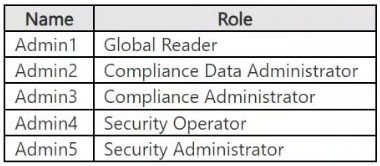
Review of Admin Roles from the Table:


Users that must be assigned the Sensitivity Label Administrator role:
Admin2 (Compliance Data Administrator)
Admin3 (Compliance Administrator)
Admin1 (Global Reader) (should be assigned this role to fulfill the requirement that all admins can create labels).
Implement information protection
Question Set 2


View Related Case Study

You have a Microsoft 365 E5 subscription that contains a Microsoft Teams channel named Channel1.
Channel1 contains research and development documents.

You plan to implement Microsoft 365 Copilot for the subscription.

You need to prevent the contents of files stored in Channel1 from being included in answers generated by Copilot and shown to unauthorized users.

What should you use?

  1. data loss prevention (DLP)
  2. Microsoft Purview insider risk management
  3. Microsoft Purview Information Barriers (IBs)
  4. sensitivity labels

Answer(s): D

Explanation:

To prevent the contents of files stored in Channel1 from being included in Microsoft 365 Copilot responses and ensure unauthorized users cannot access them, you should use Microsoft Purview Sensitivity Labels.
Sensitivity labels allow you to classify, protect, and restrict access to sensitive files. You can configure label- based encryption and access control policies to ensure that only authorized users can access or interact with the files in Channel1. Microsoft 365 Copilot respects sensitivity labels, meaning if a file is labeled with restricted permissions, Copilot will not use it in generated responses for unauthorized users.


View Related Case Study

DRAG DROP (Drag and Drop is not supported)

You have a Microsoft 365 E5 subscription that uses Microsoft Defender for Cloud Apps.

You plan to deploy a Defender for Cloud Apps file policy that will be triggered when the following conditions are met:

A file is shared externally.
A file is labeled as internal only.

Which filter should you use for each condition? To answer, drag the appropriate filters to the correct conditions. Each filter may be used once, more than once, or not at all. You may need to drag the split bar between panes or scroll to view content.

Note: Each correct selection is worth one point.

Select and Place:

  1. See Explanation section for answer.

Answer(s): A

Explanation:


The "Access level" filter in Microsoft Defender for Cloud Apps helps identify how a file is shared, including whether it is shared externally outside the organization.

The "Sensitivity label" filter is used to track files that have been classified with specific Microsoft Purview sensitivity labels, such as Internal only, ensuring that files with internal classifications are properly monitored and protected.

The "Collaborators" filter tracks users who have access but does not indicate external sharing. The "Matched policy" filter identifies files based on predefined policies but does not directly filter for external sharing or sensitivity labels.


View Related Case Study

HOTSPOT (Drag and Drop is not supported)

You have a Microsoft 365 E5 subscription that contains three DOCX files named File1, File2, and File3.

You create the sensitivity labels shown in the following table.


You apply the labels to the files as shown in the following table.


You ask Microsoft 365 Copilot to summarize the files, and you receive the results shown in the following table.


For each of the following statements, select Yes if the statement is true. Otherwise, select No.

Note: Each correct selection is worth one point.

Hot Area:

  1. See Explanation section for answer.

Answer(s): A

Explanation:


Summary1 is based on File1 and File3. File3 has Label2 applied, and Label2 has content marking enabled, meaning the label persists in derived content. Since File3 contributes to Summary1, Summary1 inherits the sensitivity label from File3.

Summary2 is based on File2, which has Label1 applied. Label1 grants viewer permissions to authenticated users, but content marking is disabled. Since the label still applies to the content, Summary2 inherits Label1.

Summary3 is based on File1, File2, and File3. File2 has Label1 applied, and File3 has Label2 applied, meaning the summary will inherit at least one of these labels. Since at least one labeled file is used, the summary inherits a sensitivity label.


View Related Case Study

You have a Microsoft 365 E5 subscription.

You need to create a sensitivity label named Label1. The solution must ensure that users can use Microsoft 365 Copilot to summarize files that have Label1 applied.

Which permission should you select for Label1?

  1. Export content(EXPORT)
  2. Copy and extract content(EXTRACT)
  3. Edit content(DOCEDIT)
  4. View rights(VIEW)

Answer(s): B

Explanation:

To allow Microsoft 365 Copilot to summarize files that have Label1 applied, the label must grant permission to extract content from the document. The correct permission for this is Copy and extract content (EXTRACT).
Microsoft 365 Copilot requires access to read and process content in documents to generate summaries. The EXTRACT permission allows users (and AI tools like Copilot) to copy and extract content for processing while still maintaining the protection applied by the sensitivity label.


View Related Case Study

HOTSPOT (Drag and Drop is not supported)

You have a Microsoft 365 sensitivity label that is published to all the users in your Microsoft Entra tenant as shown in the following exhibit.

For each of the following statements, select Yes if the statement is true. Otherwise, select No.

Hot Area:

  1. See Explanation section for answer.

Answer(s): A

Explanation:


Statement 1 - No. The sensitivity label includes content marking (watermark: INTERNAL), but it only applies to documents where the label is manually or automatically applied, not to all documents by default.

Statement 2 - No. The sensitivity label only specifies a watermark, not a header. If a header marking was configured, it would explicitly appear in the label settings.

Statement 3 - No. There is no indication that auto-labeling is configured to apply the label only to documents with the word "rebranding". Auto-labeling is an optional setting that needs explicit configuration.


View Related Case Study

HOTSPOT (Drag and Drop is not supported)

You have a Microsoft 365 E5 tenant that contains a sensitivity label named label1.

You plan to enable co-authoring for encrypted files.

You need to ensure that files that have label1 applied support co-authoring.

Which two settings should you modify? To answer, select the settings in the answer area.

Note: Each correct selection is worth one point.

Hot Area:

  1. See Explanation section for answer.

Answer(s): A

Explanation:


Double Key Encryption (DKE) prevents co-authoring because Microsoft 365 services cannot process encrypted content. You must disable this setting to allow real-time collaboration.

Co-authoring requires that permissions are explicitly assigned to users or groups. Without defined permissions, users won't be able to access or co-author the document.


Viewing page 2 of 27
Viewing questions 9 - 16 out of 264 questions


Post your Comments and Discuss Microsoft SC-401 exam dumps with other Community members:

SC-401 Exam Discussions & Posts

AI Tutor AI Tutor 👋 I’m here to help!