Free SAT Exam Braindumps
Scholastic Aptitude Test Exam Questions 193–200 (page: 26)

Updated On: 31-Jul-2026

This passage is adapted from Francis J. Flynn and Gabrielle S. Adams, "Money Can't Buy Love: Asymmetric Beliefs about Gift Price and Feelings of Appreciation." Copyright 2008 by Elsevier Inc. Every day, millions of shoppers hit the stores in full force `" both online and on foot `" searching frantically for the perfect gift. Last year, Americans spent over $30 billion at retail stores in the month of December alone. Aside from purchasing holiday gifts, most people regularly buy presents for other occasions throughout the year, including weddings, birthdays, anniversaries, graduations, and baby showers. This frequent experience of gift-giving can engender ambivalent feelings in gift-givers. Many relish the opportunity to buy presents because gift-giving offers a powerful means to build stronger bonds with one's closest peers. At the same time, many dread the thought of buying gifts; they worry that their purchases will disappoint rather than delight the intended recipients. Anthropologists describe gift-giving as a positive social process, serving various political, religious, and psychological functions. Economists, however, offer a less favorable view. According to Waldfogel (1993), gift-giving represents an objective waste of resources. People buy gifts that recipients would not choose to buy on their own, or at least not spend as much money to purchase (a phenomenon referred to as `˜`˜the deadweight loss of Christmas`). To wit, givers are likely to spend $100 to purchase a gift that receivers would spend only $80 to buy themselves. This `˜`˜deadweight loss` suggests that gift-givers are not very good at predicting what gifts others will appreciate. That in itself is not surprising to social psychologists. Research has found that people often struggle to take account of others' perspectives `" their insights are subject to egocentrism, social projection, and multiple attribution errors.
What is surprising is that gift-givers have considerable experience acting as both gift-givers and gift-recipients, but nevertheless tend to overspend each time they set out to purchase a meaningful gift. In the present research, we propose a unique psychological explanation for this overspending problem `" that is, that gift- givers equate how much they spend with how much recipients will appreciate the gift (the more expensive the gift, the stronger a gift-recipient's feelings of appreciation). Although a link between gift price and feelings of appreciation might seem intuitive to gift-givers, such an assumption may be unfounded. Indeed, we propose that gift-recipients will be less inclined to base their feelings of appreciation on the magnitude of a gift than givers assume.
Why do gift-givers assume that gift price is closely linked to gift-recipients' feelings of appreciation? Perhaps givers believe that bigger (that is, more expensive) gifts convey stronger signals of thoughtfulness and consideration. According to Camerer (1988) and others, gift-giving represents a symbolic ritual, whereby gift-givers attempt to signal their positive attitudes toward the intended recipient and their willingness to invest resources in a future relationship. In this sense, gift- givers may be motivated to spend more money on a gift in order to send a `stronger signal` to their intended recipient. As for gift-recipients, they may not construe smaller and larger gifts as representing smaller and larger signals of thoughtfulness and consideration. The notion of gift-givers and gift-recipients being unable to account for the other party's perspective seems puzzling because people slip in and out of these roles every day, and, in some cases, multiple times in the course of the same day. Yet, despite the extensive experience that people have as both givers and receivers, they often struggle to transfer information gained from one role (for example, as a giver) and apply it in another, complementary role (for example, as a receiver). In theoretical terms, people fail to utilize information about their own preferences and experiences in order to produce more efficient outcomes in their exchange relations. In practical terms, people spend hundreds of dollars each year on gifts, but somehow never learn to calibrate their gift expenditures according to personal insight.
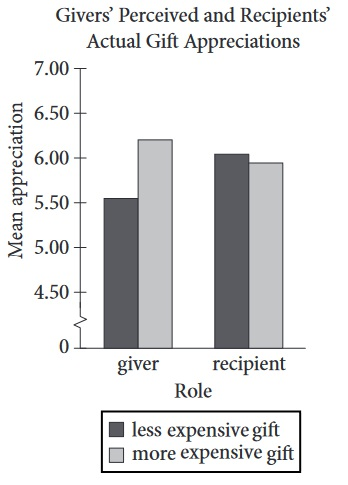
The authors indicate that people value gift-giving because they feel it:

  1. functions as a form of self-expression.
  2. is an inexpensive way to show appreciation.
  3. requires the gift-recipient to reciprocate.
  4. can serve to strengthen a relationship.

Answer(s): D

Explanation:

Choice [can serve to strengthen a relationship.] is the best answer. In sentence 5 of paragraph 1, the authors clearly state that some people believe gift-giving can help a relationship because it offers a powerful means to build stronger bonds with one's closest peers. Choice [functions as a form of self-expression.] is incorrect because even though the authors state that some shoppers make their choices based on egocentrism, (sentence 8 of paragraph 2) there is no evidence in the passage that people view shopping as a form of self-expression. Choice [is an inexpensive way to show appreciation.] is incorrect because the passage implies that shopping is an expensive habit. Choice [requires the gift-recipient to reciprocate.] is incorrect because the passage states that most people have purchased and received gifts, but it never implies that people are required to reciprocate the gift- giving process.


This passage is adapted from Francis J. Flynn and Gabrielle S. Adams, "Money Can't Buy Love: Asymmetric Beliefs about Gift Price and Feelings of Appreciation." Copyright 2008 by Elsevier Inc. Every day, millions of shoppers hit the stores in full force `" both online and on foot `" searching frantically for the perfect gift. Last year, Americans spent over $30 billion at retail stores in the month of December alone. Aside from purchasing holiday gifts, most people regularly buy presents for other occasions throughout the year, including weddings, birthdays, anniversaries, graduations, and baby showers. This frequent experience of gift-giving can engender ambivalent feelings in gift-givers. Many relish the opportunity to buy presents because gift-giving offers a powerful means to build stronger bonds with one's closest peers. At the same time, many dread the thought of buying gifts; they worry that their purchases will disappoint rather than delight the intended recipients. Anthropologists describe gift-giving as a positive social process, serving various political, religious, and psychological functions. Economists, however, offer a less favorable view. According to Waldfogel (1993), gift-giving represents an objective waste of resources. People buy gifts that recipients would not choose to buy on their own, or at least not spend as much money to purchase (a phenomenon referred to as `˜`˜the deadweight loss of Christmas`). To wit, givers are likely to spend $100 to purchase a gift that receivers would spend only $80 to buy themselves. This `˜`˜deadweight loss` suggests that gift-givers are not very good at predicting what gifts others will appreciate. That in itself is not surprising to social psychologists. Research has found that people often struggle to take account of others' perspectives `" their insights are subject to egocentrism, social projection, and multiple attribution errors.
What is surprising is that gift-givers have considerable experience acting as both gift-givers and gift-recipients, but nevertheless tend to overspend each time they set out to purchase a meaningful gift. In the present research, we propose a unique psychological explanation for this overspending problem `" that is, that gift- givers equate how much they spend with how much recipients will appreciate the gift (the more expensive the gift, the stronger a gift-recipient's feelings of appreciation). Although a link between gift price and feelings of appreciation might seem intuitive to gift-givers, such an assumption may be unfounded. Indeed, we propose that gift-recipients will be less inclined to base their feelings of appreciation on the magnitude of a gift than givers assume.
Why do gift-givers assume that gift price is closely linked to gift-recipients' feelings of appreciation? Perhaps givers believe that bigger (that is, more expensive) gifts convey stronger signals of thoughtfulness and consideration. According to Camerer (1988) and others, gift-giving represents a symbolic ritual, whereby gift-givers attempt to signal their positive attitudes toward the intended recipient and their willingness to invest resources in a future relationship. In this sense, gift- givers may be motivated to spend more money on a gift in order to send a `stronger signal` to their intended recipient. As for gift-recipients, they may not construe smaller and larger gifts as representing smaller and larger signals of thoughtfulness and consideration. The notion of gift-givers and gift-recipients being unable to account for the other party's perspective seems puzzling because people slip in and out of these roles every day, and, in some cases, multiple times in the course of the same day. Yet, despite the extensive experience that people have as both givers and receivers, they often struggle to transfer information gained from one role (for example, as a giver) and apply it in another, complementary role (for example, as a receiver). In theoretical terms, people fail to utilize information about their own preferences and experiences in order to produce more efficient outcomes in their exchange relations. In practical terms, people spend hundreds of dollars each year on gifts, but somehow never learn to calibrate their gift expenditures according to personal insight.

The `social psychologists` mentioned in paragraph 2 would likely describe the `deadweight loss` phenomenon as:

  1. predictable.
  2. questionable.
  3. disturbing.
  4. unprecedented.

Answer(s): A

Explanation:

Choice predictable is the best answer. The deadweight loss mentioned in the second paragraph is the significant monetary difference between what a gift-giver would pay for something and what a gift-recipient would pay for the same item. That difference would be predictable to social psychologists, whose research has found that people often struggle to take account of others' perspectives " their insights are subject to egocentrism, social projection, and multiple attribution errors (sentence 8 of paragraph 2). Other choices are all incorrect because sentence 8 of paragraph 2 makes clear that social psychologists would expect a disconnect between gift-givers and gift- recipients, not that they would question it, be disturbed by it, or find it surprising or unprecedented.


This passage is adapted from Francis J. Flynn and Gabrielle S. Adams, "Money Can't Buy Love: Asymmetric Beliefs about Gift Price and Feelings of Appreciation." Copyright 2008 by Elsevier Inc. Every day, millions of shoppers hit the stores in full force `" both online and on foot `" searching frantically for the perfect gift. Last year, Americans spent over $30 billion at retail stores in the month of December alone. Aside from purchasing holiday gifts, most people regularly buy presents for other occasions throughout the year, including weddings, birthdays, anniversaries, graduations, and baby showers. This frequent experience of gift-giving can engender ambivalent feelings in gift-givers. Many relish the opportunity to buy presents because gift-giving offers a powerful means to build stronger bonds with one's closest peers. At the same time, many dread the thought of buying gifts; they worry that their purchases will disappoint rather than delight the intended recipients. Anthropologists describe gift-giving as a positive social process, serving various political, religious, and psychological functions. Economists, however, offer a less favorable view. According to Waldfogel (1993), gift-giving represents an objective waste of resources. People buy gifts that recipients would not choose to buy on their own, or at least not spend as much money to purchase (a phenomenon referred to as `˜`˜the deadweight loss of Christmas`). To wit, givers are likely to spend $100 to purchase a gift that receivers would spend only $80 to buy themselves. This `˜`˜deadweight loss` suggests that gift-givers are not very good at predicting what gifts others will appreciate. That in itself is not surprising to social psychologists. Research has found that people often struggle to take account of others' perspectives `" their insights are subject to egocentrism, social projection, and multiple attribution errors.
What is surprising is that gift-givers have considerable experience acting as both gift-givers and gift-recipients, but nevertheless tend to overspend each time they set out to purchase a meaningful gift. In the present research, we propose a unique psychological explanation for this overspending problem `" that is, that gift- givers equate how much they spend with how much recipients will appreciate the gift (the more expensive the gift, the stronger a gift-recipient's feelings of appreciation). Although a link between gift price and feelings of appreciation might seem intuitive to gift-givers, such an assumption may be unfounded. Indeed, we propose that gift-recipients will be less inclined to base their feelings of appreciation on the magnitude of a gift than givers assume.
Why do gift-givers assume that gift price is closely linked to gift-recipients' feelings of appreciation? Perhaps givers believe that bigger (that is, more expensive) gifts convey stronger signals of thoughtfulness and consideration. According to Camerer (1988) and others, gift-giving represents a symbolic ritual, whereby gift-givers attempt to signal their positive attitudes toward the intended recipient and their willingness to invest resources in a future relationship. In this sense, gift- givers may be motivated to spend more money on a gift in order to send a `stronger signal` to their intended recipient. As for gift-recipients, they may not construe smaller and larger gifts as representing smaller and larger signals of thoughtfulness and consideration. The notion of gift-givers and gift-recipients being unable to account for the other party's perspective seems puzzling because people slip in and out of these roles every day, and, in some cases, multiple times in the course of the same day. Yet, despite the extensive experience that people have as both givers and receivers, they often struggle to transfer information gained from one role (for example, as a giver) and apply it in another, complementary role (for example, as a receiver). In theoretical terms, people fail to utilize information about their own preferences and experiences in order to produce more efficient outcomes in their exchange relations. In practical terms, people spend hundreds of dollars each year on gifts, but somehow never learn to calibrate their gift expenditures according to personal insight.

The passage indicates that the assumption made by gift-givers in sentence 2 of paragraph 3 may be:

  1. insincere.
  2. unreasonable.
  3. incorrect.
  4. substantiated.

Answer(s): C

Explanation:

Choice [incorrect] is the best answer. Sentence 2 of paragraph 3 suggests that gift-givers assume a correlation between the cost of a gift and how well-received it will be: ¦gift-givers equate how much they spend with how much recipients will appreciate the gift (the more expensive the gift, the stronger a gift-recipient's feelings of appreciation). However, the authors suggest this assumption may be incorrect or unfounded (sentence 3 of paragraph 3), as gift-recipients may not construe smaller and larger gifts as representing smaller and larger signals of thoughtfulness and consideration (sentence 5 of paragraph 4). Other choices are all incorrect because the passage neither states nor implies that the gift-givers' assumption is insincere, unreasonable, or substantiated.


This passage is adapted from Francis J. Flynn and Gabrielle S. Adams, "Money Can't Buy Love: Asymmetric Beliefs about Gift Price and Feelings of Appreciation." Copyright 2008 by Elsevier Inc. Every day, millions of shoppers hit the stores in full force `" both online and on foot `" searching frantically for the perfect gift. Last year, Americans spent over $30 billion at retail stores in the month of December alone. Aside from purchasing holiday gifts, most people regularly buy presents for other occasions throughout the year, including weddings, birthdays, anniversaries, graduations, and baby showers. This frequent experience of gift-giving can engender ambivalent feelings in gift-givers. Many relish the opportunity to buy presents because gift-giving offers a powerful means to build stronger bonds with one's closest peers. At the same time, many dread the thought of buying gifts; they worry that their purchases will disappoint rather than delight the intended recipients. Anthropologists describe gift-giving as a positive social process, serving various political, religious, and psychological functions. Economists, however, offer a less favorable view. According to Waldfogel (1993), gift-giving represents an objective waste of resources. People buy gifts that recipients would not choose to buy on their own, or at least not spend as much money to purchase (a phenomenon referred to as `˜`˜the deadweight loss of Christmas`). To wit, givers are likely to spend $100 to purchase a gift that receivers would spend only $80 to buy themselves. This `˜`˜deadweight loss` suggests that gift-givers are not very good at predicting what gifts others will appreciate. That in itself is not surprising to social psychologists. Research has found that people often struggle to take account of others' perspectives `" their insights are subject to egocentrism, social projection, and multiple attribution errors.
What is surprising is that gift-givers have considerable experience acting as both gift-givers and gift-recipients, but nevertheless tend to overspend each time they set out to purchase a meaningful gift. In the present research, we propose a unique psychological explanation for this overspending problem `" that is, that gift- givers equate how much they spend with how much recipients will appreciate the gift (the more expensive the gift, the stronger a gift-recipient's feelings of appreciation). Although a link between gift price and feelings of appreciation might seem intuitive to gift-givers, such an assumption may be unfounded. Indeed, we propose that gift-recipients will be less inclined to base their feelings of appreciation on the magnitude of a gift than givers assume.
Why do gift-givers assume that gift price is closely linked to gift-recipients' feelings of appreciation? Perhaps givers believe that bigger (that is, more expensive) gifts convey stronger signals of thoughtfulness and consideration. According to Camerer (1988) and others, gift-giving represents a symbolic ritual, whereby gift-givers attempt to signal their positive attitudes toward the intended recipient and their willingness to invest resources in a future relationship. In this sense, gift- givers may be motivated to spend more money on a gift in order to send a `stronger signal` to their intended recipient. As for gift-recipients, they may not construe smaller and larger gifts as representing smaller and larger signals of thoughtfulness and consideration. The notion of gift-givers and gift-recipients being unable to account for the other party's perspective seems puzzling because people slip in and out of these roles every day, and, in some cases, multiple times in the course of the same day. Yet, despite the extensive experience that people have as both givers and receivers, they often struggle to transfer information gained from one role (for example, as a giver) and apply it in another, complementary role (for example, as a receiver). In theoretical terms, people fail to utilize information about their own preferences and experiences in order to produce more efficient outcomes in their exchange relations. In practical terms, people spend hundreds of dollars each year on gifts, but somehow never learn to calibrate their gift expenditures according to personal insight.

As it is used in sentence 2 of paragraph 4, `convey` most nearly means:

  1. transport.
  2. counteract.
  3. exchange.
  4. communicate.

Answer(s): D

Explanation:

Choice [communicate] and is the best answer. Sentence 2 of paragraph 4 states that Perhaps givers believe that bigger (that is, more expensive) gifts convey stronger signals of thoughtfulness and consideration. In this context, saying that more expensive gifts convey stronger signals means the gifts send, or communicate, stronger signals to the recipients. Other choices are incorrect because in this context, to convey something does not mean to transport it (physically move something), counteract it (act in opposition to something), or exchange it (trade one thing for another).


This passage is adapted from Francis J. Flynn and Gabrielle S. Adams, "Money Can't Buy Love: Asymmetric Beliefs about Gift Price and Feelings of Appreciation." Copyright 2008 by Elsevier Inc. Every day, millions of shoppers hit the stores in full force `" both online and on foot `" searching frantically for the perfect gift. Last year, Americans spent over $30 billion at retail stores in the month of December alone. Aside from purchasing holiday gifts, most people regularly buy presents for other occasions throughout the year, including weddings, birthdays, anniversaries, graduations, and baby showers. This frequent experience of gift-giving can engender ambivalent feelings in gift-givers. Many relish the opportunity to buy presents because gift-giving offers a powerful means to build stronger bonds with one's closest peers. At the same time, many dread the thought of buying gifts; they worry that their purchases will disappoint rather than delight the intended recipients. Anthropologists describe gift-giving as a positive social process, serving various political, religious, and psychological functions. Economists, however, offer a less favorable view. According to Waldfogel (1993), gift-giving represents an objective waste of resources. People buy gifts that recipients would not choose to buy on their own, or at least not spend as much money to purchase (a phenomenon referred to as `˜`˜the deadweight loss of Christmas`). To wit, givers are likely to spend $100 to purchase a gift that receivers would spend only $80 to buy themselves. This `˜`˜deadweight loss` suggests that gift-givers are not very good at predicting what gifts others will appreciate. That in itself is not surprising to social psychologists. Research has found that people often struggle to take account of others' perspectives `" their insights are subject to egocentrism, social projection, and multiple attribution errors.
What is surprising is that gift-givers have considerable experience acting as both gift-givers and gift-recipients, but nevertheless tend to overspend each time they set out to purchase a meaningful gift. In the present research, we propose a unique psychological explanation for this overspending problem `" that is, that gift- givers equate how much they spend with how much recipients will appreciate the gift (the more expensive the gift, the stronger a gift-recipient's feelings of appreciation). Although a link between gift price and feelings of appreciation might seem intuitive to gift-givers, such an assumption may be unfounded. Indeed, we propose that gift-recipients will be less inclined to base their feelings of appreciation on the magnitude of a gift than givers assume.
Why do gift-givers assume that gift price is closely linked to gift-recipients' feelings of appreciation? Perhaps givers believe that bigger (that is, more expensive) gifts convey stronger signals of thoughtfulness and consideration. According to Camerer (1988) and others, gift-giving represents a symbolic ritual, whereby gift-givers attempt to signal their positive attitudes toward the intended recipient and their willingness to invest resources in a future relationship. In this sense, gift- givers may be motivated to spend more money on a gift in order to send a `stronger signal` to their intended recipient. As for gift-recipients, they may not construe smaller and larger gifts as representing smaller and larger signals of thoughtfulness and consideration. The notion of gift-givers and gift-recipients being unable to account for the other party's perspective seems puzzling because people slip in and out of these roles every day, and, in some cases, multiple times in the course of the same day. Yet, despite the extensive experience that people have as both givers and receivers, they often struggle to transfer information gained from one role (for example, as a giver) and apply it in another, complementary role (for example, as a receiver). In theoretical terms, people fail to utilize information about their own preferences and experiences in order to produce more efficient outcomes in their exchange relations. In practical terms, people spend hundreds of dollars each year on gifts, but somehow never learn to calibrate their gift expenditures according to personal insight.

The authors refer to work by Camerer and others (sentence 3 of paragraph 4) in order to:

  1. offer an explanation.
  2. introduce an argument.
  3. question a motive.
  4. support a conclusion.

Answer(s): D

Explanation:

Choice [offer an explanation] is the best answer. The paragraph examines how gift-givers believe expensive gifts are more thoughtful than less expensive gifts and will be more valued by recipients. The work of Camerer and others offers an explanation for the gift-givers' reasoning: gift-givers attempt to signal their positive attitudes toward the intended recipient and their willingness to invest resources in a future relationship (sentence 3 of paragraph 4). Other choices are incorrect because the theory articulated by Camerer and others is used to explain an idea put forward by the authors (givers believe that bigger ... gifts convey stronger signals), not to introduce an argument, question a motive, or support a conclusion.


This passage is adapted from Francis J. Flynn and Gabrielle S. Adams, "Money Can't Buy Love: Asymmetric Beliefs about Gift Price and Feelings of Appreciation." Copyright 2008 by Elsevier Inc. Every day, millions of shoppers hit the stores in full force `" both online and on foot `" searching frantically for the perfect gift. Last year, Americans spent over $30 billion at retail stores in the month of December alone. Aside from purchasing holiday gifts, most people regularly buy presents for other occasions throughout the year, including weddings, birthdays, anniversaries, graduations, and baby showers. This frequent experience of gift-giving can engender ambivalent feelings in gift-givers. Many relish the opportunity to buy presents because gift-giving offers a powerful means to build stronger bonds with one's closest peers. At the same time, many dread the thought of buying gifts; they worry that their purchases will disappoint rather than delight the intended recipients. Anthropologists describe gift-giving as a positive social process, serving various political, religious, and psychological functions. Economists, however, offer a less favorable view. According to Waldfogel (1993), gift-giving represents an objective waste of resources. People buy gifts that recipients would not choose to buy on their own, or at least not spend as much money to purchase (a phenomenon referred to as `˜`˜the deadweight loss of Christmas`). To wit, givers are likely to spend $100 to purchase a gift that receivers would spend only $80 to buy themselves. This `˜`˜deadweight loss` suggests that gift-givers are not very good at predicting what gifts others will appreciate. That in itself is not surprising to social psychologists. Research has found that people often struggle to take account of others' perspectives `" their insights are subject to egocentrism, social projection, and multiple attribution errors.
What is surprising is that gift-givers have considerable experience acting as both gift-givers and gift-recipients, but nevertheless tend to overspend each time they set out to purchase a meaningful gift. In the present research, we propose a unique psychological explanation for this overspending problem `" that is, that gift- givers equate how much they spend with how much recipients will appreciate the gift (the more expensive the gift, the stronger a gift-recipient's feelings of appreciation). Although a link between gift price and feelings of appreciation might seem intuitive to gift-givers, such an assumption may be unfounded. Indeed, we propose that gift-recipients will be less inclined to base their feelings of appreciation on the magnitude of a gift than givers assume.
Why do gift-givers assume that gift price is closely linked to gift-recipients' feelings of appreciation? Perhaps givers believe that bigger (that is, more expensive) gifts convey stronger signals of thoughtfulness and consideration. According to Camerer (1988) and others, gift-giving represents a symbolic ritual, whereby gift-givers attempt to signal their positive attitudes toward the intended recipient and their willingness to invest resources in a future relationship. In this sense, gift- givers may be motivated to spend more money on a gift in order to send a `stronger signal` to their intended recipient. As for gift-recipients, they may not construe smaller and larger gifts as representing smaller and larger signals of thoughtfulness and consideration. The notion of gift-givers and gift-recipients being unable to account for the other party's perspective seems puzzling because people slip in and out of these roles every day, and, in some cases, multiple times in the course of the same day. Yet, despite the extensive experience that people have as both givers and receivers, they often struggle to transfer information gained from one role (for example, as a giver) and apply it in another, complementary role (for example, as a receiver). In theoretical terms, people fail to utilize information about their own preferences and experiences in order to produce more efficient outcomes in their exchange relations. In practical terms, people spend hundreds of dollars each year on gifts, but somehow never learn to calibrate their gift expenditures according to personal insight.

The graph following the passage offers evidence that gift-givers base their predictions of how much a gift will be appreciated on:

  1. the appreciation level of the gift-recipients.
  2. the monetary value of the gift.
  3. their own desires for the gifts they purchase.
  4. their relationship with the gift-recipients.

Answer(s): B

Explanation:

Choice [the monetary value of the gift.] is the best answer. The graph clearly shows that gift-givers believe that a more valuable gift will be more appreciated than a less valuable gift. According to the graph, gift-givers believe the monetary value of a gift will determine whether that gift is well received or not. Choice [the appreciation level of the gift-recipients.] is incorrect because the graph does not suggest that gift-givers are aware of gift-recipients' appreciation levels. Choices [their own desires for the gifts they purchase.] and [their relationship with the gift-recipients.] are incorrect because neither the gift-givers' desire for the gifts they purchase nor the gift-givers' relationship with the gift-recipients is addressed in the graph.


This passage is adapted from Francis J. Flynn and Gabrielle S. Adams, "Money Can't Buy Love: Asymmetric Beliefs about Gift Price and Feelings of Appreciation." Copyright 2008 by Elsevier Inc. Every day, millions of shoppers hit the stores in full force `" both online and on foot `" searching frantically for the perfect gift. Last year, Americans spent over $30 billion at retail stores in the month of December alone. Aside from purchasing holiday gifts, most people regularly buy presents for other occasions throughout the year, including weddings, birthdays, anniversaries, graduations, and baby showers. This frequent experience of gift-giving can engender ambivalent feelings in gift-givers. Many relish the opportunity to buy presents because gift-giving offers a powerful means to build stronger bonds with one's closest peers. At the same time, many dread the thought of buying gifts; they worry that their purchases will disappoint rather than delight the intended recipients. Anthropologists describe gift-giving as a positive social process, serving various political, religious, and psychological functions. Economists, however, offer a less favorable view. According to Waldfogel (1993), gift-giving represents an objective waste of resources. People buy gifts that recipients would not choose to buy on their own, or at least not spend as much money to purchase (a phenomenon referred to as `˜`˜the deadweight loss of Christmas`). To wit, givers are likely to spend $100 to purchase a gift that receivers would spend only $80 to buy themselves. This `˜`˜deadweight loss` suggests that gift-givers are not very good at predicting what gifts others will appreciate. That in itself is not surprising to social psychologists. Research has found that people often struggle to take account of others' perspectives `" their insights are subject to egocentrism, social projection, and multiple attribution errors.
What is surprising is that gift-givers have considerable experience acting as both gift-givers and gift-recipients, but nevertheless tend to overspend each time they set out to purchase a meaningful gift. In the present research, we propose a unique psychological explanation for this overspending problem `" that is, that gift- givers equate how much they spend with how much recipients will appreciate the gift (the more expensive the gift, the stronger a gift-recipient's feelings of appreciation). Although a link between gift price and feelings of appreciation might seem intuitive to gift-givers, such an assumption may be unfounded. Indeed, we propose that gift-recipients will be less inclined to base their feelings of appreciation on the magnitude of a gift than givers assume.
Why do gift-givers assume that gift price is closely linked to gift-recipients' feelings of appreciation? Perhaps givers believe that bigger (that is, more expensive) gifts convey stronger signals of thoughtfulness and consideration. According to Camerer (1988) and others, gift-giving represents a symbolic ritual, whereby gift-givers attempt to signal their positive attitudes toward the intended recipient and their willingness to invest resources in a future relationship. In this sense, gift- givers may be motivated to spend more money on a gift in order to send a `stronger signal` to their intended recipient. As for gift-recipients, they may not construe smaller and larger gifts as representing smaller and larger signals of thoughtfulness and consideration. The notion of gift-givers and gift-recipients being unable to account for the other party's perspective seems puzzling because people slip in and out of these roles every day, and, in some cases, multiple times in the course of the same day. Yet, despite the extensive experience that people have as both givers and receivers, they often struggle to transfer information gained from one role (for example, as a giver) and apply it in another, complementary role (for example, as a receiver). In theoretical terms, people fail to utilize information about their own preferences and experiences in order to produce more efficient outcomes in their exchange relations. In practical terms, people spend hundreds of dollars each year on gifts, but somehow never learn to calibrate their gift expenditures according to personal insight.

The authors would likely attribute the differences in gift-giver and recipient mean appreciation as represented in the graph to:

  1. an inability to shift perspective.
  2. an increasingly materialistic culture.
  3. a growing opposition to gift-giving.
  4. a misunderstanding of intentions.

Answer(s): A

Explanation:

Choice [an inability to shift perspective.] is the best answer. Sentence 2 of paragraph 5 explains that while people are often both gift-givers and gift-receivers, they struggle to apply information they learned as a gift-giver to a time when they were a gift-receiver: Yet, despite the extensive experience that people have as both givers and receivers, they often struggle to transfer information gained from one role (for example, as a giver) and apply it in another, complementary role (for example, as a receiver). The authors suggest that the disconnect between how much appreciation a gift-giver thinks a gift merits and how much appreciation a gift-recipient displays for the gift may be caused by both individuals' inability to comprehend the other's perspective.
Choices [an increasingly materialistic culture.] and [a growing opposition to gift-giving.] are incorrect because neither the passage nor the graph addresses the idea that society has become more materialistic or that there is a growing opposition to gift-giving. Choice [a misunderstanding of intentions.] is incorrect because the passage emphasizes that gift-givers and gift-recipients fail to understand each other's perspective, but it offers no evidence that the disconnect results only from a failure to understand the other's intentions.


This passage is adapted from J. D. Watson and F. H. C. Crick, `Genetical Implications of the Structure of Deoxyribonucleic Acid.` Copyright 1953 by Nature Publishing Group. Watson and Crick deduced the structure of DNA using evidence from Rosalind Franklin and R. G. Gosling's X ray crystallography diagrams of DNA and from Erwin Chargaff's data on the base composition of DNA. The chemical formula of deoxyribonucleic acid (DNA) is now well established. The molecule is a very long chain, the backbone of which consists of a regular alternation of sugar and phosphate groups. To each sugar is attached a nitrogenous base, which can be of four different types. Two of the possible bases `" adenine and guanine `" are purines, and the other two `" thymine and cytosine `" are pyrimidines. So far as is known, the sequence of bases along the chain is irregular. The monomer unit, consisting of phosphate, sugar and base, is known as a nucleotide. The first feature of our structure which is of biological interest is that it consists not of one chain, but of two. These two chains are both coiled around a common fiber axis. It has often been assumed that since there was only one chain in the chemical formula there would only be one in the structural unit. However, the density, taken with the X ray evidence, suggests very strongly that there are two. The other biologically important feature is the manner in which the two chains are held together. This is done by hydrogen bonds between the bases. The bases are joined together in pairs, a single base from one chain being hydrogen bonded to a single base from the other. The important point is that only certain pairs of bases will fit into the structure. One member of a pair must be a purine and the other a pyrimidine in order to bridge between the two chains. If a pair consisted of two purines, for example, there would not be room for it. We believe that the bases will be present almost entirely in their most probable forms. If this is true, the conditions for forming hydrogen bonds are more restrictive, and the only pairs of bases possible are: adenine with thymine, and guanine with cytosine. Adenine, for example, can occur on either chain; but when it does, its partner on the other chain must always be thymine. The phosphate sugar backbone of our model is completely regular, but any sequence of the pairs of bases can fit into the structure. It follows that in a long molecule many different permutations are possible, and it therefore seems likely that the precise sequence of bases is the code which carries the genetical information. If the actual order of the bases on one of the pair of chains were given, one could write down the exact order of the bases on the other one, because of the specific pairing. Thus one chain is, as it were, the complement of the other, and it is this feature which suggests how the deoxyribonucleic acid molecule might duplicate itself. The table shows, for various organisms, the percentage of each of the four types of nitrogenous bases in that organism's DNA.

The authors use the word `backbone` in sentence 2 of paragraph 1 and sentence 1 of paragraph 5 to indicate that:

  1. only very long chains of DNA can be taken from an organism with a spinal column.
  2. the main structure of a chain in a DNA molecule is composed of repeating units.
  3. a chain in a DNA molecule consists entirely of phosphate groups or of sugars.
  4. nitrogenous bases form the main structural unit of DNA.

Answer(s): B

Explanation:

Choice [the main structure of a chain in a...] is the best answer. Sentence 2 of paragraph 1 of the passage describes DNA as a very long chain, the backbone of which consists of a regular alternation of sugar and phosphate groups. The backbone of DNA, in other words, is the main structure of a chain made up of repeating units of sugar and phosphate. Choice [only very long chains of DNA can be taken from...] is incorrect because the passage describes DNA on the molecular level only and never mentions the spinal column of organisms. Choice [a chain in a DNA molecule consists...] is incorrect because the passage describes the backbone of the molecule as having a regular alternation of sugar and phosphate, not one or the other. Choice [nitrogenous bases form the...] is incorrect because the nitrogenous bases are not the main structural unit of DNA; rather, they are attached only to the repeating units of sugar.


Viewing page 26 of 117
Viewing questions 201 - 208 out of 924 questions


Post your Comments and Discuss College Board SAT exam prep with other Community members:

AI Tutor AI Tutor 👋 I’m here to help!