Free SAT Exam Braindumps
Scholastic Aptitude Test Exam Questions 201–208 (page: 27)

Updated On: 31-Jul-2026

This passage is adapted from J. D. Watson and F. H. C. Crick, `Genetical Implications of the Structure of Deoxyribonucleic Acid.` Copyright 1953 by Nature Publishing Group. Watson and Crick deduced the structure of DNA using evidence from Rosalind Franklin and R. G. Gosling's X ray crystallography diagrams of DNA and from Erwin Chargaff's data on the base composition of DNA. The chemical formula of deoxyribonucleic acid (DNA) is now well established. The molecule is a very long chain, the backbone of which consists of a regular alternation of sugar and phosphate groups. To each sugar is attached a nitrogenous base, which can be of four different types. Two of the possible bases `" adenine and guanine `" are purines, and the other two `" thymine and cytosine `" are pyrimidines. So far as is known, the sequence of bases along the chain is irregular. The monomer unit, consisting of phosphate, sugar and base, is known as a nucleotide. The first feature of our structure which is of biological interest is that it consists not of one chain, but of two. These two chains are both coiled around a common fiber axis. It has often been assumed that since there was only one chain in the chemical formula there would only be one in the structural unit. However, the density, taken with the X ray evidence, suggests very strongly that there are two. The other biologically important feature is the manner in which the two chains are held together. This is done by hydrogen bonds between the bases. The bases are joined together in pairs, a single base from one chain being hydrogen bonded to a single base from the other. The important point is that only certain pairs of bases will fit into the structure. One member of a pair must be a purine and the other a pyrimidine in order to bridge between the two chains. If a pair consisted of two purines, for example, there would not be room for it. We believe that the bases will be present almost entirely in their most probable forms. If this is true, the conditions for forming hydrogen bonds are more restrictive, and the only pairs of bases possible are: adenine with thymine, and guanine with cytosine. Adenine, for example, can occur on either chain; but when it does, its partner on the other chain must always be thymine. The phosphate sugar backbone of our model is completely regular, but any sequence of the pairs of bases can fit into the structure. It follows that in a long molecule many different permutations are possible, and it therefore seems likely that the precise sequence of bases is the code which carries the genetical information. If the actual order of the bases on one of the pair of chains were given, one could write down the exact order of the bases on the other one, because of the specific pairing. Thus one chain is, as it were, the complement of the other, and it is this feature which suggests how the deoxyribonucleic acid molecule might duplicate itself. The table shows, for various organisms, the percentage of each of the four types of nitrogenous bases in that organism's DNA.
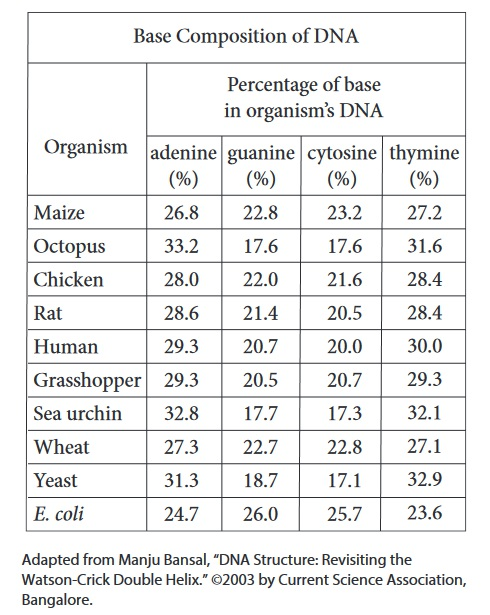
A student claims that nitrogenous bases pair randomly with one another.
Which of the following statements in the passage contradicts the student's claim?

  1. To each sugar is attached a nitrogenous base, which can be of four different types.
  2. So far as is known, the sequence of bases along the chain is irregular.
  3. The bases are joined together in pairs, a single base from one chain being hydrogen-bonded to a single base from the other
  4. One member of a pair must be a purine and the other a pyrimidine in order to bridge between the two chains

Answer(s): D

Explanation:

Choice [One member of a pair must be...] is the best answer. The authors explain that hydrogen bonds join together pairs of nitrogenous bases, and that these bases have a specific structure that leads to the pairing: One member of a pair must be a purine and the other a pyrimidine in order to bridge between the two chains (sentence 5 of paragraph 3). Given the specific chemical properties of a nitrogenous base, it would be inaccurate to call the process random. Choice [To each sugar is attached...] is incorrect because sentence 3 of paragraph 1 describes how nitrogenous bases attach to sugar but not how those bases pair with one another. Choice [So far as is known, the sequence of...] is incorrect because sentence 5 of paragraph 1 does not contradict the student's claim. Choice [The bases are joined together in pairs,...] is incorrect because sentence 3 of paragraph 3 describes how the two molecules' chains are linked, not what the specific pairing between nitrogenous bases is.


This passage is adapted from J. D. Watson and F. H. C. Crick, `Genetical Implications of the Structure of Deoxyribonucleic Acid.` Copyright 1953 by Nature Publishing Group. Watson and Crick deduced the structure of DNA using evidence from Rosalind Franklin and R. G. Gosling's X ray crystallography diagrams of DNA and from Erwin Chargaff's data on the base composition of DNA. The chemical formula of deoxyribonucleic acid (DNA) is now well established. The molecule is a very long chain, the backbone of which consists of a regular alternation of sugar and phosphate groups. To each sugar is attached a nitrogenous base, which can be of four different types. Two of the possible bases `" adenine and guanine `" are purines, and the other two `" thymine and cytosine `" are pyrimidines. So far as is known, the sequence of bases along the chain is irregular. The monomer unit, consisting of phosphate, sugar and base, is known as a nucleotide. The first feature of our structure which is of biological interest is that it consists not of one chain, but of two. These two chains are both coiled around a common fiber axis. It has often been assumed that since there was only one chain in the chemical formula there would only be one in the structural unit. However, the density, taken with the X ray evidence, suggests very strongly that there are two. The other biologically important feature is the manner in which the two chains are held together. This is done by hydrogen bonds between the bases. The bases are joined together in pairs, a single base from one chain being hydrogen bonded to a single base from the other. The important point is that only certain pairs of bases will fit into the structure. One member of a pair must be a purine and the other a pyrimidine in order to bridge between the two chains. If a pair consisted of two purines, for example, there would not be room for it. We believe that the bases will be present almost entirely in their most probable forms. If this is true, the conditions for forming hydrogen bonds are more restrictive, and the only pairs of bases possible are: adenine with thymine, and guanine with cytosine. Adenine, for example, can occur on either chain; but when it does, its partner on the other chain must always be thymine. The phosphate sugar backbone of our model is completely regular, but any sequence of the pairs of bases can fit into the structure. It follows that in a long molecule many different permutations are possible, and it therefore seems likely that the precise sequence of bases is the code which carries the genetical information. If the actual order of the bases on one of the pair of chains were given, one could write down the exact order of the bases on the other one, because of the specific pairing. Thus one chain is, as it were, the complement of the other, and it is this feature which suggests how the deoxyribonucleic acid molecule might duplicate itself. The table shows, for various organisms, the percentage of each of the four types of nitrogenous bases in that organism's DNA.

In the second paragraph, what do the authors claim to be a feature of biological interest?

  1. The chemical formula of DNA
  2. The common fiber axis
  3. The X ray evidence
  4. DNA consisting of two chains

Answer(s): D

Explanation:

Choice [DNA consisting of two chains] is the best answer. In sentence 1 of paragraph 2 the authors state: The first feature of our structure which is of biological interest is that it consists not of one chain, but of two. Choices [The chemical formula of DNA] and [The common fiber axis] are incorrect because sentence 1 of paragraph 2 explicitly states that it is the two chains of DNA that are of biological interest, not the chemical formula of DNA, nor the common fiber axis those two chains are wrapped around. Choice [The X ray evidence] is incorrect because, while the X-ray evidence did help Watson and Crick to discover that DNA consists of two chains, it was not claimed to be the feature of biological interest.


This passage is adapted from J. D. Watson and F. H. C. Crick, `Genetical Implications of the Structure of Deoxyribonucleic Acid.` Copyright 1953 by Nature Publishing Group. Watson and Crick deduced the structure of DNA using evidence from Rosalind Franklin and R. G. Gosling's X ray crystallography diagrams of DNA and from Erwin Chargaff's data on the base composition of DNA. The chemical formula of deoxyribonucleic acid (DNA) is now well established. The molecule is a very long chain, the backbone of which consists of a regular alternation of sugar and phosphate groups. To each sugar is attached a nitrogenous base, which can be of four different types. Two of the possible bases `" adenine and guanine `" are purines, and the other two `" thymine and cytosine `" are pyrimidines. So far as is known, the sequence of bases along the chain is irregular. The monomer unit, consisting of phosphate, sugar and base, is known as a nucleotide. The first feature of our structure which is of biological interest is that it consists not of one chain, but of two. These two chains are both coiled around a common fiber axis. It has often been assumed that since there was only one chain in the chemical formula there would only be one in the structural unit. However, the density, taken with the X ray evidence, suggests very strongly that there are two. The other biologically important feature is the manner in which the two chains are held together. This is done by hydrogen bonds between the bases. The bases are joined together in pairs, a single base from one chain being hydrogen bonded to a single base from the other. The important point is that only certain pairs of bases will fit into the structure. One member of a pair must be a purine and the other a pyrimidine in order to bridge between the two chains. If a pair consisted of two purines, for example, there would not be room for it. We believe that the bases will be present almost entirely in their most probable forms. If this is true, the conditions for forming hydrogen bonds are more restrictive, and the only pairs of bases possible are: adenine with thymine, and guanine with cytosine. Adenine, for example, can occur on either chain; but when it does, its partner on the other chain must always be thymine. The phosphate sugar backbone of our model is completely regular, but any sequence of the pairs of bases can fit into the structure. It follows that in a long molecule many different permutations are possible, and it therefore seems likely that the precise sequence of bases is the code which carries the genetical information. If the actual order of the bases on one of the pair of chains were given, one could write down the exact order of the bases on the other one, because of the specific pairing. Thus one chain is, as it were, the complement of the other, and it is this feature which suggests how the deoxyribonucleic acid molecule might duplicate itself. The table shows, for various organisms, the percentage of each of the four types of nitrogenous bases in that organism's DNA.

The authors' main purpose of including the information about X ray evidence and density is to:

  1. establish that DNA is the molecule that carries the genetic information.
  2. present an alternate hypothesis about the composition of a nucleotide.
  3. provide support for the authors' claim about the number of chains in a molecule of DNA.
  4. confirm the relationship between the density of DNA and the known chemical formula of DNA.

Answer(s): C

Explanation:

Choice [provide support for the authors' claim about...] is the best answer. In sentence 1 of paragraph 2 the authors claim that DNA molecules appear to be comprised of two chains, even though It has often been assumed ¦there would be only one (sentence 3 of paragraph 2). The authors support this claim with evidence compiled from an X-ray: the density, taken with the X-ray evidence, suggests very strongly that there are two [chains] (sentence 4 of paragraph 2). Other choices are incorrect because the authors mention density and X-ray evidence to support a claim, not to establish that DNA carries genetic information, present a hypothesis about the composition of a nucleotide, or confirm a relationship between the density and chemical formula of DNA.


This passage is adapted from J. D. Watson and F. H. C. Crick, `Genetical Implications of the Structure of Deoxyribonucleic Acid.` Copyright 1953 by Nature Publishing Group. Watson and Crick deduced the structure of DNA using evidence from Rosalind Franklin and R. G. Gosling's X ray crystallography diagrams of DNA and from Erwin Chargaff's data on the base composition of DNA. The chemical formula of deoxyribonucleic acid (DNA) is now well established. The molecule is a very long chain, the backbone of which consists of a regular alternation of sugar and phosphate groups. To each sugar is attached a nitrogenous base, which can be of four different types. Two of the possible bases `" adenine and guanine `" are purines, and the other two `" thymine and cytosine `" are pyrimidines. So far as is known, the sequence of bases along the chain is irregular. The monomer unit, consisting of phosphate, sugar and base, is known as a nucleotide. The first feature of our structure which is of biological interest is that it consists not of one chain, but of two. These two chains are both coiled around a common fiber axis. It has often been assumed that since there was only one chain in the chemical formula there would only be one in the structural unit. However, the density, taken with the X ray evidence, suggests very strongly that there are two. The other biologically important feature is the manner in which the two chains are held together. This is done by hydrogen bonds between the bases. The bases are joined together in pairs, a single base from one chain being hydrogen bonded to a single base from the other. The important point is that only certain pairs of bases will fit into the structure. One member of a pair must be a purine and the other a pyrimidine in order to bridge between the two chains. If a pair consisted of two purines, for example, there would not be room for it. We believe that the bases will be present almost entirely in their most probable forms. If this is true, the conditions for forming hydrogen bonds are more restrictive, and the only pairs of bases possible are: adenine with thymine, and guanine with cytosine. Adenine, for example, can occur on either chain; but when it does, its partner on the other chain must always be thymine. The phosphate sugar backbone of our model is completely regular, but any sequence of the pairs of bases can fit into the structure. It follows that in a long molecule many different permutations are possible, and it therefore seems likely that the precise sequence of bases is the code which carries the genetical information. If the actual order of the bases on one of the pair of chains were given, one could write down the exact order of the bases on the other one, because of the specific pairing. Thus one chain is, as it were, the complement of the other, and it is this feature which suggests how the deoxyribonucleic acid molecule might duplicate itself. The table shows, for various organisms, the percentage of each of the four types of nitrogenous bases in that organism's DNA.

Based on the passage, the authors' statement `If a pair consisted of two purines, for example, there would not be room for it` (sentence 6 of paragraph 3) implies that a pair:

  1. of purines would be larger than the space between a sugar and a phosphate group.
  2. of purines would be larger than a pair consisting of a purine and a pyrimidine.
  3. of pyrimidines would be larger than a pair of purines.
  4. consisting of a purine and a pyrimidine would be larger than a pair of pyrimidines.

Answer(s): B

Explanation:

Choice [of purines would be larger than a pair consisting...] is the best answer. The authors explain that only certain pairs of bases will fit into the structure (sentence 4 of paragraph 3) of the DNA molecule. These pairs must contain a purine and the other a pyrimidine in order to bridge between the two chains (sentence 5 of paragraph 3), which implies that any other pairing would not fit into the structure of the DNA molecule. Therefore, a pair of purines would be larger than the required purine/pyrimidine pair and would not fit into the structure of the DNA molecule. Choice [of purines would be larger than...] is incorrect because this section is not discussing the distance between a sugar and phosphate group. Choice [of pyrimidines would be larger than...] is incorrect because the passage never makes clear the size of the pyrimidines or purines in relation to each other, only in relation to the space needed to bond the chains of the DNA molecule. Choice [consisting of a purine and a pyrimidine would be larger...] is incorrect because the lines do not make an implication about the size of a pair of pyrimidines in relation to the size of a pair consisting of a purine and a pyrimidine.


This passage is adapted from J. D. Watson and F. H. C. Crick, `Genetical Implications of the Structure of Deoxyribonucleic Acid.` Copyright 1953 by Nature Publishing Group. Watson and Crick deduced the structure of DNA using evidence from Rosalind Franklin and R. G. Gosling's X ray crystallography diagrams of DNA and from Erwin Chargaff's data on the base composition of DNA. The chemical formula of deoxyribonucleic acid (DNA) is now well established. The molecule is a very long chain, the backbone of which consists of a regular alternation of sugar and phosphate groups. To each sugar is attached a nitrogenous base, which can be of four different types. Two of the possible bases `" adenine and guanine `" are purines, and the other two `" thymine and cytosine `" are pyrimidines. So far as is known, the sequence of bases along the chain is irregular. The monomer unit, consisting of phosphate, sugar and base, is known as a nucleotide. The first feature of our structure which is of biological interest is that it consists not of one chain, but of two. These two chains are both coiled around a common fiber axis. It has often been assumed that since there was only one chain in the chemical formula there would only be one in the structural unit. However, the density, taken with the X ray evidence, suggests very strongly that there are two. The other biologically important feature is the manner in which the two chains are held together. This is done by hydrogen bonds between the bases. The bases are joined together in pairs, a single base from one chain being hydrogen bonded to a single base from the other. The important point is that only certain pairs of bases will fit into the structure. One member of a pair must be a purine and the other a pyrimidine in order to bridge between the two chains. If a pair consisted of two purines, for example, there would not be room for it. We believe that the bases will be present almost entirely in their most probable forms. If this is true, the conditions for forming hydrogen bonds are more restrictive, and the only pairs of bases possible are: adenine with thymine, and guanine with cytosine. Adenine, for example, can occur on either chain; but when it does, its partner on the other chain must always be thymine. The phosphate sugar backbone of our model is completely regular, but any sequence of the pairs of bases can fit into the structure. It follows that in a long molecule many different permutations are possible, and it therefore seems likely that the precise sequence of bases is the code which carries the genetical information. If the actual order of the bases on one of the pair of chains were given, one could write down the exact order of the bases on the other one, because of the specific pairing. Thus one chain is, as it were, the complement of the other, and it is this feature which suggests how the deoxyribonucleic acid molecule might duplicate itself. The table shows, for various organisms, the percentage of each of the four types of nitrogenous bases in that organism's DNA.

Based on the table and passage, which choice gives the correct percentages of the purines in yeast DNA?

  1. 17.1% and 18.7%
  2. 17.1% and 32.9%
  3. 18.7% and 31.3%
  4. 31.3% and 32.9%

Answer(s): C

Explanation:

Sentence 4 of paragraph 1 states that Two of the possible bases " adenine and guanine " are purines, and on the table the percentages of adenine and guanine in yeast DNA are listed as 31.3% and 18.7% respectively.


This passage is adapted from J. D. Watson and F. H. C. Crick, `Genetical Implications of the Structure of Deoxyribonucleic Acid.` Copyright 1953 by Nature Publishing Group. Watson and Crick deduced the structure of DNA using evidence from Rosalind Franklin and R. G. Gosling's X ray crystallography diagrams of DNA and from Erwin Chargaff's data on the base composition of DNA. The chemical formula of deoxyribonucleic acid (DNA) is now well established. The molecule is a very long chain, the backbone of which consists of a regular alternation of sugar and phosphate groups. To each sugar is attached a nitrogenous base, which can be of four different types. Two of the possible bases `" adenine and guanine `" are purines, and the other two `" thymine and cytosine `" are pyrimidines. So far as is known, the sequence of bases along the chain is irregular. The monomer unit, consisting of phosphate, sugar and base, is known as a nucleotide. The first feature of our structure which is of biological interest is that it consists not of one chain, but of two. These two chains are both coiled around a common fiber axis. It has often been assumed that since there was only one chain in the chemical formula there would only be one in the structural unit. However, the density, taken with the X ray evidence, suggests very strongly that there are two. The other biologically important feature is the manner in which the two chains are held together. This is done by hydrogen bonds between the bases. The bases are joined together in pairs, a single base from one chain being hydrogen bonded to a single base from the other. The important point is that only certain pairs of bases will fit into the structure. One member of a pair must be a purine and the other a pyrimidine in order to bridge between the two chains. If a pair consisted of two purines, for example, there would not be room for it. We believe that the bases will be present almost entirely in their most probable forms. If this is true, the conditions for forming hydrogen bonds are more restrictive, and the only pairs of bases possible are: adenine with thymine, and guanine with cytosine. Adenine, for example, can occur on either chain; but when it does, its partner on the other chain must always be thymine. The phosphate sugar backbone of our model is completely regular, but any sequence of the pairs of bases can fit into the structure. It follows that in a long molecule many different permutations are possible, and it therefore seems likely that the precise sequence of bases is the code which carries the genetical information. If the actual order of the bases on one of the pair of chains were given, one could write down the exact order of the bases on the other one, because of the specific pairing. Thus one chain is, as it were, the complement of the other, and it is this feature which suggests how the deoxyribonucleic acid molecule might duplicate itself. The table shows, for various organisms, the percentage of each of the four types of nitrogenous bases in that organism's DNA.

Do the data in the table support the authors' proposed pairing of bases in DNA?

  1. Yes, because for each given organism, the percentage of adenine is closest to the percentage of thymine, and the percentage of guanine is closest to the percentage of cytosine.
  2. Yes, because for each given organism, the percentage of adenine is closest to the percentage of guanine, and the percentage of cytosine is closest to the percentage of thymine.
  3. No, because for each given organism, the percentage of adenine is closest to the percentage of thymine, and the percentage of guanine is closest to the percentage of cytosine.
  4. No, because for each given organism, the percentage of adenine is closest to the percentage of guanine, and the percentage of cytosine is closest to the percentage of thymine.

Answer(s): A

Explanation:

The authors state We believe that the bases will be present almost entirely in their most probable forms. If this is true, the conditions for forming hydrogen bonds are more restrictive, and the only pairs of bases possible are: adenine with thymine, and guanine with cytosine (sentences 1 and 2 of paragraph 4). The table shows that the pairs adenine/thymine and guanine/cytosine have notably similar percentages in DNA for all organisms listed.


This passage is adapted from J. D. Watson and F. H. C. Crick, `Genetical Implications of the Structure of Deoxyribonucleic Acid.` Copyright 1953 by Nature Publishing Group. Watson and Crick deduced the structure of DNA using evidence from Rosalind Franklin and R. G. Gosling's X ray crystallography diagrams of DNA and from Erwin Chargaff's data on the base composition of DNA. The chemical formula of deoxyribonucleic acid (DNA) is now well established. The molecule is a very long chain, the backbone of which consists of a regular alternation of sugar and phosphate groups. To each sugar is attached a nitrogenous base, which can be of four different types. Two of the possible bases `" adenine and guanine `" are purines, and the other two `" thymine and cytosine `" are pyrimidines. So far as is known, the sequence of bases along the chain is irregular. The monomer unit, consisting of phosphate, sugar and base, is known as a nucleotide. The first feature of our structure which is of biological interest is that it consists not of one chain, but of two. These two chains are both coiled around a common fiber axis. It has often been assumed that since there was only one chain in the chemical formula there would only be one in the structural unit. However, the density, taken with the X ray evidence, suggests very strongly that there are two. The other biologically important feature is the manner in which the two chains are held together. This is done by hydrogen bonds between the bases. The bases are joined together in pairs, a single base from one chain being hydrogen bonded to a single base from the other. The important point is that only certain pairs of bases will fit into the structure. One member of a pair must be a purine and the other a pyrimidine in order to bridge between the two chains. If a pair consisted of two purines, for example, there would not be room for it. We believe that the bases will be present almost entirely in their most probable forms. If this is true, the conditions for forming hydrogen bonds are more restrictive, and the only pairs of bases possible are: adenine with thymine, and guanine with cytosine. Adenine, for example, can occur on either chain; but when it does, its partner on the other chain must always be thymine. The phosphate sugar backbone of our model is completely regular, but any sequence of the pairs of bases can fit into the structure. It follows that in a long molecule many different permutations are possible, and it therefore seems likely that the precise sequence of bases is the code which carries the genetical information. If the actual order of the bases on one of the pair of chains were given, one could write down the exact order of the bases on the other one, because of the specific pairing. Thus one chain is, as it were, the complement of the other, and it is this feature which suggests how the deoxyribonucleic acid molecule might duplicate itself. The table shows, for various organisms, the percentage of each of the four types of nitrogenous bases in that organism's DNA.

The authors' use of the words `exact,` `specific,` and `complement` in sentences 3 and 4 of the final paragraph functions mainly to:

  1. confirm that the nucleotide sequences are known for most molecules of DN
  2. counter the claim that the sequences of bases along a chain can occur in any order.
  3. support the claim that the phosphate sugar backbone of the authors' model is completely regular.
  4. emphasize how one chain of DNA may serve as a template to be copied during DNA replication.

Answer(s): D

Explanation:

Choice [emphasize how one chain of DNA may serve as...] is the best answer. The authors explain how the DNA molecule contains a precise sequence of bases (sentence 2 of paragraph 5), and that the authors can use the order of bases on one chain to determine the order of bases on the other chain: If the actual order of the bases on one of the pair of chains were given, one could write down the exact order of the bases on the other one, because of the specific pairing. Thus one chain is, as it were, the complement of the other, and it is this feature which suggests how the deoxyribonucleic acid molecule might duplicate itself (sentences 3 and 4 of paragraph 5). The authors use the words exact, specific, and complement in these lines to suggest that the base pairings along a DNA chain is understood and predictable, and may explain how DNA duplicate[s] itself (sentence 4 of paragraph 5). Choice [confirm that the nucleotide sequences are...] is incorrect because the passage does not suggest that most nucleotide sequences are known. Choice [counter the claim that the sequences of...] is incorrect because these lines are not discussing the random nature of the base sequence along one chain of DNA. Choice [support the claim that...] is incorrect because the authors are describing the bases attached only to the sugar, not to the sugar-phosphate backbone.


This passage is adapted from J. D. Watson and F. H. C. Crick, `Genetical Implications of the Structure of Deoxyribonucleic Acid.` Copyright 1953 by Nature Publishing Group. Watson and Crick deduced the structure of DNA using evidence from Rosalind Franklin and R. G. Gosling's X ray crystallography diagrams of DNA and from Erwin Chargaff's data on the base composition of DNA. The chemical formula of deoxyribonucleic acid (DNA) is now well established. The molecule is a very long chain, the backbone of which consists of a regular alternation of sugar and phosphate groups. To each sugar is attached a nitrogenous base, which can be of four different types. Two of the possible bases `" adenine and guanine `" are purines, and the other two `" thymine and cytosine `" are pyrimidines. So far as is known, the sequence of bases along the chain is irregular. The monomer unit, consisting of phosphate, sugar and base, is known as a nucleotide. The first feature of our structure which is of biological interest is that it consists not of one chain, but of two. These two chains are both coiled around a common fiber axis. It has often been assumed that since there was only one chain in the chemical formula there would only be one in the structural unit. However, the density, taken with the X ray evidence, suggests very strongly that there are two. The other biologically important feature is the manner in which the two chains are held together. This is done by hydrogen bonds between the bases. The bases are joined together in pairs, a single base from one chain being hydrogen bonded to a single base from the other. The important point is that only certain pairs of bases will fit into the structure. One member of a pair must be a purine and the other a pyrimidine in order to bridge between the two chains. If a pair consisted of two purines, for example, there would not be room for it. We believe that the bases will be present almost entirely in their most probable forms. If this is true, the conditions for forming hydrogen bonds are more restrictive, and the only pairs of bases possible are: adenine with thymine, and guanine with cytosine. Adenine, for example, can occur on either chain; but when it does, its partner on the other chain must always be thymine. The phosphate sugar backbone of our model is completely regular, but any sequence of the pairs of bases can fit into the structure. It follows that in a long molecule many different permutations are possible, and it therefore seems likely that the precise sequence of bases is the code which carries the genetical information. If the actual order of the bases on one of the pair of chains were given, one could write down the exact order of the bases on the other one, because of the specific pairing. Thus one chain is, as it were, the complement of the other, and it is this feature which suggests how the deoxyribonucleic acid molecule might duplicate itself. The table shows, for various organisms, the percentage of each of the four types of nitrogenous bases in that organism's DNA.

Based on the table, is the percentage of adenine in each organism's DNA the same or does it vary, and which statement made by the authors is most consistent with that data?

  1. The same; Two of the possible bases " adenine and guanine " are purines, and the other two " thymine and cytosine " are pyrimidines.
  2. The same; The important point is that only certain pairs of bases will fit into the structure.
  3. It varies; Adenine for example, can occur on either chain; but when it does, its partner on the other chain must always be thymine.
  4. It varies; It follows that in a long molecule many different permutations are possible, and it therefore seems likely that the precise sequence of bases is the code which carries the genetical information.

Answer(s): D

Explanation:

The table clearly shows that the percentage of adenine in each organism's DNA is different, ranging from 24.7% in E.coli to 33.2% in the octopus. That such a variability would exist is predicted in sentence 2 of paragraph 5, which states that in a long molecule many different permutations are possible. The table shows that the percentage of adenine varies between 24.7% and 33.2% in different organisms. Sentence 3 of paragraph 4 states that adenine pairs with thymine but does not mention the variability of the base composition of DNA.


Viewing page 27 of 117
Viewing questions 209 - 216 out of 924 questions


Post your Comments and Discuss College Board SAT exam prep with other Community members:

AI Tutor AI Tutor 👋 I’m here to help!