Free SAT Exam Braindumps
Scholastic Aptitude Test Exam Questions 281–288 (page: 37)

Updated On: 31-Jul-2026

This passage is adapted from Bryan Walsh, `Whole Food Blues: Why Organic Agriculture May Not Be So Sustainable.` ֲ ©2012 by Time Incorporated.
When it comes to energy, everyone loves efficiency. Cutting energy waste is one of those goals that both sides of the political divide can agree on, even if they sometimes diverge on how best to get there. Energy efficiency allows us to get more out of our given resources, which is good for the economy and (mostly) good for the environment as well. In an increasingly hot and crowded world, the only sustainable way to live is to get more out of less. Every environmentalist would agree. But change the conversation to food, and suddenly efficiency doesn't look so good. Conventional industrial agriculture has become incredibly efficient on a simple land to food basis. Thanks to fertilizers, mechanization and irrigation, each American farmer feeds over 155 people worldwide. Conventional farming gets more and more crop per square foot of cultivated land `" over 170 bushels of corn per acre in Iowa, for example `" which can mean less territory needs to be converted from wilderness to farmland. And since a third of the planet is already used for agriculture `" destroying forests and other wild habitats along the way `" anything that could help us produce more food on less land would seem to be good for the environment. Of course, that's not how most environmentalists regard their arugula [a leafy green]. They have embraced organic food as better for the planet `" and healthier and tastier, too `" than the stuff produced by agricultural corporations. Environmentalists disdain the enormous amounts of energy needed and waste created by conventional farming, while organic practices `" forgoing artificial fertilizers and chemical pesticides `" are considered far more sustainable. Sales of organic food rose 7.7% in 2010, up to $26.7 billion `" and people are making those purchases for their consciences as much as their taste buds. Yet a new meta-analysis in Nature does the math and comes to a hard conclusion: organic farming yields 25% fewer crops on average than conventional agriculture. More land is therefore needed to produce fewer crops `" and that means organic farming may not be as good for the planet as we think. In the Nature analysis, scientists from McGill University in Montreal and the University of Minnesota performed an analysis of 66 studies comparing conventional and organic methods across 34 different crop species, from fruits to grains to legumes. They found that organic farming delivered a lower yield for every crop type, though the disparity varied widely. For rain watered legume crops like beans or perennial crops like fruit trees, organic trailed conventional agriculture by just 5%. Yet for major cereal crops like corn or wheat, as well as most vegetables `" all of which provide the bulk of the world's calories `" conventional agriculture outperformed organics by more than 25%. The main difference is nitrogen, the chemical key to plant growth. Conventional agriculture makes use of 171 million metric tons of synthetic fertilizer each year, and all that nitrogen enables much faster plant growth than the slower release of nitrogen from the compost or cover crops used in organic farming.
When we talk about a Green Revolution, we really mean a nitrogen revolution `" along with a lot of water. But not all the nitrogen used in conventional fertilizer ends up in crops `" much of it ends up running off the soil and into the oceans, creating vast polluted dead zones. We're already putting more nitrogen into the soil than the planet can stand over the long term. And conventional agriculture also depends heavily on chemical pesticides, which can have unintended side effects.
What that means is that while conventional agriculture is more efficient `" sometimes much more efficient `" than organic farming, there are trade-offs with each. So an ideal global agriculture system, in the views of the study's authors, may borrow the best from both systems, as Jonathan Foley of the University of Minnesota explained: `The bottom line? Today's organic farming practices are probably best deployed in fruit and vegetable farms, where growing nutrition (not just bulk calories) is the primary goal. But for delivering sheer calories, especially in our staple crops of wheat, rice, maize, soybeans and so on, conventional farms have the advantage right now. Looking forward, I think we will need to deploy different kinds of practices (especially new, mixed approaches that take the best of organic and conventional farming systems) where they are best suited `" geographically, economically, socially, etc.`
Which statement best expresses a relationship between organic farming and conventional farming that is presented in the passage?

  1. Both are equally sustainable, but they differ dramatically in the amount of land they require to produce equivalent yields.
  2. Both rely on artificial chemicals for pest control, but organic farmers use the chemicals sparingly in conjunction with natural remedies.
  3. Both use nitrogen to encourage plant growth, but the nitrogen used in conventional farming comes from synthetic sources.
  4. Both create a substantial amount of nitrogen runoff, but only the type of nitrogen found in fertilizers used in conventional farming can be dangerous.

Answer(s): C

Explanation:

The passage makes it clear that while both conventional and organic farming need nitrogen for plant growth, conventional farming uses synthetic fertilizers and organic does not: Conventional agriculture makes use of 171 million metric tons of synthetic fertilizer each year, and all that nitrogen enables much faster plant growth than the slower release of nitrogen from the compost or cover crops used in organic farming (sentence 2 of paragraph 6).


This passage is adapted from Bryan Walsh, `Whole Food Blues: Why Organic Agriculture May Not Be So Sustainable.` ֲ ©2012 by Time Incorporated.
When it comes to energy, everyone loves efficiency. Cutting energy waste is one of those goals that both sides of the political divide can agree on, even if they sometimes diverge on how best to get there. Energy efficiency allows us to get more out of our given resources, which is good for the economy and (mostly) good for the environment as well. In an increasingly hot and crowded world, the only sustainable way to live is to get more out of less. Every environmentalist would agree. But change the conversation to food, and suddenly efficiency doesn't look so good. Conventional industrial agriculture has become incredibly efficient on a simple land to food basis. Thanks to fertilizers, mechanization and irrigation, each American farmer feeds over 155 people worldwide. Conventional farming gets more and more crop per square foot of cultivated land `" over 170 bushels of corn per acre in Iowa, for example `" which can mean less territory needs to be converted from wilderness to farmland. And since a third of the planet is already used for agriculture `" destroying forests and other wild habitats along the way `" anything that could help us produce more food on less land would seem to be good for the environment. Of course, that's not how most environmentalists regard their arugula [a leafy green]. They have embraced organic food as better for the planet `" and healthier and tastier, too `" than the stuff produced by agricultural corporations. Environmentalists disdain the enormous amounts of energy needed and waste created by conventional farming, while organic practices `" forgoing artificial fertilizers and chemical pesticides `" are considered far more sustainable. Sales of organic food rose 7.7% in 2010, up to $26.7 billion `" and people are making those purchases for their consciences as much as their taste buds. Yet a new meta-analysis in Nature does the math and comes to a hard conclusion: organic farming yields 25% fewer crops on average than conventional agriculture. More land is therefore needed to produce fewer crops `" and that means organic farming may not be as good for the planet as we think. In the Nature analysis, scientists from McGill University in Montreal and the University of Minnesota performed an analysis of 66 studies comparing conventional and organic methods across 34 different crop species, from fruits to grains to legumes. They found that organic farming delivered a lower yield for every crop type, though the disparity varied widely. For rain watered legume crops like beans or perennial crops like fruit trees, organic trailed conventional agriculture by just 5%. Yet for major cereal crops like corn or wheat, as well as most vegetables `" all of which provide the bulk of the world's calories `" conventional agriculture outperformed organics by more than 25%. The main difference is nitrogen, the chemical key to plant growth. Conventional agriculture makes use of 171 million metric tons of synthetic fertilizer each year, and all that nitrogen enables much faster plant growth than the slower release of nitrogen from the compost or cover crops used in organic farming.
When we talk about a Green Revolution, we really mean a nitrogen revolution `" along with a lot of water. But not all the nitrogen used in conventional fertilizer ends up in crops `" much of it ends up running off the soil and into the oceans, creating vast polluted dead zones. We're already putting more nitrogen into the soil than the planet can stand over the long term. And conventional agriculture also depends heavily on chemical pesticides, which can have unintended side effects.
What that means is that while conventional agriculture is more efficient `" sometimes much more efficient `" than organic farming, there are trade-offs with each. So an ideal global agriculture system, in the views of the study's authors, may borrow the best from both systems, as Jonathan Foley of the University of Minnesota explained: `The bottom line? Today's organic farming practices are probably best deployed in fruit and vegetable farms, where growing nutrition (not just bulk calories) is the primary goal. But for delivering sheer calories, especially in our staple crops of wheat, rice, maize, soybeans and so on, conventional farms have the advantage right now. Looking forward, I think we will need to deploy different kinds of practices (especially new, mixed approaches that take the best of organic and conventional farming systems) where they are best suited `" geographically, economically, socially, etc.`

According to Foley, an `ideal global agriculture system` (sentence 2 of paragraph 8):

  1. focuses primarily on yield percentages and global markets.
  2. considers multiple factors in the selection of farming techniques.
  3. weighs the economic interests of farmers against the needs of consumers.
  4. puts the nutritional value of produce first and foremost.

Answer(s): B

Explanation:

Choice [considers multiple factors in the selection of farming techniques.] is the best answer. The passage states that the authors of the study comparing conventional and organic farming have come to the conclusion that an ideal global agriculture system would borrow the best from both systems (sentence 2 of paragraph 8).
The quote from Jonathan Foley in paragraphs 9 and 10 indicates that this ideal system would take into consideration many different factors, including the nutrition and calories offered by specific types of foods as well as different geographic, economic, and social needs. Choices [focuses primarily on yield percentages and global markets.] and [puts the nutritional value of produce first and foremost.] are incorrect because the passage makes it clear that the ideal global agriculture system would give consideration to multiple factors, not that it would focus mainly on productivity or nutritional value. Choice [weighs the economic interests of farmers against the needs of consumers.] is incorrect because Foley states that the ideal system would take economics into consideration but does not indicate that farmers' economic interests would be weighed against consumers' needs.


This passage is adapted from Bryan Walsh, `Whole Food Blues: Why Organic Agriculture May Not Be So Sustainable.` ֲ ©2012 by Time Incorporated.
When it comes to energy, everyone loves efficiency. Cutting energy waste is one of those goals that both sides of the political divide can agree on, even if they sometimes diverge on how best to get there. Energy efficiency allows us to get more out of our given resources, which is good for the economy and (mostly) good for the environment as well. In an increasingly hot and crowded world, the only sustainable way to live is to get more out of less. Every environmentalist would agree. But change the conversation to food, and suddenly efficiency doesn't look so good. Conventional industrial agriculture has become incredibly efficient on a simple land to food basis. Thanks to fertilizers, mechanization and irrigation, each American farmer feeds over 155 people worldwide. Conventional farming gets more and more crop per square foot of cultivated land `" over 170 bushels of corn per acre in Iowa, for example `" which can mean less territory needs to be converted from wilderness to farmland. And since a third of the planet is already used for agriculture `" destroying forests and other wild habitats along the way `" anything that could help us produce more food on less land would seem to be good for the environment. Of course, that's not how most environmentalists regard their arugula [a leafy green]. They have embraced organic food as better for the planet `" and healthier and tastier, too `" than the stuff produced by agricultural corporations. Environmentalists disdain the enormous amounts of energy needed and waste created by conventional farming, while organic practices `" forgoing artificial fertilizers and chemical pesticides `" are considered far more sustainable. Sales of organic food rose 7.7% in 2010, up to $26.7 billion `" and people are making those purchases for their consciences as much as their taste buds. Yet a new meta-analysis in Nature does the math and comes to a hard conclusion: organic farming yields 25% fewer crops on average than conventional agriculture. More land is therefore needed to produce fewer crops `" and that means organic farming may not be as good for the planet as we think. In the Nature analysis, scientists from McGill University in Montreal and the University of Minnesota performed an analysis of 66 studies comparing conventional and organic methods across 34 different crop species, from fruits to grains to legumes. They found that organic farming delivered a lower yield for every crop type, though the disparity varied widely. For rain watered legume crops like beans or perennial crops like fruit trees, organic trailed conventional agriculture by just 5%. Yet for major cereal crops like corn or wheat, as well as most vegetables `" all of which provide the bulk of the world's calories `" conventional agriculture outperformed organics by more than 25%. The main difference is nitrogen, the chemical key to plant growth. Conventional agriculture makes use of 171 million metric tons of synthetic fertilizer each year, and all that nitrogen enables much faster plant growth than the slower release of nitrogen from the compost or cover crops used in organic farming.
When we talk about a Green Revolution, we really mean a nitrogen revolution `" along with a lot of water. But not all the nitrogen used in conventional fertilizer ends up in crops `" much of it ends up running off the soil and into the oceans, creating vast polluted dead zones. We're already putting more nitrogen into the soil than the planet can stand over the long term. And conventional agriculture also depends heavily on chemical pesticides, which can have unintended side effects.
What that means is that while conventional agriculture is more efficient `" sometimes much more efficient `" than organic farming, there are trade-offs with each. So an ideal global agriculture system, in the views of the study's authors, may borrow the best from both systems, as Jonathan Foley of the University of Minnesota explained: `The bottom line? Today's organic farming practices are probably best deployed in fruit and vegetable farms, where growing nutrition (not just bulk calories) is the primary goal. But for delivering sheer calories, especially in our staple crops of wheat, rice, maize, soybeans and so on, conventional farms have the advantage right now. Looking forward, I think we will need to deploy different kinds of practices (especially new, mixed approaches that take the best of organic and conventional farming systems) where they are best suited `" geographically, economically, socially, etc.`

In sentence 2 of paragraph 9, the word `sheer` most nearly means:

  1. transparent.
  2. abrupt.
  3. steep.
  4. pure.

Answer(s): D

Explanation:

Choice pure is the best answer. The passage states that conventional agriculture can be superior to organic farming in terms of producing sheer calories (sentence 2 of paragraph 9). In this context, sheer most nearly means pure; the passage is referring to the pure number of calories delivered by foods.
Other choices are incorrect because in the context of discussing the calories foods can provide, sheer suggests the pure number of calories. Also, it does not make sense to say that calories can be seen through, are somehow sudden or happen unexpectedly, or are at a very sharp angle.


This passage is adapted from Bryan Walsh, `Whole Food Blues: Why Organic Agriculture May Not Be So Sustainable.` ֲ ©2012 by Time Incorporated.
When it comes to energy, everyone loves efficiency. Cutting energy waste is one of those goals that both sides of the political divide can agree on, even if they sometimes diverge on how best to get there. Energy efficiency allows us to get more out of our given resources, which is good for the economy and (mostly) good for the environment as well. In an increasingly hot and crowded world, the only sustainable way to live is to get more out of less. Every environmentalist would agree. But change the conversation to food, and suddenly efficiency doesn't look so good. Conventional industrial agriculture has become incredibly efficient on a simple land to food basis. Thanks to fertilizers, mechanization and irrigation, each American farmer feeds over 155 people worldwide. Conventional farming gets more and more crop per square foot of cultivated land `" over 170 bushels of corn per acre in Iowa, for example `" which can mean less territory needs to be converted from wilderness to farmland. And since a third of the planet is already used for agriculture `" destroying forests and other wild habitats along the way `" anything that could help us produce more food on less land would seem to be good for the environment. Of course, that's not how most environmentalists regard their arugula [a leafy green]. They have embraced organic food as better for the planet `" and healthier and tastier, too `" than the stuff produced by agricultural corporations. Environmentalists disdain the enormous amounts of energy needed and waste created by conventional farming, while organic practices `" forgoing artificial fertilizers and chemical pesticides `" are considered far more sustainable. Sales of organic food rose 7.7% in 2010, up to $26.7 billion `" and people are making those purchases for their consciences as much as their taste buds. Yet a new meta-analysis in Nature does the math and comes to a hard conclusion: organic farming yields 25% fewer crops on average than conventional agriculture. More land is therefore needed to produce fewer crops `" and that means organic farming may not be as good for the planet as we think. In the Nature analysis, scientists from McGill University in Montreal and the University of Minnesota performed an analysis of 66 studies comparing conventional and organic methods across 34 different crop species, from fruits to grains to legumes. They found that organic farming delivered a lower yield for every crop type, though the disparity varied widely. For rain watered legume crops like beans or perennial crops like fruit trees, organic trailed conventional agriculture by just 5%. Yet for major cereal crops like corn or wheat, as well as most vegetables `" all of which provide the bulk of the world's calories `" conventional agriculture outperformed organics by more than 25%. The main difference is nitrogen, the chemical key to plant growth. Conventional agriculture makes use of 171 million metric tons of synthetic fertilizer each year, and all that nitrogen enables much faster plant growth than the slower release of nitrogen from the compost or cover crops used in organic farming.
When we talk about a Green Revolution, we really mean a nitrogen revolution `" along with a lot of water. But not all the nitrogen used in conventional fertilizer ends up in crops `" much of it ends up running off the soil and into the oceans, creating vast polluted dead zones. We're already putting more nitrogen into the soil than the planet can stand over the long term. And conventional agriculture also depends heavily on chemical pesticides, which can have unintended side effects.
What that means is that while conventional agriculture is more efficient `" sometimes much more efficient `" than organic farming, there are trade-offs with each. So an ideal global agriculture system, in the views of the study's authors, may borrow the best from both systems, as Jonathan Foley of the University of Minnesota explained: `The bottom line? Today's organic farming practices are probably best deployed in fruit and vegetable farms, where growing nutrition (not just bulk calories) is the primary goal. But for delivering sheer calories, especially in our staple crops of wheat, rice, maize, soybeans and so on, conventional farms have the advantage right now. Looking forward, I think we will need to deploy different kinds of practices (especially new, mixed approaches that take the best of organic and conventional farming systems) where they are best suited `" geographically, economically, socially, etc.`

Which statement is best supported by the information provided in figure 1?

  1. The organic yield as a percentage of conventional yield is greater for vegetables than for fruits.
  2. The organic yield as a percentage of conventional yield is similar for cereals and all crops.
  3. The reported number of observations for each crop type exceeds 82.
  4. The organic yield as a percentage of conventional yield is greater for vegetable crops than it is for oilseed crops.

Answer(s): B

Explanation:

Figure 1 shows that the organic yield as a percentage of conventional yield is similar for cereals and all crops, with both yielding roughly 75%.


This passage is adapted from Bryan Walsh, `Whole Food Blues: Why Organic Agriculture May Not Be So Sustainable.` ֲ ©2012 by Time Incorporated.
When it comes to energy, everyone loves efficiency. Cutting energy waste is one of those goals that both sides of the political divide can agree on, even if they sometimes diverge on how best to get there. Energy efficiency allows us to get more out of our given resources, which is good for the economy and (mostly) good for the environment as well. In an increasingly hot and crowded world, the only sustainable way to live is to get more out of less. Every environmentalist would agree. But change the conversation to food, and suddenly efficiency doesn't look so good. Conventional industrial agriculture has become incredibly efficient on a simple land to food basis. Thanks to fertilizers, mechanization and irrigation, each American farmer feeds over 155 people worldwide. Conventional farming gets more and more crop per square foot of cultivated land `" over 170 bushels of corn per acre in Iowa, for example `" which can mean less territory needs to be converted from wilderness to farmland. And since a third of the planet is already used for agriculture `" destroying forests and other wild habitats along the way `" anything that could help us produce more food on less land would seem to be good for the environment. Of course, that's not how most environmentalists regard their arugula [a leafy green]. They have embraced organic food as better for the planet `" and healthier and tastier, too `" than the stuff produced by agricultural corporations. Environmentalists disdain the enormous amounts of energy needed and waste created by conventional farming, while organic practices `" forgoing artificial fertilizers and chemical pesticides `" are considered far more sustainable. Sales of organic food rose 7.7% in 2010, up to $26.7 billion `" and people are making those purchases for their consciences as much as their taste buds. Yet a new meta-analysis in Nature does the math and comes to a hard conclusion: organic farming yields 25% fewer crops on average than conventional agriculture. More land is therefore needed to produce fewer crops `" and that means organic farming may not be as good for the planet as we think. In the Nature analysis, scientists from McGill University in Montreal and the University of Minnesota performed an analysis of 66 studies comparing conventional and organic methods across 34 different crop species, from fruits to grains to legumes. They found that organic farming delivered a lower yield for every crop type, though the disparity varied widely. For rain watered legume crops like beans or perennial crops like fruit trees, organic trailed conventional agriculture by just 5%. Yet for major cereal crops like corn or wheat, as well as most vegetables `" all of which provide the bulk of the world's calories `" conventional agriculture outperformed organics by more than 25%. The main difference is nitrogen, the chemical key to plant growth. Conventional agriculture makes use of 171 million metric tons of synthetic fertilizer each year, and all that nitrogen enables much faster plant growth than the slower release of nitrogen from the compost or cover crops used in organic farming.
When we talk about a Green Revolution, we really mean a nitrogen revolution `" along with a lot of water. But not all the nitrogen used in conventional fertilizer ends up in crops `" much of it ends up running off the soil and into the oceans, creating vast polluted dead zones. We're already putting more nitrogen into the soil than the planet can stand over the long term. And conventional agriculture also depends heavily on chemical pesticides, which can have unintended side effects.
What that means is that while conventional agriculture is more efficient `" sometimes much more efficient `" than organic farming, there are trade-offs with each. So an ideal global agriculture system, in the views of the study's authors, may borrow the best from both systems, as Jonathan Foley of the University of Minnesota explained: `The bottom line? Today's organic farming practices are probably best deployed in fruit and vegetable farms, where growing nutrition (not just bulk calories) is the primary goal. But for delivering sheer calories, especially in our staple crops of wheat, rice, maize, soybeans and so on, conventional farms have the advantage right now. Looking forward, I think we will need to deploy different kinds of practices (especially new, mixed approaches that take the best of organic and conventional farming systems) where they are best suited `" geographically, economically, socially, etc.`

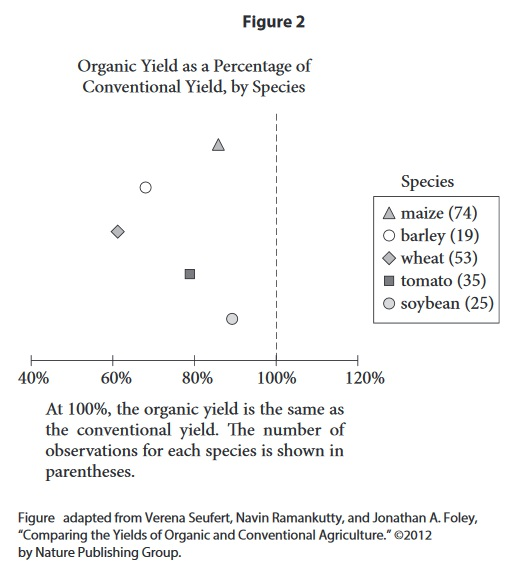
Which of the following claims is supported by figure 2?

  1. Of the organically grown species represented, soybeans have the lowest yield.
  2. The organically grown maize and barley represented are comparable in their yields to conventionally grown maize and barley.
  3. Of the organically grown species represented, tomatoes have the highest yield.
  4. The organically grown species represented have lower yields than their conventionally grown counterparts do.

Answer(s): D

Explanation:

Every organically grown species represented in figure 2 produces a smaller yield than do their conventional counterparts. All of the organically grown species are within a range of approximately 60"90% of the conventional yield.


This passage is adapted from John Bohannon, `Why You Shouldn't Trust Internet Comments.` ֲ ©2013 by American Association for the Advancement of Science. The `wisdom of crowds` has become a mantra of the Internet age. Need to choose a new vacuum cleaner? Check out the reviews on online merchant Amazon. But a new study suggests that such online scores don't always reveal the best choice. A massive controlled experiment of Web users finds that such ratings are highly susceptible to irrational `herd behavior` `" and that the herd can be manipulated. Sometimes the crowd really is wiser than you. The classic examples are guessing the weight of a bull or the number of gumballs in a jar. Your guess is probably going to be far from the mark, whereas the average of many people's choices is remarkably close to the true number. But what happens when the goal is to judge something less tangible, such as the quality or worth of a product? According to one theory, the wisdom of the crowd still holds `" measuring the aggregate of people's opinions produces a stable, reliable value. Skeptics, however, argue that people's opinions are easily swayed by those of others. So nudging a crowd early on by presenting contrary opinions `" for example, exposing them to some very good or very bad attitudes `" will steer the crowd in a different direction. To test which hypothesis is true, you would need to manipulate huge numbers of people, exposing them to false information and determining how it affects their opinions. A team led by Sinan Aral, a network scientist at the Massachusetts Institute of Technology in Cambridge, did exactly that. Aral has been secretly working with a popular website that aggregates news stories. The website allows users to make comments about news stories and vote each other's comments up or down. The vote tallies are visible as a number next to each comment, and the position of the comments is chronological. (Stories on the site get an average of about ten comments and about three votes per comment.) It's a follow up to his experiment using people's ratings of movies to measure how much individual people influence each other online (answer: a lot). This time, he wanted to know how much the crowd influences the individual, and whether it can be controlled from outside. For five months, every comment submitted by a user randomly received an `up` vote (positive); a `down` vote (negative); or as a control, no vote at all. The team then observed how users rated those comments. The users generated more than 100,000 comments that were viewed more than 10 million times and rated more than 300,000 times by other users. At least when it comes to comments on news sites, the crowd is more herdlike than wise. Comments that received fake positive votes from the researchers were 32% more likely to receive more positive votes compared with a control, the team reports. And those comments were no more likely than the control to be down voted by the next viewer to see them. By the end of the study, positively manipulated comments got an overall boost of about 25%. However, the same did not hold true for negative manipulation. The ratings of comments that got a fake down vote were usually negated by an up vote by the next user to see them. `Our experiment does not reveal the psychology behind people's decisions,` Aral says, `but an intuitive explanation is that people are more skeptical of negative social influence. They're more willing to go along with positive opinions from other people.` Duncan Watts, a network scientist at Microsoft Research in New York City, agrees with that conclusion. `[But] one question is whether the positive [herding] bias is specific to this site` or true in general, Watts says. He points out that the category of the news items in the experiment had a strong effect on how much people could be manipulated. `I would have thought that `˜business' is pretty similar to `˜economics,' yet they find a much stronger effect (almost 50% stronger) for the former than the latter.
What explains this difference? If we're going to apply these findings in the real world, we'll need to know the answers.` Will companies be able to boost their products by manipulating online ratings on a massive scale? `That is easier said than done,` Watts says. If people detect `" or learn `" that comments on a website are being manipulated, the herd may spook and leave entirely.

Over the course of the passage, the main focus shifts from a discussion of an experiment and its results to:

  1. an explanation of the practical applications of the results.
  2. a consideration of the questions prompted by the results.
  3. an analysis of the defects undermining the results.
  4. a conversation with a scientist who disputes the results.

Answer(s): B

Explanation:

Choice [a consideration of the questions prompted by the results.] is the best answer. The majority of the passage focuses on the experiment concerning how much the crowd influences the individual, and whether it can be controlled from outside (sentence 7 of paragraph 4). After explaining the experiment and the results it produced, the passage moves on to consider questions raised by the results, such as whether the findings are site specific or true in general (sentence 2 of paragraph 8), why different findings are observed, and whether companies can boost their products by manipulating online ratings on a massive scale (sentence 1 of paragraph 9). Choice [an explanation of the...] is incorrect because the passage does not conclude by explaining the practical ways the experiment's findings have been applied but rather by considering questions the findings raise. Choices [an analysis of the...] and [a conversation with...] are incorrect because the passage does not indicate that there were any flaws in the experiment's findings and does not include statements from anyone who disputes the findings.


This passage is adapted from John Bohannon, `Why You Shouldn't Trust Internet Comments.` ֲ ©2013 by American Association for the Advancement of Science.
The `wisdom of crowds` has become a mantra of the Internet age. Need to choose a new vacuum cleaner? Check out the reviews on online merchant Amazon. But a new study suggests that such online scores don't always reveal the best choice. A massive controlled experiment of Web users finds that such ratings are highly susceptible to irrational `herd behavior` `" and that the herd can be manipulated. Sometimes the crowd really is wiser than you. The classic examples are guessing the weight of a bull or the number of gumballs in a jar. Your guess is probably going to be far from the mark, whereas the average of many people's choices is remarkably close to the true number. But what happens when the goal is to judge something less tangible, such as the quality or worth of a product? According to one theory, the wisdom of the crowd still holds `" measuring the aggregate of people's opinions produces a stable, reliable value. Skeptics, however, argue that people's opinions are easily swayed by those of others. So nudging a crowd early on by presenting contrary opinions `" for example, exposing them to some very good or very bad attitudes `" will steer the crowd in a different direction. To test which hypothesis is true, you would need to manipulate huge numbers of people, exposing them to false information and determining how it affects their opinions. A team led by Sinan Aral, a network scientist at the Massachusetts Institute of Technology in Cambridge, did exactly that. Aral has been secretly working with a popular website that aggregates news stories. The website allows users to make comments about news stories and vote each other's comments up or down. The vote tallies are visible as a number next to each comment, and the position of the comments is chronological. (Stories on the site get an average of about ten comments and about three votes per comment.) It's a follow up to his experiment using people's ratings of movies to measure how much individual people influence each other online (answer: a lot). This time, he wanted to know how much the crowd influences the individual, and whether it can be controlled from outside. For five months, every comment submitted by a user randomly received an `up` vote (positive); a `down` vote (negative); or as a control, no vote at all. The team then observed how users rated those comments. The users generated more than 100,000 comments that were viewed more than 10 million times and rated more than 300,000 times by other users. At least when it comes to comments on news sites, the crowd is more herdlike than wise. Comments that received fake positive votes from the researchers were 32% more likely to receive more positive votes compared with a control, the team reports. And those comments were no more likely than the control to be down voted by the next viewer to see them. By the end of the study, positively manipulated comments got an overall boost of about 25%. However, the same did not hold true for negative manipulation. The ratings of comments that got a fake down vote were usually negated by an up vote by the next user to see them. `Our experiment does not reveal the psychology behind people's decisions,` Aral says, `but an intuitive explanation is that people are more skeptical of negative social influence. They're more willing to go along with positive opinions from other people.` Duncan Watts, a network scientist at Microsoft Research in New York City, agrees with that conclusion. `[But] one question is whether the positive [herding] bias is specific to this site` or true in general, Watts says. He points out that the category of the news items in the experiment had a strong effect on how much people could be manipulated. `I would have thought that `˜business' is pretty similar to `˜economics,' yet they find a much stronger effect (almost 50% stronger) for the former than the latter.
What explains this difference? If we're going to apply these findings in the real world, we'll need to know the answers.` Will companies be able to boost their products by manipulating online ratings on a massive scale? `That is easier said than done,` Watts says. If people detect `" or learn `" that comments on a website are being manipulated, the herd may spook and leave entirely.

The author of the passage suggests that crowds may be more effective at:

  1. creating controversy than examining an issue in depth.
  2. reinforcing members' ideas than challenging those ideas.
  3. arriving at accurate quantitative answers than producing valid qualitative judgments.
  4. ranking others' opinions than developing genuinely original positions.

Answer(s): C

Explanation:

The author of the passage suggests that a group of people can be wiser and more effective than a single person at assessing a quantitative answer, or a measurement, versus producing a valid qualitative judgment, or a judgment of the quality of something. This is most clear in sentence 2 of paragraph 2, which state that when guessing a bull's weight or how many gumballs are in a jar, your guess is probably going to be far from the mark, whereas the average of many people's choices is remarkably close to the true number. Other choices are incorrect because sentence 2 of paragraph 2 indicates that the author believes that crowds may be more effective than individuals when arriving at quantitative answers rather than qualitative results. Nothing in the passage suggests that the author believes that crowds are better at starting disagreements than studying an issue in depth, supporting ideas rather than challenging them, or ranking opinions rather than coming up with new ideas.


This passage is adapted from John Bohannon, `Why You Shouldn't Trust Internet Comments.` ֲ ©2013 by American Association for the Advancement of Science. The `wisdom of crowds` has become a mantra of the Internet age. Need to choose a new vacuum cleaner? Check out the reviews on online merchant Amazon.
But a new study suggests that such online scores don't always reveal the best choice. A massive controlled experiment of Web users finds that such ratings are highly susceptible to irrational `herd behavior` `" and that the herd can be manipulated. Sometimes the crowd really is wiser than you. The classic examples are guessing the weight of a bull or the number of gumballs in a jar. Your guess is probably going to be far from the mark, whereas the average of many people's choices is remarkably close to the true number. But what happens when the goal is to judge something less tangible, such as the quality or worth of a product? According to one theory, the wisdom of the crowd still holds `" measuring the aggregate of people's opinions produces a stable, reliable value. Skeptics, however, argue that people's opinions are easily swayed by those of others. So nudging a crowd early on by presenting contrary opinions `" for example, exposing them to some very good or very bad attitudes `" will steer the crowd in a different direction. To test which hypothesis is true, you would need to manipulate huge numbers of people, exposing them to false information and determining how it affects their opinions. A team led by Sinan Aral, a network scientist at the Massachusetts Institute of Technology in Cambridge, did exactly that. Aral has been secretly working with a popular website that aggregates news stories. The website allows users to make comments about news stories and vote each other's comments up or down. The vote tallies are visible as a number next to each comment, and the position of the comments is chronological. (Stories on the site get an average of about ten comments and about three votes per comment.) It's a follow up to his experiment using people's ratings of movies to measure how much individual people influence each other online (answer: a lot). This time, he wanted to know how much the crowd influences the individual, and whether it can be controlled from outside. For five months, every comment submitted by a user randomly received an `up` vote (positive); a `down` vote (negative); or as a control, no vote at all. The team then observed how users rated those comments. The users generated more than 100,000 comments that were viewed more than 10 million times and rated more than 300,000 times by other users. At least when it comes to comments on news sites, the crowd is more herdlike than wise. Comments that received fake positive votes from the researchers were 32% more likely to receive more positive votes compared with a control, the team reports. And those comments were no more likely than the control to be down voted by the next viewer to see them. By the end of the study, positively manipulated comments got an overall boost of about 25%. However, the same did not hold true for negative manipulation. The ratings of comments that got a fake down vote were usually negated by an up vote by the next user to see them. `Our experiment does not reveal the psychology behind people's decisions,` Aral says, `but an intuitive explanation is that people are more skeptical of negative social influence. They're more willing to go along with positive opinions from other people.` Duncan Watts, a network scientist at Microsoft Research in New York City, agrees with that conclusion. `[But] one question is whether the positive [herding] bias is specific to this site` or true in general, Watts says. He points out that the category of the news items in the experiment had a strong effect on how much people could be manipulated. `I would have thought that `˜business' is pretty similar to `˜economics,' yet they find a much stronger effect (almost 50% stronger) for the former than the latter.
What explains this difference? If we're going to apply these findings in the real world, we'll need to know the answers.` Will companies be able to boost their products by manipulating online ratings on a massive scale? `That is easier said than done,` Watts says. If people detect `" or learn `" that comments on a website are being manipulated, the herd may spook and leave entirely.

Which choice best supports the view of the `skeptics` (sentence 3 of paragraph 3)?

  1. Sentence 2 of paragraph 6 (Comments . . . reports)
  2. Sentence 3 of paragraph 6 (And . . . them)
  3. Sentence 6 of paragraph 6 (The ratings . . . them)
  4. Sentence 3 of paragraph 8 (He . . . manipulated)

Answer(s): A

Explanation:

In the passage, the author explains that those who are skeptical of the theory that measuring the aggregate of people's opinions produces a stable, reliable value (sentence 2 of paragraph 3) believe that people's opinions are easily swayed by those of others (sentence 3 of paragraph 3). This idea is best supported in sentence 2 of paragraph 6, which describes a finding from a study of opinions in crowds: Comments that received fake positive votes from the researchers were 32% more likely to receive more positive votes compared with a control, the team reports. In other words, people were more likely to give a positive vote when they thought other people had given positive votes. Other choices are incorrect because the lines cited do not provide support for the skeptics' idea that people's opinions are easily influenced by the thoughts of others. Instead, they cite findings concerning people giving ratings different from those already given and share an observation that the degree to which others can be influenced depends in part on the context of the situation.


Viewing page 37 of 117
Viewing questions 289 - 296 out of 924 questions


Post your Comments and Discuss College Board SAT exam prep with other Community members:

AI Tutor AI Tutor 👋 I’m here to help!