Free SAT Exam Braindumps
Scholastic Aptitude Test Exam Questions 289–296 (page: 38)

Updated On: 31-Jul-2026

This passage is adapted from John Bohannon, `Why You Shouldn't Trust Internet Comments.` ֲ ©2013 by American Association for the Advancement of Science. The `wisdom of crowds` has become a mantra of the Internet age. Need to choose a new vacuum cleaner? Check out the reviews on online merchant Amazon. But a new study suggests that such online scores don't always reveal the best choice. A massive controlled experiment of Web users finds that such ratings are highly susceptible to irrational `herd behavior` `" and that the herd can be manipulated. Sometimes the crowd really is wiser than you. The classic examples are guessing the weight of a bull or the number of gumballs in a jar. Your guess is probably going to be far from the mark, whereas the average of many people's choices is remarkably close to the true number. But what happens when the goal is to judge something less tangible, such as the quality or worth of a product? According to one theory, the wisdom of the crowd still holds `" measuring the aggregate of people's opinions produces a stable, reliable value. Skeptics, however, argue that people's opinions are easily swayed by those of others. So nudging a crowd early on by presenting contrary opinions `" for example, exposing them to some very good or very bad attitudes `" will steer the crowd in a different direction. To test which hypothesis is true, you would need to manipulate huge numbers of people, exposing them to false information and determining how it affects their opinions. A team led by Sinan Aral, a network scientist at the Massachusetts Institute of Technology in Cambridge, did exactly that. Aral has been secretly working with a popular website that aggregates news stories. The website allows users to make comments about news stories and vote each other's comments up or down. The vote tallies are visible as a number next to each comment, and the position of the comments is chronological. (Stories on the site get an average of about ten comments and about three votes per comment.) It's a follow up to his experiment using people's ratings of movies to measure how much individual people influence each other online (answer: a lot). This time, he wanted to know how much the crowd influences the individual, and whether it can be controlled from outside. For five months, every comment submitted by a user randomly received an `up` vote (positive); a `down` vote (negative); or as a control, no vote at all. The team then observed how users rated those comments. The users generated more than 100,000 comments that were viewed more than 10 million times and rated more than 300,000 times by other users. At least when it comes to comments on news sites, the crowd is more herdlike than wise. Comments that received fake positive votes from the researchers were 32% more likely to receive more positive votes compared with a control, the team reports. And those comments were no more likely than the control to be down voted by the next viewer to see them. By the end of the study, positively manipulated comments got an overall boost of about 25%. However, the same did not hold true for negative manipulation. The ratings of comments that got a fake down vote were usually negated by an up vote by the next user to see them. `Our experiment does not reveal the psychology behind people's decisions,` Aral says, `but an intuitive explanation is that people are more skeptical of negative social influence. They're more willing to go along with positive opinions from other people.` Duncan Watts, a network scientist at Microsoft Research in New York City, agrees with that conclusion. `[But] one question is whether the positive [herding] bias is specific to this site` or true in general, Watts says. He points out that the category of the news items in the experiment had a strong effect on how much people could be manipulated. `I would have thought that `˜business' is pretty similar to `˜economics,' yet they find a much stronger effect (almost 50% stronger) for the former than the latter.
What explains this difference? If we're going to apply these findings in the real world, we'll need to know the answers.` Will companies be able to boost their products by manipulating online ratings on a massive scale? `That is easier said than done,` Watts says. If people detect `" or learn `" that comments on a website are being manipulated, the herd may spook and leave entirely.
Which action would best address a question Watts raises about the study?

  1. Providing fewer fake positive comments
  2. Using multiple websites to collect ratings
  3. Requiring users to register on the website before voting
  4. Informing users that voting data are being analyzed

Answer(s): B

Explanation:

Choice [Using multiple websites to collect ratings] is the best answer. One question Watts asks in regard to the experiment is whether the results would hold true on a larger scale. The passage quotes him in sentence 2 of paragraph 8: '[But] one question is whether the positive [herding] bias is specific to this site' or true in general. Doing the experiment again but collecting ratings on multiple websites would address Watts's question, as it would show whether or not the same results occur on other sites. Other choices are incorrect. Providing fewer fake positive comments during the experiment, requiring users to be registered on the website, or telling users that their answers will be studied are actions that likely would affect the results of the experiment involving users voting on comments about stories on one news website, but they would not address Watts's questions about whether the study would produce the same results on other websites or why different categories of news items had different effects on the news website.


This passage is adapted from John Bohannon, `Why You Shouldn't Trust Internet Comments.` ֲ ©2013 by American Association for the Advancement of Science. The `wisdom of crowds` has become a mantra of the Internet age. Need to choose a new vacuum cleaner? Check out the reviews on online merchant Amazon.
But a new study suggests that such online scores don't always reveal the best choice. A massive controlled experiment of Web users finds that such ratings are highly susceptible to irrational `herd behavior` `" and that the herd can be manipulated. Sometimes the crowd really is wiser than you. The classic examples are guessing the weight of a bull or the number of gumballs in a jar. Your guess is probably going to be far from the mark, whereas the average of many people's choices is remarkably close to the true number. But what happens when the goal is to judge something less tangible, such as the quality or worth of a product? According to one theory, the wisdom of the crowd still holds `" measuring the aggregate of people's opinions produces a stable, reliable value. Skeptics, however, argue that people's opinions are easily swayed by those of others. So nudging a crowd early on by presenting contrary opinions `" for example, exposing them to some very good or very bad attitudes `" will steer the crowd in a different direction. To test which hypothesis is true, you would need to manipulate huge numbers of people, exposing them to false information and determining how it affects their opinions. A team led by Sinan Aral, a network scientist at the Massachusetts Institute of Technology in Cambridge, did exactly that. Aral has been secretly working with a popular website that aggregates news stories. The website allows users to make comments about news stories and vote each other's comments up or down. The vote tallies are visible as a number next to each comment, and the position of the comments is chronological. (Stories on the site get an average of about ten comments and about three votes per comment.) It's a follow up to his experiment using people's ratings of movies to measure how much individual people influence each other online (answer: a lot). This time, he wanted to know how much the crowd influences the individual, and whether it can be controlled from outside. For five months, every comment submitted by a user randomly received an `up` vote (positive); a `down` vote (negative); or as a control, no vote at all. The team then observed how users rated those comments. The users generated more than 100,000 comments that were viewed more than 10 million times and rated more than 300,000 times by other users. At least when it comes to comments on news sites, the crowd is more herdlike than wise. Comments that received fake positive votes from the researchers were 32% more likely to receive more positive votes compared with a control, the team reports. And those comments were no more likely than the control to be down voted by the next viewer to see them. By the end of the study, positively manipulated comments got an overall boost of about 25%. However, the same did not hold true for negative manipulation. The ratings of comments that got a fake down vote were usually negated by an up vote by the next user to see them. `Our experiment does not reveal the psychology behind people's decisions,` Aral says, `but an intuitive explanation is that people are more skeptical of negative social influence. They're more willing to go along with positive opinions from other people.` Duncan Watts, a network scientist at Microsoft Research in New York City, agrees with that conclusion. `[But] one question is whether the positive [herding] bias is specific to this site` or true in general, Watts says. He points out that the category of the news items in the experiment had a strong effect on how much people could be manipulated. `I would have thought that `˜business' is pretty similar to `˜economics,' yet they find a much stronger effect (almost 50% stronger) for the former than the latter.
What explains this difference? If we're going to apply these findings in the real world, we'll need to know the answers.` Will companies be able to boost their products by manipulating online ratings on a massive scale? `That is easier said than done,` Watts says. If people detect `" or learn `" that comments on a website are being manipulated, the herd may spook and leave entirely.

As used in sentence 1 of paragraph 9, the word `boost` most nearly means:

  1. increase.
  2. accelerate.
  3. promote.
  4. protect.

Answer(s): C

Explanation:

Choice promote is the best answer. In sentence 1 of paragraph 9 the author asks, Will companies be able to boost their products by manipulating online ratings on a massive scale? In the context of selling products by manipulating user reviews, boost most nearly means promote. Other choices are incorrect because in the context of selling products by manipulating user reviews, the word boost refers to promoting the products, not making them larger or bigger (increase), faster (accelerate), or safe (protect).


This passage is adapted from John Bohannon, `Why You Shouldn't Trust Internet Comments.` ֲ ©2013 by American Association for the Advancement of Science. The `wisdom of crowds` has become a mantra of the Internet age. Need to choose a new vacuum cleaner? Check out the reviews on online merchant Amazon. But a new study suggests that such online scores don't always reveal the best choice. A massive controlled experiment of Web users finds that such ratings are highly susceptible to irrational `herd behavior` `" and that the herd can be manipulated. Sometimes the crowd really is wiser than you. The classic examples are guessing the weight of a bull or the number of gumballs in a jar. Your guess is probably going to be far from the mark, whereas the average of many people's choices is remarkably close to the true number. But what happens when the goal is to judge something less tangible, such as the quality or worth of a product? According to one theory, the wisdom of the crowd still holds `" measuring the aggregate of people's opinions produces a stable, reliable value. Skeptics, however, argue that people's opinions are easily swayed by those of others. So nudging a crowd early on by presenting contrary opinions `" for example, exposing them to some very good or very bad attitudes `" will steer the crowd in a different direction. To test which hypothesis is true, you would need to manipulate huge numbers of people, exposing them to false information and determining how it affects their opinions. A team led by Sinan Aral, a network scientist at the Massachusetts Institute of Technology in Cambridge, did exactly that. Aral has been secretly working with a popular website that aggregates news stories. The website allows users to make comments about news stories and vote each other's comments up or down. The vote tallies are visible as a number next to each comment, and the position of the comments is chronological. (Stories on the site get an average of about ten comments and about three votes per comment.) It's a follow up to his experiment using people's ratings of movies to measure how much individual people influence each other online (answer: a lot). This time, he wanted to know how much the crowd influences the individual, and whether it can be controlled from outside. For five months, every comment submitted by a user randomly received an `up` vote (positive); a `down` vote (negative); or as a control, no vote at all. The team then observed how users rated those comments. The users generated more than 100,000 comments that were viewed more than 10 million times and rated more than 300,000 times by other users. At least when it comes to comments on news sites, the crowd is more herdlike than wise. Comments that received fake positive votes from the researchers were 32% more likely to receive more positive votes compared with a control, the team reports. And those comments were no more likely than the control to be down voted by the next viewer to see them. By the end of the study, positively manipulated comments got an overall boost of about 25%. However, the same did not hold true for negative manipulation. The ratings of comments that got a fake down vote were usually negated by an up vote by the next user to see them. `Our experiment does not reveal the psychology behind people's decisions,` Aral says, `but an intuitive explanation is that people are more skeptical of negative social influence. They're more willing to go along with positive opinions from other people.` Duncan Watts, a network scientist at Microsoft Research in New York City, agrees with that conclusion. `[But] one question is whether the positive [herding] bias is specific to this site` or true in general, Watts says. He points out that the category of the news items in the experiment had a strong effect on how much people could be manipulated. `I would have thought that `˜business' is pretty similar to `˜economics,' yet they find a much stronger effect (almost 50% stronger) for the former than the latter.
What explains this difference? If we're going to apply these findings in the real world, we'll need to know the answers.` Will companies be able to boost their products by manipulating online ratings on a massive scale? `That is easier said than done,` Watts says. If people detect `" or learn `" that comments on a website are being manipulated, the herd may spook and leave entirely.

As used in sentence 1 of paragraph 9, the word `scale` most nearly means:

  1. level.
  2. wage.
  3. interval.
  4. scheme.

Answer(s): A

Explanation:

Choice level is the best answer. In sentence 1 of paragraph 9 the author asks, Will companies be able to boost their products by manipulating online ratings on a massive scale? In the context of selling products by manipulating user reviews on a massive scale, the word scale most nearly means level or size. Other choices are incorrect because in the context of selling products by manipulating user reviews, a massive scale refers to a great level or size, not to a payment (wage), an interval or space between things (interval), or a plan (scheme).


This passage is adapted from John Bohannon, `Why You Shouldn't Trust Internet Comments.` ֲ ©2013 by American Association for the Advancement of Science. The `wisdom of crowds` has become a mantra of the Internet age. Need to choose a new vacuum cleaner? Check out the reviews on online merchant Amazon. But a new study suggests that such online scores don't always reveal the best choice. A massive controlled experiment of Web users finds that such ratings are highly susceptible to irrational `herd behavior` `" and that the herd can be manipulated. Sometimes the crowd really is wiser than you. The classic examples are guessing the weight of a bull or the number of gumballs in a jar. Your guess is probably going to be far from the mark, whereas the average of many people's choices is remarkably close to the true number. But what happens when the goal is to judge something less tangible, such as the quality or worth of a product? According to one theory, the wisdom of the crowd still holds `" measuring the aggregate of people's opinions produces a stable, reliable value. Skeptics, however, argue that people's opinions are easily swayed by those of others. So nudging a crowd early on by presenting contrary opinions `" for example, exposing them to some very good or very bad attitudes `" will steer the crowd in a different direction. To test which hypothesis is true, you would need to manipulate huge numbers of people, exposing them to false information and determining how it affects their opinions. A team led by Sinan Aral, a network scientist at the Massachusetts Institute of Technology in Cambridge, did exactly that. Aral has been secretly working with a popular website that aggregates news stories. The website allows users to make comments about news stories and vote each other's comments up or down. The vote tallies are visible as a number next to each comment, and the position of the comments is chronological. (Stories on the site get an average of about ten comments and about three votes per comment.) It's a follow up to his experiment using people's ratings of movies to measure how much individual people influence each other online (answer: a lot). This time, he wanted to know how much the crowd influences the individual, and whether it can be controlled from outside. For five months, every comment submitted by a user randomly received an `up` vote (positive); a `down` vote (negative); or as a control, no vote at all. The team then observed how users rated those comments. The users generated more than 100,000 comments that were viewed more than 10 million times and rated more than 300,000 times by other users. At least when it comes to comments on news sites, the crowd is more herdlike than wise. Comments that received fake positive votes from the researchers were 32% more likely to receive more positive votes compared with a control, the team reports. And those comments were no more likely than the control to be down voted by the next viewer to see them. By the end of the study, positively manipulated comments got an overall boost of about 25%. However, the same did not hold true for negative manipulation. The ratings of comments that got a fake down vote were usually negated by an up vote by the next user to see them. `Our experiment does not reveal the psychology behind people's decisions,` Aral says, `but an intuitive explanation is that people are more skeptical of negative social influence. They're more willing to go along with positive opinions from other people.` Duncan Watts, a network scientist at Microsoft Research in New York City, agrees with that conclusion. `[But] one question is whether the positive [herding] bias is specific to this site` or true in general, Watts says. He points out that the category of the news items in the experiment had a strong effect on how much people could be manipulated. `I would have thought that `˜business' is pretty similar to `˜economics,' yet they find a much stronger effect (almost 50% stronger) for the former than the latter.
What explains this difference? If we're going to apply these findings in the real world, we'll need to know the answers.` Will companies be able to boost their products by manipulating online ratings on a massive scale? `That is easier said than done,` Watts says. If people detect `" or learn `" that comments on a website are being manipulated, the herd may spook and leave entirely.

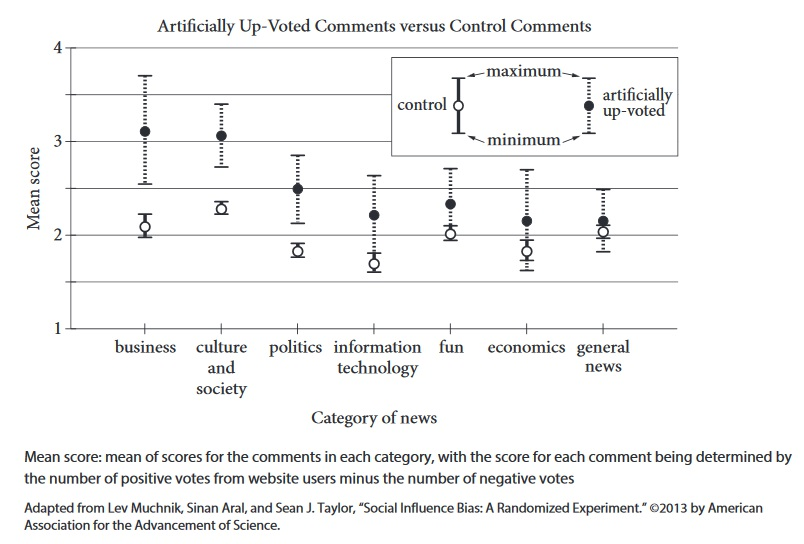
In the figure, which category of news has an artificially up voted mean score of 2.5?

  1. Business
  2. Politics
  3. Fun
  4. General news

Answer(s): B

Explanation:

Choice Politics is the best answer. The figure shows that while the mean score of the control comments in the politics category is below 2.0, the artificially up- voted mean score for that category is exactly 2.5. Choice Business is incorrect because the artificially up-voted mean score of comments in the business category is higher than 3.0. Choice Fun is incorrect because the artificially up-voted mean score of comments in the fun category is less than 2.5. Choice General news is incorrect because the artificially up-voted mean score of the comments in the general news category is just over 2.0.


This passage is adapted from John Bohannon, `Why You Shouldn't Trust Internet Comments.` ֲ ©2013 by American Association for the Advancement of Science. The `wisdom of crowds` has become a mantra of the Internet age. Need to choose a new vacuum cleaner? Check out the reviews on online merchant Amazon. But a new study suggests that such online scores don't always reveal the best choice. A massive controlled experiment of Web users finds that such ratings are highly susceptible to irrational `herd behavior` `" and that the herd can be manipulated. Sometimes the crowd really is wiser than you. The classic examples are guessing the weight of a bull or the number of gumballs in a jar. Your guess is probably going to be far from the mark, whereas the average of many people's choices is remarkably close to the true number. But what happens when the goal is to judge something less tangible, such as the quality or worth of a product? According to one theory, the wisdom of the crowd still holds `" measuring the aggregate of people's opinions produces a stable, reliable value. Skeptics, however, argue that people's opinions are easily swayed by those of others. So nudging a crowd early on by presenting contrary opinions `" for example, exposing them to some very good or very bad attitudes `" will steer the crowd in a different direction. To test which hypothesis is true, you would need to manipulate huge numbers of people, exposing them to false information and determining how it affects their opinions. A team led by Sinan Aral, a network scientist at the Massachusetts Institute of Technology in Cambridge, did exactly that. Aral has been secretly working with a popular website that aggregates news stories. The website allows users to make comments about news stories and vote each other's comments up or down. The vote tallies are visible as a number next to each comment, and the position of the comments is chronological. (Stories on the site get an average of about ten comments and about three votes per comment.) It's a follow up to his experiment using people's ratings of movies to measure how much individual people influence each other online (answer: a lot). This time, he wanted to know how much the crowd influences the individual, and whether it can be controlled from outside. For five months, every comment submitted by a user randomly received an `up` vote (positive); a `down` vote (negative); or as a control, no vote at all. The team then observed how users rated those comments. The users generated more than 100,000 comments that were viewed more than 10 million times and rated more than 300,000 times by other users. At least when it comes to comments on news sites, the crowd is more herdlike than wise. Comments that received fake positive votes from the researchers were 32% more likely to receive more positive votes compared with a control, the team reports. And those comments were no more likely than the control to be down voted by the next viewer to see them. By the end of the study, positively manipulated comments got an overall boost of about 25%. However, the same did not hold true for negative manipulation. The ratings of comments that got a fake down vote were usually negated by an up vote by the next user to see them. `Our experiment does not reveal the psychology behind people's decisions,` Aral says, `but an intuitive explanation is that people are more skeptical of negative social influence. They're more willing to go along with positive opinions from other people.` Duncan Watts, a network scientist at Microsoft Research in New York City, agrees with that conclusion. `[But] one question is whether the positive [herding] bias is specific to this site` or true in general, Watts says. He points out that the category of the news items in the experiment had a strong effect on how much people could be manipulated. `I would have thought that `˜business' is pretty similar to `˜economics,' yet they find a much stronger effect (almost 50% stronger) for the former than the latter.
What explains this difference? If we're going to apply these findings in the real world, we'll need to know the answers.` Will companies be able to boost their products by manipulating online ratings on a massive scale? `That is easier said than done,` Watts says. If people detect `" or learn `" that comments on a website are being manipulated, the herd may spook and leave entirely.

According to the figure, which category of news showed the smallest difference in mean score between artificially up voted comments and control comments?

  1. Culture and society
  2. Information technology
  3. Fun
  4. General news

Answer(s): D

Explanation:

Choice General news is the best answer. The figure shows that the mean score for both control comments and artificially up-voted comments in the general news category is just above 2.0. Choice Culture and society is incorrect because the mean score for the control comments in the culture and society category is a little below 2.5 while the mean score for the artificially up-voted comments is over 3.0. Choice Information technology is incorrect because the mean score for the control comments in the information technology category is a little above 1.5 while the mean score for the artificially up-voted comments is above 2.0. Choice Fun is incorrect because the mean score for the control comments in the fun category is exactly 2.0 while the mean score for the artificially up-voted comments is nearly 2.5.


This passage is adapted from John Bohannon, `Why You Shouldn't Trust Internet Comments.` ֲ ©2013 by American Association for the Advancement of Science. The `wisdom of crowds` has become a mantra of the Internet age. Need to choose a new vacuum cleaner? Check out the reviews on online merchant Amazon. But a new study suggests that such online scores don't always reveal the best choice. A massive controlled experiment of Web users finds that such ratings are highly susceptible to irrational `herd behavior` `" and that the herd can be manipulated. Sometimes the crowd really is wiser than you. The classic examples are guessing the weight of a bull or the number of gumballs in a jar. Your guess is probably going to be far from the mark, whereas the average of many people's choices is remarkably close to the true number. But what happens when the goal is to judge something less tangible, such as the quality or worth of a product? According to one theory, the wisdom of the crowd still holds `" measuring the aggregate of people's opinions produces a stable, reliable value. Skeptics, however, argue that people's opinions are easily swayed by those of others. So nudging a crowd early on by presenting contrary opinions `" for example, exposing them to some very good or very bad attitudes `" will steer the crowd in a different direction. To test which hypothesis is true, you would need to manipulate huge numbers of people, exposing them to false information and determining how it affects their opinions. A team led by Sinan Aral, a network scientist at the Massachusetts Institute of Technology in Cambridge, did exactly that. Aral has been secretly working with a popular website that aggregates news stories. The website allows users to make comments about news stories and vote each other's comments up or down. The vote tallies are visible as a number next to each comment, and the position of the comments is chronological. (Stories on the site get an average of about ten comments and about three votes per comment.) It's a follow up to his experiment using people's ratings of movies to measure how much individual people influence each other online (answer: a lot). This time, he wanted to know how much the crowd influences the individual, and whether it can be controlled from outside. For five months, every comment submitted by a user randomly received an `up` vote (positive); a `down` vote (negative); or as a control, no vote at all. The team then observed how users rated those comments. The users generated more than 100,000 comments that were viewed more than 10 million times and rated more than 300,000 times by other users. At least when it comes to comments on news sites, the crowd is more herdlike than wise. Comments that received fake positive votes from the researchers were 32% more likely to receive more positive votes compared with a control, the team reports. And those comments were no more likely than the control to be down voted by the next viewer to see them. By the end of the study, positively manipulated comments got an overall boost of about 25%. However, the same did not hold true for negative manipulation. The ratings of comments that got a fake down vote were usually negated by an up vote by the next user to see them. `Our experiment does not reveal the psychology behind people's decisions,` Aral says, `but an intuitive explanation is that people are more skeptical of negative social influence. They're more willing to go along with positive opinions from other people.` Duncan Watts, a network scientist at Microsoft Research in New York City, agrees with that conclusion. `[But] one question is whether the positive [herding] bias is specific to this site` or true in general, Watts says. He points out that the category of the news items in the experiment had a strong effect on how much people could be manipulated. `I would have thought that `˜business' is pretty similar to `˜economics,' yet they find a much stronger effect (almost 50% stronger) for the former than the latter.
What explains this difference? If we're going to apply these findings in the real world, we'll need to know the answers.` Will companies be able to boost their products by manipulating online ratings on a massive scale? `That is easier said than done,` Watts says. If people detect `" or learn `" that comments on a website are being manipulated, the herd may spook and leave entirely.

Data presented in the figure most directly support which idea from the passage?

  1. The mean score of artificially down voted comments is similar to that of the control.
  2. The patterns observed in the experiment suggest that people are suspicious of negative social influence.
  3. The positive bias observed in users of the news site may not apply to human behavior in other contexts.
  4. The type of story being commented on has an impact on the degree to which people can be influenced.

Answer(s): D

Explanation:

In the passage Watts notes that the category of the news items ... had a strong effect on how much people could be manipulated (sentence 3 of paragraph 8). That idea is directly supported by the data in the figure, which show that the difference in mean score between the control comments and the artificially up-voted comments varies by subject (for example, in the general news category there is virtually no difference between the mean scores of the two types of comments, while for the business category there is almost a 1.0-point difference between the mean scores). Choices [The mean score of artificially down...] and [The patterns observed in the experiment suggest that...] are incorrect because the passage provides no data for artificially down-voted comments or negative social influence. Choice [The positive bias observed in users of...] is incorrect because the figure applies only to one context (mean score of control comments versus mean score of artificially up-voted comments on the news site); there is no way to tell what patterns would be observed in other contexts.


Read the following passage and answer the question. Technology is rapidly expanding the scope of capabilities for both professional and personal use; such is the case with smart phones. Professionals now have devices available to them capable of digital media, internet access,
phone communication, multi-person scheduling and office tools for documents and presentations. Businesspeople that are often mobile may maximize the use of these critical features on smart phones. Individuals who simply enjoy the luxury of multi-function devices often use these devices for frivolous pursuits such as downloading catchy ring tones, instant messaging about the latest gossip and looking up the world record for most cans crushed on one's head during the Superbowl. This fusion of capabilities and increased availability of such devices could be a sign of a growing blend in society between work and personal life, or individuals could simply be taking a luxurious approach to their connectivity in personal lives.
What is the purpose of the conclusion sentence?

  1. Draw a conclusion about what we know smart phones can do
  2. Assume where technology is headed and how it will affect society
  3. Comment on human connectivity through the use of smart phones
  4. Predict how the government will regulate and guide future technology
  5. Present two possible explanations for the growing popularity of smart phones

Answer(s): E

Explanation:

Justification
The passage ends with a sentence that offers two alternative interpretations of why people use smartphones: (1) a societal merging of work and personal life, or (2) a “luxurious” approach to personal connectivity. This wording directly mirrors the phrasing of option E – “Present two possible explanations for the growing popularity of smart phones.” Option A only asks to “draw a conclusion about what we know smart phones can do,” which is too narrow; the conclusion goes beyond capabilities to explain why usage is expanding. Option B suggests speculation about the future trajectory of technology and its societal impact, which the passage does not address. Option C focuses on “human connectivity,” a thematic element, but the conclusion is not a commentary on connectivity itself—it is a presentation of explanations. Option D introduces an unrelated topic (government regulation), which is never mentioned in the passage.
Therefore, option E is the only choice that accurately captures the purpose of the concluding sentence.


Reference:

https://www.pewresearch.org/internet/2023/01/01/smartphone-use/ https://www.statista.com/statistics/277125/average-number-of-smartphone-apps-used-per-day-worldwide/


Read the following passage and answer the question. But man is not destined to vanish. He can be killed, but he cannot be destroyed, because his soul is deathless and his spirit is irrepressible. Therefore, though the situation seems dark in the context of the confrontation between the superpowers, the silver lining is provided by amazing phenomenon that the very nations which have spent incalculable resources and energy for the production of deadly weapons are desperately trying to find out how they might never be used. They threaten each other, intimidate each other and go to the brink, but before the total hour arrives they withdraw from the brink. The main point from the author's view is that:

  1. Man's soul and spirit can not be destroyed by superpowers.
  2. Man's destiny is not fully clear or visible.
  3. Man's soul and spirit are immortal.
  4. Man's safety is assured by the delicate balance of power in terms of nuclear weapons.
  5. Human society will survive despite the serious threat of total annihilation.

Answer(s): E

Explanation:

Justification
Option E – “Human society will survive despite the serious threat of total annihilation.” The passage emphasizes that, although nuclear powers threaten each other and approach the brink of destruction, they ultimately step back before a total catastrophe occurs. This “silver lining” illustrates the author’s belief that humanity will endure even under the gravest nuclear danger. Hence, E directly captures the author’s central message.
Why the other options are less appropriate
A – While the text mentions an “immortal” soul and “irpressible” spirit, it does not argue that these metaphysical qualities protect humanity from nuclear annihilation; the focus is on societal survival, not on an unkillable soul. B – The passage does not discuss the ambiguity of destiny; it affirms a concrete outcome (survival) rather than leaving destiny “unclear or invisible.” C – The immortality of the soul/spirit is stated, but it serves as a rhetorical device supporting the broader claim about societal endurance, not the main point itself. D – The “delicate balance of power” is referenced only indirectly; the author’s emphasis is on the avoidance of total war, not on a stable balance as a guarantee of safety.
Conclusion – Option E best reflects the author’s overarching assertion that humanity will persist despite the existential nuclear threat.


Reference:

https://www.britannica.com/topic/nuclear-weapons https://www.iaea.org/topics/nuclear-weapons-and-explosives
Prepared for certification exam review – concise, technical, and structured.


Viewing page 38 of 117
Viewing questions 297 - 304 out of 924 questions


Post your Comments and Discuss College Board SAT exam prep with other Community members:

AI Tutor AI Tutor 👋 I’m here to help!