Explanation:
While it is true that absorption of RF by various materials (buildings, trees, water vapor, etc.) tends to increase with frequency, remember we are talking about "free space" here. The frequency dependence in this case is solely due to the decreasing effective aperture of the receiving antenna as the frequency increases. This is intuitively reasonable, since the physical size of a given antenna type is inversely proportional to frequency. If we double the frequency, the linear dimensions of the antenna decrease by a factor of one-half, and the capture area by a factor of one-quarter. The antenna therefore captures only one-quarter of the power flux density at the higher frequency versus the lower one, and delivers 6 dB less signal to the receiver. However, in most cases we can easily get this 6 dB back by increasing the effective aperture, and hence the gain, of the receiving antenna. For example, suppose we are using a parabolic dish antenna at the lower frequency A consideration when planning or troubleshooting an RF link is the Fresnel Zone. The Fresnel Zone occupies a series of concentric ellipsoid-shaped areas around the LOS path, as can be seen in Figure 2.10. The Fresnel Zone is important to the integrity of the RF link because it defines an area around the LOS that can introduce RF signal interference if blocked. Objects in the Fresnel Zone such as trees, hilltops, and buildings can diffract or reflect the main signal away from the receiver, changing the RF LOS. These same objects can absorb or scatter the main RF signal, causing degradation or complete signal loss.
///
A consideration when planning or troubleshooting an RF link is the Fresnel Zone. The
 Fresnel Zone occupies a series of concentric ellipsoid-shaped areas around the LOS path, as can be seen in Figure 2.10. The Fresnel Zone is important to the integrity of the RF link because it defines an area around the LOS that can introduce RF signal interference if blocked. Objects in the Fresnel Zone such as trees, hilltops, and buildings can diffract or reflect the main signal away from the receiver, changing the RF LOS. These same objects can absorb or scatter the main RF signal, causing degradation or complete signal loss.
// To illustrate co-channel interference, assume a 3-story building, with a wireless LAN on each floor, with the wireless LANs each using channel 1. The access points' signal ranges, or cells, would likely overlap in this situation. Because each access point is on the same channel, they will interfere with one another. This type of interference is known as co-channel interference.
In order to troubleshoot co-channel interference, a wireless network sniffer will be needed. The sniffer will be able to show packets coming from each of the wireless LANs using any particular channel. Additionally, it will show the signal strength of each wireless LAN's packets, giving you an idea of just how much one wireless LAN is interfering with the others.
The two solutions for co-channel interference are, first, the use of a different, nonoverlapping channel for each of the wireless LANs, and second, moving the wireless LANs far enough apart that the access points' cells do not overlap. These solutions are the same remedy as for adjacent channel interference.
D, E:
Co-channel Interference
Co-channel interference can have the same effects as adjacent channel interference, but is an altogether different set of circumstances. Co-channel interference as seen by a spectrum analyzer is illustrated in Figure 9.17 while how a network configuration would produce this problem is shown in Figure
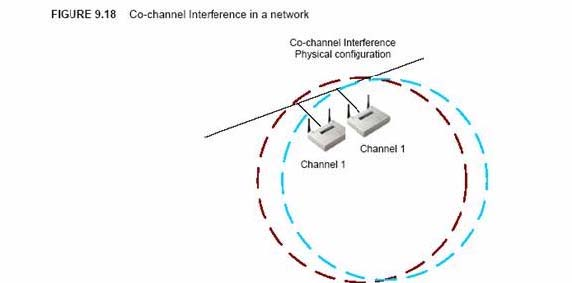
To illustrate co-channel interference, assume a 3-story building, with a wireless LAN on each floor, with the wireless LANs each using channel 1. The access points' signal ranges, or cells, would likely overlap in this situation. Because each access point is on the same channel, they will interfere with one another. This type of interference is known as co-channel interference.
In order to troubleshoot co-channel interference, a wireless network sniffer will be needed. The sniffer will be able to show packets coming from each of the wireless LANs using any particular channel. Additionally, it will show the signal strength of each wireless LAN's packets, giving you an idea of just how much one wireless LAN is interfering with the others.
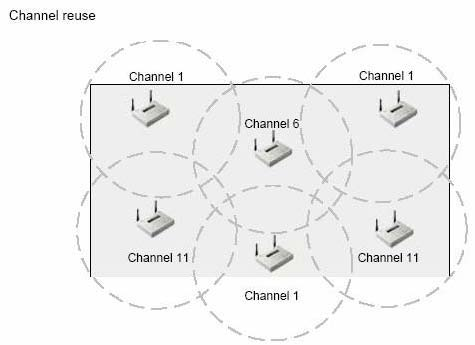
The two solutions for co-channel interference are, first, the use of a different, nonoverlapping channel for each of the wireless LANs, and second, moving the wireless LANs far enough apart that the access points' cells do not overlap. These solutions are the same remedy as for adjacent channel interference
wireless clients are polled for data transmission
WHEN AN ACCESS POINT is operating in distributed coordination function mode,