Free SC-500 Exam Braindumps
Implementing End-to-End Security Controls for Cloud and AI Workloads Questions 19–23 (page: 19)

Updated On: 23-Oct-2026
View Related Case Study

HOTSPOT (Drag and Drop is not supported)
You have an Azure subscription that contains two users named User1 and User2 and the blob containers shown in the following table.

Policy1 is configured as shown in the following exhibit.

You assign the roles for storagte1 as shown in the following table.

The storage1 account has the following shared access signature (SAS) named SAS1:

Dates are in MM/DD/YYYY format.
For each of the following statements, select Yes if the statement is true. Otherwise, select No.
Note: Each correct selection is worth one point.
Hot Area:

  1. See Explanation section for answer.

Answer(s): A

Explanation:


Yes
Yes
No
SAS1 is an account SAS that permits Blob service access to container resources with read and write permissions from December 1 through December 31, 2025. Therefore, it permits writes to either container during that validity period. The stored access policy on container1 does not restrict this account SAS because stored access policies apply to service SAS tokens, not account SAS tokens.
January 10, 2025 is outside the SAS1 validity period, so SAS1 cannot be used to read container2 on that date.


View Related Case Study

HOTSPOT (Drag and Drop is not supported)
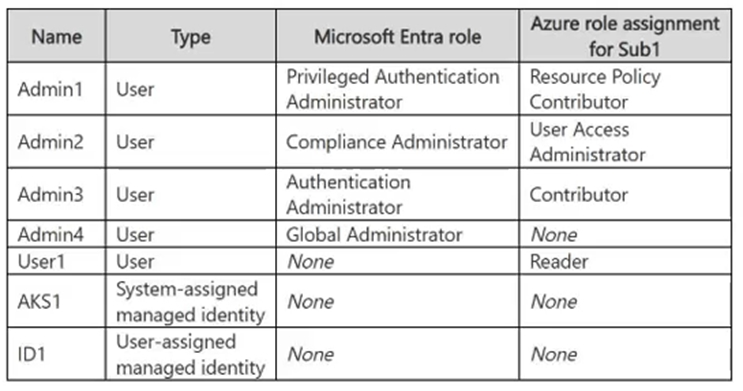
You have an Azure subscription that contains the virtual networks shown in the following table.

NSG1 and NSG2 both have default rules only.
The subscription contains the virtual machines shown in the following table.

The subscription contains the app service web apps shown in the following table.

For each of the following statements, select Yes if the statement is true. Otherwise, select No.
Note: Each correct selection is worth one point.
Hot Area:

  1. See Explanation section for answer.

Answer(s): A

Explanation:


Yes
No
Yes
WebApp1 uses App Service virtual network integration with VNet1. Virtual network integration provides outbound access not only to resources in VNet1 but also to resources in peered virtual networks, so WebApp1 can reach VM2 in VNet2.
Virtual network integration does not provide inbound private access to an App Service app. An NSG associated with the integration subnet can control the app’s outbound traffic, but its inbound rules do not control inbound traffic to the web app.
WebApp2 is hosted in an App Service Environment in Subnet2. Apps in an App Service Environment can access resources in connected networks, including peered virtual networks, so WebApp2 can reach VM1 in VNet1 through the VNet peering.


Reference:

https://learn.microsoft.com/en-us/azure/app-service/overview-vnet-integration https://learn.microsoft.com/en-us/azure/app-service/networking-features https://learn.microsoft.com/en-us/azure/app-service/environment/overview


View Related Case Study

Note: This section contains one or more sets of questions with the same scenario and problem. Each question presents a unique solution to the problem. You must determine whether the solution meets the stated goals. More than one solution in the set might solve the problem. It is also possible that none of the solutions in the set solve the problem.
After you answer a question in this section, you will NOT be able to return. As a result, these questions do not appear on the Review Screen.
You have an Azure subscription that contains two virtual machines named VM1 and VM2. Each virtual machine has system-assigned managed identity enabled.
You have an Azure Storage account named storage1. Public access from all networks is enabled for storage1.
You need to ensure that VM1 and VM2 can access storage1.
Solution: You add each virtual machine to a security group, and then add the security group to a role on storage1.
Does this meet the goal?

  1. Yes
  2. No

Answer(s): A

Explanation:

A system-assigned managed identity is a Microsoft Entra security principal and can be added to a Microsoft Entra security group. Assigning an appropriate Azure Storage data-access role to that security group grants the managed identities of VM1 and VM2 access to storage1. Group-based permission changes for managed identities can take several hours to become effective because managed identity tokens are cached, but the solution meets the access requirement.


Reference:

https://learn.microsoft.com/en-us/entra/identity/managed-identities-azure-resources/managed-ident ity-best-practice-recommendations


View Related Case Study

You have an Azure subscription that contains the virtual networks shown in the following table.

The subscription contains the virtual machines shown in the following table.

On NIC1, you configure an application security group named ASG1.
On which other network interfaces can you configure ASG1?

  1. NIC2 only
  2. NIC2 and NIC3 only
  3. NIC2, NIC3, and NIC4 only
  4. NIC2, NIC3, NIC4, and NIC5

Answer(s): B

Explanation:

All network interfaces in an application security group must belong to the same virtual network. NIC2 and NIC3 are both in VNET1 with NIC1, so they can join ASG1 even though they use different subnets.


Reference:

https://learn.microsoft.com/en-us/azure/Virtual-Network/application-security-groups


View Related Case Study

HOTSPOT (Drag and Drop is not supported)
You have an Azure subscription that contains the resources shown in the following table.
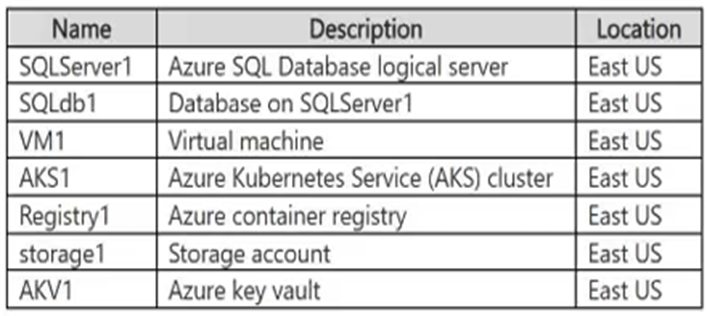
You create a shared access token as shown in the following exhibit.

Which resources can you access by using the shared access token and Key 1? To answer, select the appropriate options in the answer area.
Note: Each correct answer is worth one point.
Hot Area:

  1. See Explanation section for answer.

Answer(s): A

Explanation:


Shared access token: container1 only
Key 1: container1 and share1 only
The shared access token is generated specifically for container1, so its scope is limited to that blob container in the contoso2023 storage account.
Storage account Key 1 provides access to the services and resources in the entire contoso2023 storage account. Therefore, it can be used to access both container1 and share1, but not resources in the separate contoso2024 storage account.


Viewing page 19 of 43
Viewing questions 91 - 95 out of 207 questions


Post your Comments and Discuss Microsoft SC-500 exam prep with other Community members:

AI Tutor AI Tutor 👋 I’m here to help!