Free SC-500 Exam Braindumps
Implementing End-to-End Security Controls for Cloud and AI Workloads Questions 42–46 (page: 11)

Updated On: 23-Oct-2026
View Related Case Study

You have an Azure management group named MG1 that contains two subscriptions named Sub1 and Sub2. Both subscriptions are linked to a Microsoft Entra tenant that contains a security group named Group1.
You need to ensure that the members of Group1 can assign roles to the resources in Sub1 and Sub2. The solution must follow the principle of least privilege.
Which role should you assign to Group1?

  1. Contributor at the MG1 scope
  2. Contributor at the Sub1 and Sub2 scopes
  3. User Access Administrator at the MG1 scope
  4. Owner at the MG1 scope

Answer(s): C

Explanation:

The User Access Administrator role permits members of Group1 to manage role assignments without granting them permission to modify the underlying Azure resources. Assigning the role at the MG1 scope causes the permission to be inherited by both Sub1 and Sub2 and their resources, providing centralized least-privilege access management.


Reference:

https://learn.microsoft.com/en-us/azure/role-based-access-control/role-definitions https://learn.microsoft.com/en-us/azure/role-based-access-control/elevate-access-global-admin?tabs=azure-p ortal%2Centra-audit-logs https://learn.microsoft.com/en-us/azure/role-based-access-control/scope-overview


View Related Case Study

Note: This section contains one or more sets of questions with the same scenario and problem. Each question presents a unique solution to the problem. You must determine whether the solution meets the stated goals. More than one solution in the set might solve the problem. It is also possible that none of the solutions in the set solve the problem.
After you answer a question in this section, you will NOT be able to return. As a result, these questions do not appear on the Review Screen.
You have an Azure subscription that contains two virtual machine named VM1 and VM2 and a storage account named storage1.
An application runs on VM1 and VM2. The application is being migrated from storage account key authentication to Microsoft Entra authentication.
You review the current configuration and identify the following:
● VM1 and VM2 each have a system-assigned managed identity.
● Each application instance requests tokens by using only the local system-assigned managed identity.
● Network access to storage1 from VM1 and VM2 is allowed.
● No Azure RBAC data roles are assigned to the managed identities on storage1.
You need to enable the application on VM1 and VM2 to read and write blob data in storage1 by using Microsoft Entra authentication without changing how the application requests tokens.
Solution: You assign the system-assigned managed identities of VM1 and VM2 the Storage Blob Data Contributor role scoped to storage1.
Does this meet the goal?

  1. Yes
  2. No

Answer(s): A

Explanation:

Storage Blob Data Contributor grants read and write access to blob data. Assigning it to both VMs’ system-assigned managed identities at the storage1 scope authorizes the identities already used by the application, so no changes to token acquisition are required.


Reference:

https://learn.microsoft.com/en-us/azure/storage/blobs/authorize-access-azure-active-directory


View Related Case Study

You have an Azure subscription that contains a virtual network named VNet1.
VNet1 contains an Azure VPN gateway named Gateway1 that is configured for Point-to-Site (P2S) connections.
You have a Microsoft 365 E5 subscription.
You need to configure a VPN authentication method for Gateway1. The solution must enforce Conditional Access policies during VPN sign-ins.
Which authentication method should you configure?

  1. a custom IPsec/IKE policy
  2. Microsoft Entra authentication
  3. certificate authentication
  4. forced tunneling

Answer(s): B

Explanation:

To enforce Conditional Access policies during Point-to-Site (P2S) VPN sign-ins, you must configure Microsoft Entra ID authentication as the VPN authentication method.
Native Integration: Microsoft Entra ID is the only authentication method for Azure VPN Gateway that natively integrates with Microsoft Entra Conditional Access policies.
Policy Enforcement: When users log in, Microsoft Entra ID evaluates your Conditional Access rules (such as requiring Multi-Factor Authentication, checking device compliance, or restricting login locations) before granting the VPN connection.
Protocol Support: This method uses the OpenVPN protocol and requires users to sign in using the Azure VPN Client.


Reference:

https://learn.microsoft.com/en-us/azure/vpn-gateway/openvpn-azure-ad-tenant


View Related Case Study

HOTSPOT (Drag and Drop is not supported)
You have an Azure subscription that contains the resources shown in the following table.
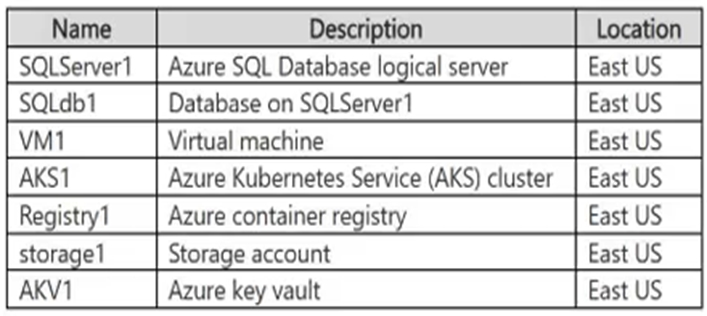
Transparent Data Encryption (TDE) is disabled on SQL1.
You assign policies to the resource groups as shown in the following table.

You plan to deploy Azure SQL databases by using an Azure Resource Manager (ARM) templates. The databases will be configured as shown in the following table.

For each of the following statements, select Yes if the statement is true. Otherwise, select No.
Note: Each correct selection is worth one point.
Hot Area:

  1. See Explanation section for answer.

Answer(s): A

Explanation:


No
Yes
No
SQL1: SQL1 already exists when Policy2 is assigned to RG3. A DeployIfNotExists policy marks existing resources as noncompliant but requires a remediation task to enable TDE on them.
SQL2: RG2 has Policy1, which denies deployments with TDE disabled. The deny effect blocks the deployment before DeployIfNotExists can remediate it.
SQL3: RG1 also has Policy1, so deploying SQL3 with TDE disabled is denied. The additional audit policy does not override that denial.


Reference:

https://learn.microsoft.com/en-us/azure/governance/policy/concepts/effect-deploy-if-not-exists https://learn.microsoft.com/en-us/azUre/governance/policy/concepts/effect-basics


View Related Case Study

Note: This section contains one or more sets of questions with the same scenario and problem. Each question presents a unique solution to the problem. You must determine whether the solution meets the stated goals. More than one solution in the set might solve the problem. It is also possible that none of the solutions in the set solve the problem.
After you answer a question in this section, you will NOT be able to return. As a result, these questions do not appear on the Review Screen.
You have an Azure subscription that contains two virtual machine named VM1 and VM2 and a storage account named storage1.
An application runs on VM1 and VM2. The application is being migrated from storage account key authentication to Microsoft Entra authentication.
You review the current configuration and identify the following:
● VM1 and VM2 each have a system-assigned managed identity.
● Each application instance requests tokens by using only the local system-assigned managed identity.
● Network access to storage1 from VM1 and VM2 is allowed.
● No Azure RBAC data roles are assigned to the managed identities on storage1.
You need to enable the application on VM1 and VM2 to read and write blob data in storage1 by using Microsoft Entra authentication without changing how the application requests tokens.
Solution: You create a private endpoint for the blob service of storage1.
Does this meet the goal?

  1. Yes
  2. No

Answer(s): B

Explanation:

A private endpoint only provides private network connectivity to the storage account; it does not grant data access. The system-assigned managed identities of VM1 and VM2 must be assigned an appropriate Azure RBAC data role, such as Storage Blob Data Contributor, on storage1 to read and write blob data by using Microsoft Entra authentication.


Viewing page 11 of 43
Viewing questions 51 - 55 out of 207 questions


Post your Comments and Discuss Microsoft SC-500 exam prep with other Community members:

AI Tutor AI Tutor 👋 I’m here to help!